
 English
  Nederlands
  Deutsch
Silicon Valley has no shortage of venture capital firms. But few have reshaped the rules of the game quite like Andreessen Horowitz, better known as a16z.
Founded in 2009 at the height of post-financial-crisis uncertainty, the firm didn’t just write checks. It rewrote what it meant to be a venture capitalist: operational muscle, media reach, policy influence, and sector-specific funds all under one roof.
Today, a16z manages tens of billions in assets and backs startups across AI, crypto, fintech, enterprise software, defense tech, healthcare, and consumer platforms. Its track record includes some of the most consequential tech companies of the last 15 years.
This is the story of how two operators turned investors and built one of the most influential firms in modern tech.
From Founders to Fund Managers
Andreessen Horowitz was founded by:
- Marc Andreessen
- Ben Horowitz
Marc Andreessen co-created Mosaic, the early web browser that helped bring the internet to the mainstream, and later co-founded Netscape. Ben Horowitz built and scaled Opsware, which was eventually acquired by Hewlett-Packard for $1.6 billion.
They weren’t career financiers. They were operators who had seen both meteoric success and near-collapse. That operator DNA would become a16z’s edge.
In 2009, they launched their first fund, with roughly $300 million. Within a few years, fund sizes ballooned into the billions. The message was clear: they weren’t playing small ball.
The Investment Philosophy: Asymmetric Upside or Nothing
At its core, a16z bets on asymmetry.
The firm prioritizes:
- Massive addressable markets
- Category-defining ideas
- Founders with obsession-level conviction
- Technology with defensible advantages
Rather than optimizing for downside protection, the firm focuses on the magnitude of the outcome. If a company works, it should reshape its industry, not just nibble at it.
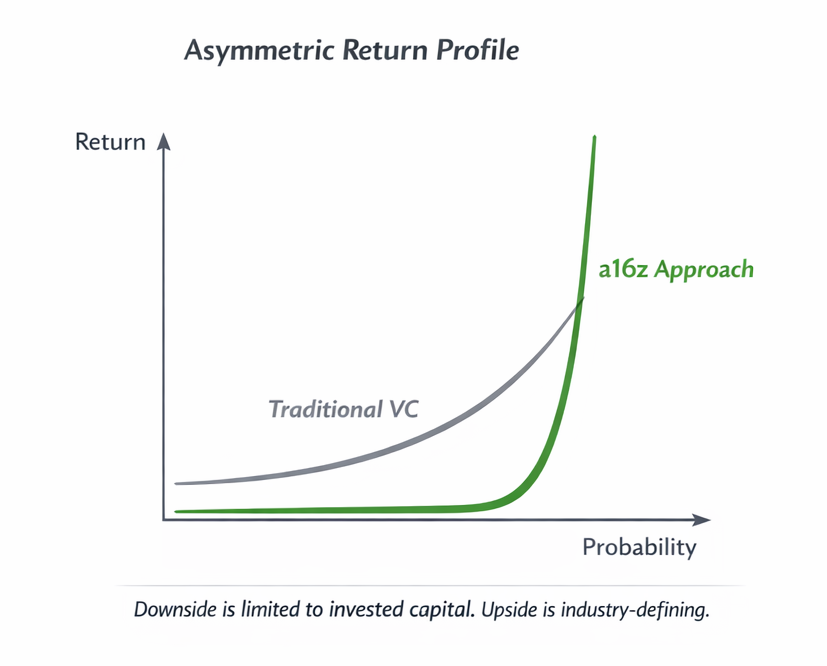
This philosophy has powered investments in companies that became household names.
Early Wins That Defined the Brand
Some of a16z’s most notable investments include:
- Airbnb
- Coinbase
- Slack
- GitHub
These weren’t safe bets at the time. Social media was unproven. Home-sharing was controversial. Crypto exchanges were fringe.
But a16z consistently leaned into founder conviction when markets were skeptical.
The result? Multiple IPOs and multi-billion-dollar exits that cemented the firm’s reputation.
Assets Under Management and Scale
Over time, a16z evolved from a single generalist fund into a platform with specialized verticals:
- Crypto
- Bio + Healthcare
- Fintech
- Consumer
- Enterprise
- American Dynamism (defense, national infrastructure, industrial tech)
The firm now manages tens of billions in assets across multiple funds. That scale allows it to invest from seed rounds all the way to late-stage growth capital.
Importantly, a16z structures funds to align with long-term conviction. In crypto, for example, it raised multi-billion-dollar vehicles dedicated solely to web3 infrastructure and decentralized networks.
Betting on the Third Era of the Internet
One of the most influential arms of the firm is a16z crypto.
Launched in 2013, it invests in:
- Layer 1 and Layer 2 protocols
- DeFi infrastructure
- DAO tooling
- Consumer web3 apps
- Crypto security and research
Its thesis: the internet is entering a third era, decentralized, community-owned, programmable.
Unlike many VCs that only provide capital, a16z crypto offers:
- Dedicated research teams
- Protocol engineering support
- Governance advisory
- Regulatory and policy expertise
- Go-to-market resources
- Educational content and ecosystem development
The firm has also published influential research reports and essays shaping crypto policy debates in the U.S.
In crypto, a16z is not a passive investor. It participates in governance, validator networks, and technical direction.
The “VC as Platform” Model
Traditional venture firms write checks and offer board seats. a16z built something more akin to a services organization layered on top of capital.
Portfolio companies gain access to:
- Recruiting networks
- Marketing and communications teams
- Enterprise sales connections
- Policy guidance
- Executive coaching
- Technical talent
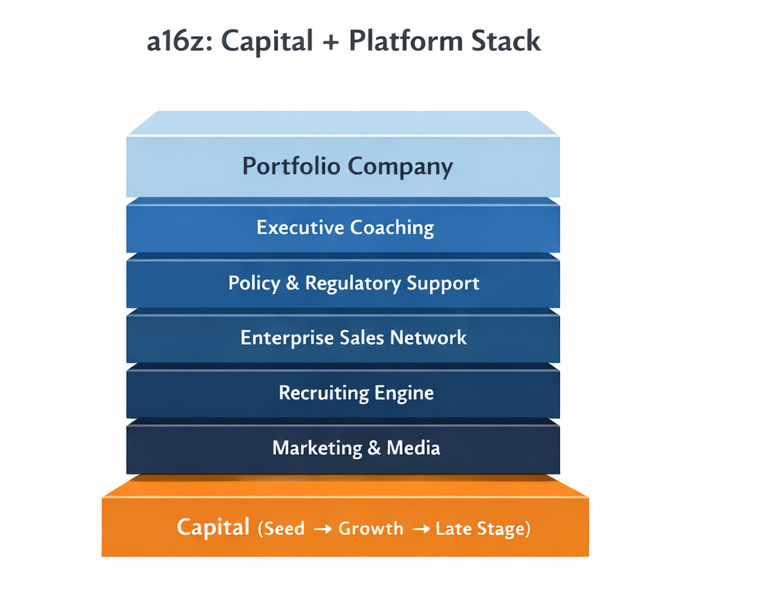
The goal: compress the time it takes for startups to scale.
This platform model has since been copied across the venture ecosystem.
First-Class Business, Long-Term Relationships
a16z publicly codifies its internal culture around a few core principles:
- Respect for founders
- Long-term trust over short-term gain
- Truthful communication, even when uncomfortable
- Playing to win, but without reckless overpaying
- Team-first mentality
One distinctive trait: the firm rarely publicly criticizes entrepreneurs. It treats relationships as decades-long partnerships.
The philosophy is simple venture capital is ultimately a relationship business.
Sector Expansion: AI, Defense, and Infrastructure
While crypto receives headlines, a16z has aggressively expanded into:
AI and Machine Learning
The firm has backed leading frontier model companies and AI infrastructure startups, positioning itself at the center of the generative AI wave.
American Dynamism
Investments in defense tech, aerospace, manufacturing, and national infrastructure signal a shift toward “hard tech” and geopolitical resilience.
Bio + Healthcare
Through computational biology and machine-learning-driven drug discovery, a16z has backed companies pushing precision medicine and longevity research.
Rather than chasing trends, the firm often frames its investments as long-arc bets on structural change.
Measuring Success: KPIs That Matter
Internally and across portfolio companies, a16z emphasizes metrics such as:
- Revenue growth rate
- Customer acquisition cost (CAC)
- Customer lifetime value (CLTV)
- Burn rate discipline
- Gross margin expansion
- Market share capture
- Network effects
The firm looks for businesses that demonstrate scalable economics, not just headline valuation growth.
Not Just Investors Narrative Builders
a16z operates one of the most influential content engines in venture capital:
- Podcasts
- Research papers
- Long-form essays
- Market reports
- Educational glossaries
- Books such as Read Write Own
This media strategy shapes industry conversations, especially in crypto and AI.
In a world where narrative often drives capital flows, controlling the intellectual frame matters.
Criticism and Controversy
No large VC firm escapes scrutiny.
Critics argue that:
- Mega-funds distort startup valuations
- Aggressive capital deployment increases systemic risk
- Public policy advocacy can blur lines between investment and influence
a16z has faced questions about its political donations, regulatory lobbying in crypto, and market concentration effects.
Yet its defenders argue that innovation requires conviction capital and that bold bets drive technological progress.
Betting on Tomorrow
Andreessen Horowitz isn’t just another venture firm. It’s a capital allocator, policy participant, content machine, and ecosystem architect rolled into one.
From backing social media giants to funding crypto infrastructure and frontier AI labs, the firm repeatedly positions itself where technological shifts are about to accelerate.
Its strategy can be summarized in one idea:
Bet big on founders who want to rebuild the world and then help them do it.
In a market where many funds optimize for incremental returns, a16z plays a different game. It chases generational outcomes.
And so far, that strategy has paid off.