
 English
  Nederlands
  Deutsch
Arbitrum is a Layer-2 network built on top of Ethereum that helps it run faster, cheaper, and at a much larger scale without replacing Ethereum or changing how it works. Instead of forcing every transaction to run directly on the Ethereum main chain, Arbitrum processes most of the work off-chain, bundles the results together, and then sends a compressed summary back to Ethereum for final verification.
Think of Ethereum as a busy city center and Arbitrum as a high-speed transit lane that keeps traffic flowing while still ending up at the same destination.
The goal is simple:
- Reduce gas fees
- Speed up transactions
- Handle more activity
- While still inheriting Ethereum’s security
And that balance is why Arbitrum has become one of the most widely used Layer-2 networks in the ecosystem.
Why Ethereum Needed Layer-2 Help
Ethereum is powerful, but it can only process a limited number of transactions per second. When usage spikes, the network feels like rush-hour traffic:
- Transactions pile up
- Fees spike
- Confirmations take longer
Scaling directly on the base chain would threaten decentralization (since only powerful machines could run nodes). So instead of “making Ethereum bigger,” solutions like Arbitrum help by moving the heavy lifting off-chain while keeping Ethereum as the final source of truth.
Layer-2 networks exist to:
- Relieve congestion
- Keep costs affordable
- Maintain decentralization
- Support growing apps and users
Arbitrum is one of the leading networks built for that exact job.
How Arbitrum Works
Arbitrum uses a technology called Optimistic Rollups it:
- Processes lots of transactions off-chain
- Groups them into batches
- Posts the batch back to Ethereum
- Assumes everything is valid unless someone disputes it
Only disputed activity gets re-checked on Ethereum, which saves massive amounts of computation and fees.
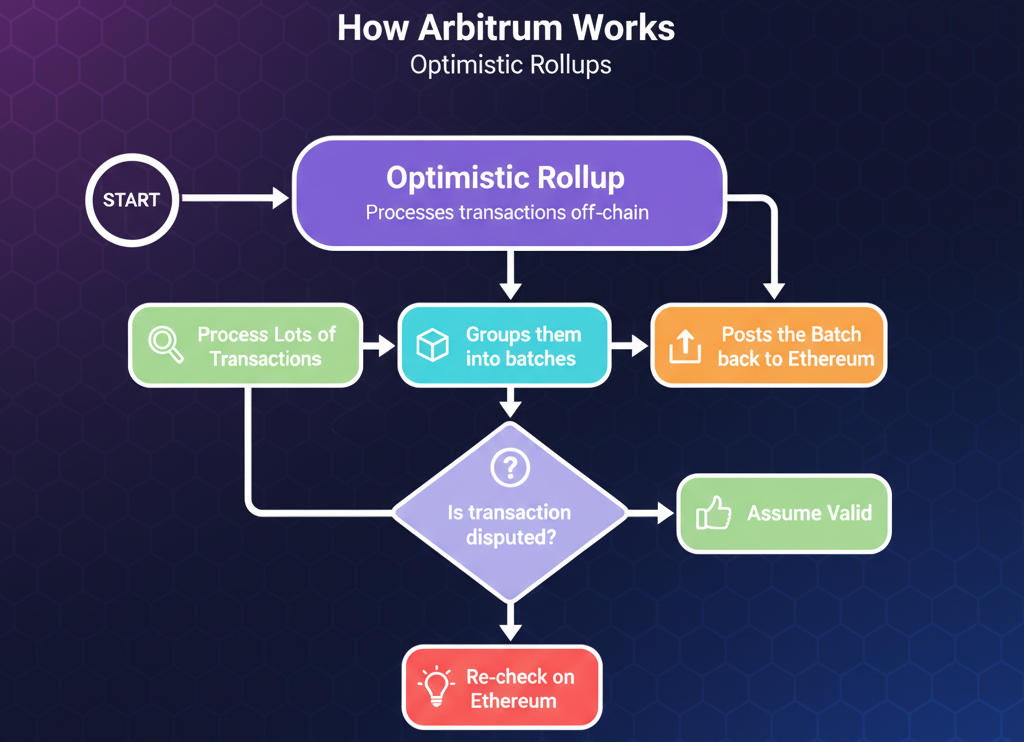
This lets Ethereum approve hundreds of transactions in one go, instead of verifying every single one individually.
Key ideas behind Optimistic Rollups
- “Optimistic” = everything is valid unless challenged
- Fraud-proofs step in if something looks wrong
- Bad actors risk losing their stake if they cheat
- Users benefit from speed + low fees
It’s a clever mix of efficiency and accountability.
The Arbitrum Tech Stack
Arbitrum is built to stay familiar for Ethereum developers, which is a big reason adoption grew so fast.
Some important components include:
- Arbitrum Virtual Machine & Nitro stack
runs smart contracts in a way that mirrors Ethereum, but with higher throughput - Sequencer
orders transactions and gives instant confirmations - Dispute system
resolves fraud claims during a challenge window - Stylus (new developer upgrade)
Let’s devs write smart contracts in languages like Rust or C alongside Solidity
Instead of reinventing Ethereum, Arbitrum extends it like adding extra lanes to a highway while keeping the same road rules.
What People Use Arbitrum For
Because it’s cheaper and faster than transacting on Ethereum directly, Arbitrum has become a natural home for:
- DeFi platforms & liquidity protocols
- Gaming ecosystems & on-chain economies
- NFT marketplaces
- Social & community-driven apps
Some well-known projects operate or mirror activity on Arbitrum because it makes everyday interaction more practical and affordable.
Typical user actions that benefit from Layer-2:
- Swapping tokens
- Lending or borrowing
- Staking and yield strategies
- In-game transactions
- Frequent micro-payments
All with significantly lower fees than the main chain.
Different Flavors of Arbitrum
Arbitrum isn’t just one network; it’s a family of chains that trade off cost, trust assumptions, and performance.
Arbitrum One
- Main public rollup chain
- Posts all data to Ethereum
- Highly trust-minimized
- Ideal for DeFi and high-value transactions
Arbitrum Nova
- Uses a Data Availability Committee
- Stores some data off-chain to cut fees further
- Better for high-volume, low-cost activity
- Commonly used for gaming and social apps
Orbit Chains
- Customizable chains built on Arbitrum tech
- Can run as Layer-2 or Layer-3 networks
- Developers can tune performance & governance
Together, they give builders flexibility while staying tied into the broader Ethereum ecosystem.
Benefits of Arbitrum
Arbitrum became popular because it solves real-world pain points users were feeling on Ethereum.
Some of the biggest advantages:
- Fees are dramatically lower
- Transactions confirm faster
- Security inherits from Ethereum
- Apps work the same way as on mainnet
- Ecosystem support is huge
- DAO governance steers upgrades
It delivers scalability without forcing people to abandon Ethereum’s infrastructure.
Trade-Offs & Limitations
Like any scaling system, Arbitrum isn’t perfect. Some considerations still exist:
- Withdrawals from rollups can take time due to challenge windows
- Sequencer operations aren’t fully decentralized yet
- Nova chains introduce some trust in data committees
- Moving between L2s can be technically complex
These aren’t deal-breakers, but they’re part of the honest reality of modern scaling tech.
The community continues to work toward:
- More decentralization of operators
- Smoother bridging & interoperability
- Stronger transparency standards
The direction is trending forward.
What About the ARB Token?
ARB is primarily a governance token, not a spending token for everyday transactions.
Holders can:
- Vote on ecosystem proposals
- Delegate votes to representatives
- Help elect security council members
- Influence funding and development decisions
It’s part of Arbitrum’s move toward community-driven stewardship rather than centralized control.
In other words, ARB isn’t just about speculation. It helps shape how the network evolves over time.
Where Arbitrum Fits Into Ethereum’s Future
Arbitrum represents a practical middle ground:
- Ethereum stays secure and decentralized
- Layer-2 handles scale and speed
- Developers keep familiar tools
- Users avoid painful fees
As more apps and games move on-chain, demand for scalable environments grows, and networks like Arbitrum are helping make that possible today, not someday in the distant future.
It’s less about replacing Ethereum and more about helping it breathe.