
 English
  Nederlands
  Deutsch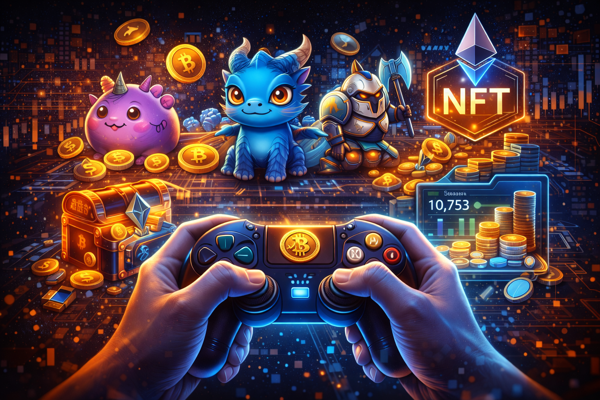
For most of gaming history, playing video games was purely about fun. You battled monsters, won races, completed quests, and earned bragging rights, not cash. That began to change with the rise of blockchain technology, cryptocurrencies, and digital ownership concepts like NFTs (non‑fungible tokens). Enter Play‑to‑Earn (P2E), a novel gaming model that lets players earn real economic value just by playing.
What Is Play‑to‑Earn (P2E)?
Play‑to‑Earn (P2E) is a gaming model most often based on blockchain technology that rewards players with assets that have real‑world financial value for participating in the game. These rewards typically include:
- Cryptocurrencies (tokens native to the game or blockchain),
- NFTs (unique digital items that can be sold or traded),
- Other digital assets that carry market value.
Unlike traditional games, where in‑game progress or items exist only inside a closed system and can’t be converted into cash, P2E lets players own, trade, sell, or monetize their digital earnings in real markets.
This means in the right game, someone can literally play to earn money.
How Does P2E Work?
At its core, P2E gaming combines blockchain technology + digital ownership + economic incentives. Here’s a simplified breakdown:
1. Blockchain as the Backbone
P2E games typically run on blockchains like Ethereum or sidechains. The blockchain:
- Records who owns what digital asset (e.g., a sword or land),
- Verifies transactions,
- Ensures scarcity and transparency.
2. NFTs Represent Game Assets
Non‑fungible tokens (NFTs) are unique digital items like characters, weapons, skins, or virtual real estate that players truly own. Unlike traditional game items (owned by the game company), NFTs can be sold or traded on external marketplaces.
3. Play and Earn
Players earn rewards by:
- Completing quests or challenges,
- Winning battles,
- Exploring virtual worlds,
- Selling rare items or characters they’ve acquired.
These rewards, whether tokens or NFTs, can be converted into real money through crypto exchanges or NFT marketplaces, giving players tangible value for their time.
Why Is P2E a Big Deal?
1. Real Economic Opportunity
For many players, especially in countries where typical job markets are challenging, P2E offered a legitimate way to earn income through gameplay. Users don’t just play for fun; they earn value from achievements.
2. Rapid Market Growth
Analysts project explosive growth for the P2E sector:
- One report estimated the P2E market at about USD 2.7 billion in 2024, growing to $26.6 billion by 2034, that’s a 25.7% compound annual growth rate (CAGR).
- Another forecast valued the P2E market at USD 5.3 billion in 2024, potentially reaching $27.3 billion by 2033.
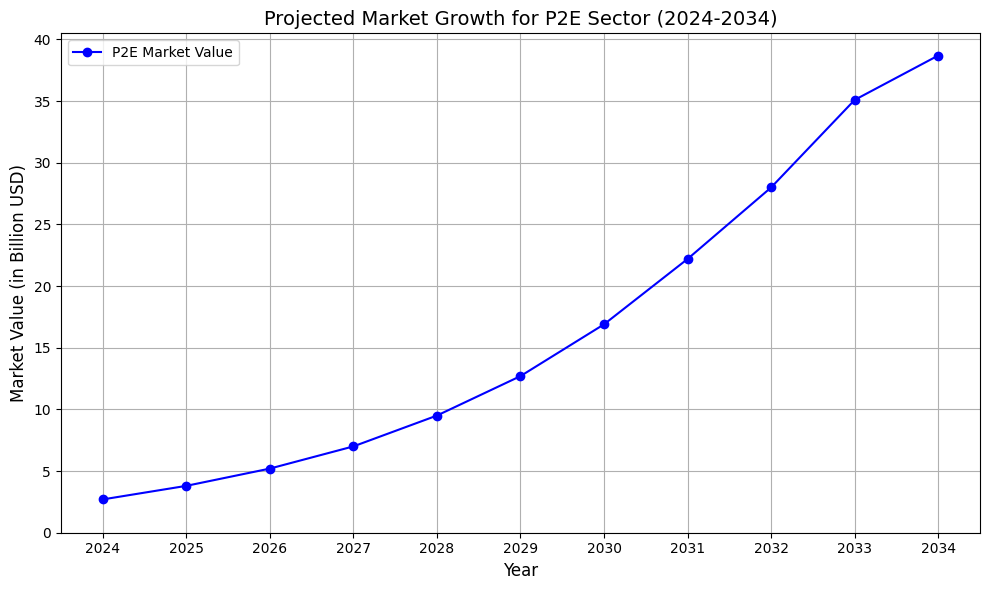
This growth reflects not just gaming interest, but real economic and investment demand in P2E ecosystems.
3. New Types of Digital Economies
P2E games create player‑owned economies. Players don’t just consume content they contribute to economic value by earning, trading, and speculating on digital assets that have their own markets.
Popular P2E Games & Examples
Some of the biggest names associated with P2E include:
• Axie Infinity
One of the most famous early P2E games, Axie Infinity, lets players collect, breed, and battle fantasy creatures called Axies, each represented as an NFT on the blockchain. Players could earn tokens through gameplay and sell them.
However, it also sparked debate: its token economy suffered massive volatility (one token lost 99% of its peak value), and a major hack in 2022 saw about $620 million stolen from its network.
• Decentraland & The Sandbox
These are virtual worlds/metaverse platforms where players can buy, sell, and develop virtual land and items as NFTs, often yielding real‑world returns.
• New Titles
Many emerging blockchain games, e.g., Sunflower Land, Heroes of Mavia, and Parallel TCG, mix P2E elements with gameplay, offering crypto rewards and prizes for in‑game success.
How Players & Developers Benefit
Players
- Earn money through achievements, battles, and quests.
- Own real assets: NFTs and tokens belong to players, not publishers.
- Monetize skills: Dedicated players can treat gaming like freelance work or a side income.
Developers
- New revenue streams: through tokenomics, marketplaces, and transaction fees.
- Player retention: Economic incentives keep players engaged longer.
Criticisms & Challenges
While P2E is exciting, it isn’t without controversy:
Economic Stability
Token prices in P2E games can be highly volatile. If the token’s value collapses, player earnings can evaporate overnight. This happened with Axie Infinity’s secondary token, which lost over 99% of its value after its peak.
Accessibility Issues
Some P2E games have high entry costs. For instance, early participation in Axie Infinity required buying several Axies, which could cost hundreds of dollars.
Regulatory & Legal Questions
Because P2E blurs the lines between gaming, investing, and earning income, the regulation and taxation of earnings varies by country and remain unresolved in many jurisdictions.
Game Balance Concerns
Some critics argue that focusing too much on earning can make games feel more like work and less like entertainment compared to traditional gaming experiences.
Where P2E Is Headed
Analysts and enthusiasts believe P2E will continue evolving, merging with metaverse experiences, decentralized finance (DeFi), and mainstream gaming. The idea of digital ownership + real economic rewards is reshaping not only games but how people think about digital work and economies.
Market research suggests that blockchain gaming (of which P2E is a major part) could see tens to hundreds of billions in overall growth through the next decade.
Gaming Revolutionized
Play‑to‑Earn is far more than a fad; it’s a transformative shift in how gaming intersects with economics, technology, and digital ownership. By enabling players to earn real crypto and digital assets, P2E has expanded the idea of gaming from leisure to an income‑generating activity. While challenges around stability and regulation remain, the model continues to grow rapidly, drawing millions to blockchain gaming and creating entirely new digital economies.
Whether you’re a gamer, investor, or developer, P2E represents a fascinating convergence of play, technology, and finance, and it’s just getting started.