 English
  Nederlands
  Deutsch
Tether (USDT) is the largest stablecoin in the global cryptocurrency market, a type of digital asset designed to maintain a stable value by being tied to a traditional currency rather than floating freely like Bitcoin or Ethereum. Specifically:
- USDT is pegged 1:1 to the U.S. dollar, meaning 1 USDT ≈ 1 USD in value.
- It was launched in 2014 by Tether Limited, one of the earliest projects aiming to combine the benefits of blockchain speed with fiat currency stability.
- Unlike many cryptocurrencies that experience dramatic price swings, USDT’s low volatility makes it useful as a digital “dollar” in crypto markets.
This price stability is achieved by holding reserves (cash and liquid assets) that back the amount of USDT in circulation, hence the term stablecoin.
Market Size and Key Figures
As of the most recent data:
- Market Capitalization: Around $183.67 billion USD in circulating USDT tokens.
- Circulating Supply: Roughly 183.74 billion USDT coins in circulation.
- USDT consistently ranks as one of the top 3 largest cryptocurrencies in the world by market cap, behind Bitcoin and Ethereum.
This means Tether isn’t a niche asset; it holds a central place in digital finance and is widely used across exchanges, trading platforms, and payment services.
How USDT Works: Blockchain and Backing
Blockchain Integration
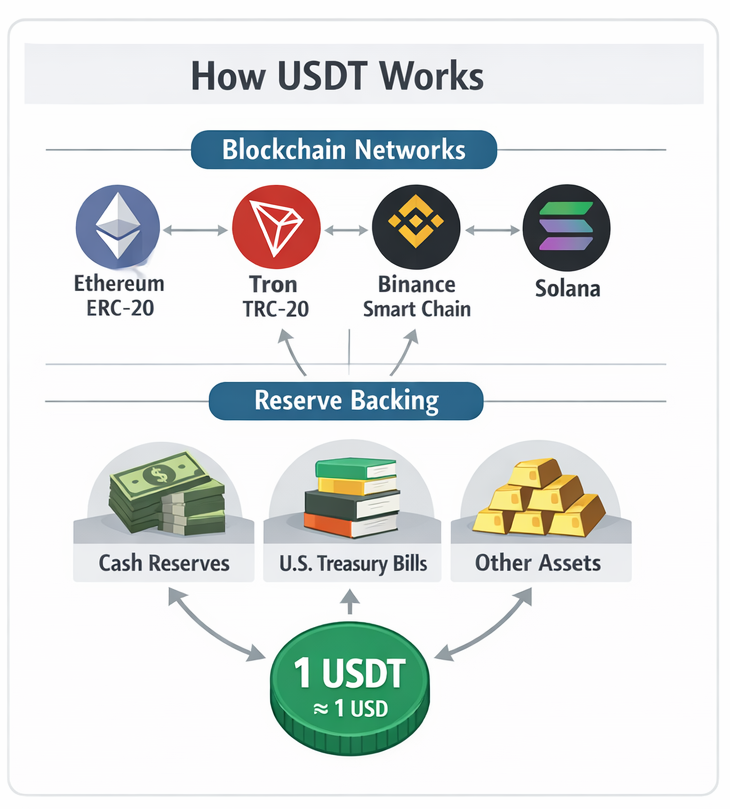
USDT operates on multiple blockchain networks, which allows it to move quickly and cheaply between users. Common platforms include:
- Ethereum (as ERC‑20 tokens)
- Tron (as TRC‑20 tokens)
- Other chains like Solana and Binance Smart Chain
- Tether’s wide network support increases accessibility and reduces transfer costs.
Reserve Backing
To keep value stable, Tether claims it backs each USDT approximately 1:1 with real‑world assets, such as:
- U.S. dollar cash
- U.S. Treasury bills
- Other liquid assets, like commercial paper
- Tether publishes regular reserve reports or attestations, though not full independent audits.
The goal is to ensure that if holders want to redeem USDT for actual dollars, there are enough assets to cover that redemption.
Why Tether Is Widely Used
USDT plays several major roles in today’s crypto ecosystem:
Liquidity & Trading
- A very high proportion of crypto trades involve USDT pairs.
- Recent analysis shows that about 61.5 % of all crypto trading volume occurs in USDT trading pairs.
- Traders often move into USDT during market turbulence to lock in value without exiting the crypto ecosystem.
Cross‑Border Transactions
Because USDT is stable, fast, and transferable globally without traditional banks, it has become popular for:
- International payments
- Remittances
- Digital business transactions
- Fast settlement compared with conventional banking systems.
Alternative to Local Currency
In countries with unstable local currencies or limited access to U.S. dollars, people use USDT as a digital dollar substitute.
Regulatory Landscape and EU Restrictions
As stablecoins grew in systemic importance, regulatory oversight intensified, particularly in Europe.
Under the European Union’s Markets in Crypto-Assets Regulation (MiCA) framework, stablecoin issuers must meet strict transparency, capital, and licensing requirements to operate legally within EU member states.
As of 2026:
- USDT is not authorized for regulated issuance or public offering within the European Union under MiCA.
- Several EU-based platforms, including Bitstamp, Kraken, and Crypto.com, have restricted or adjusted certain USDT trading pairs for European users to align with MiCA compliance requirements.
- European regulators have emphasized concerns regarding reserve transparency and disclosure standards.
While USDT remains globally dominant, its regulatory acceptance is jurisdiction-dependent, and Europe represents one of the clearest examples of tightening oversight.
Risks, Controversies, and Transparency Issues
Despite its widespread use, Tether and USDT face key concerns that researchers, regulators, and investors point out:
Transparency and Reserves
- Tether’s reporting has not always been fully transparent, with critics and regulatory bodies noting a lack of independent audits.
- In late 2025, S&P Global Ratings downgraded USDT’s stability rating to “weak”, citing increased exposure to high‑risk assets and limited transparency in reserve disclosures.
Reserve Composition Changes
- Reports noted portions of Tether’s reserves in assets like corporate bonds, precious metals, and even other cryptocurrencies instead of pure cash or Treasuries.
- Holding more volatile or less liquid assets increases risk, especially during financial stress.
Regulatory Scrutiny
- Law enforcement and financial authorities around the world have investigated stablecoins, including USDT, for compliance with financial crime laws and reserve claims.
This doesn’t mean USDT has collapsed, but it highlights why regulators and market observers are cautious about transparency, reserve backing, and systemic risk.
Broader Market Impact
Tether not only affects crypto traders; it has implications for global finance:
- Stablecoins like USDT are becoming important liquidity sources for global markets and are increasingly integrated into traditional financial activities.
- Research shows Tether may even hold significant amounts of U.S. Treasury bills, making it a substantial non‑sovereign holder of these assets.
In other words, USDT is not just a niche crypto token but a player in broader financial markets.
Alternatives to Tether (USDT)
Due to regulatory differences, transparency preferences, or regional restrictions, users often consider alternatives:
USD Coin (USDC)
- Issued by Circle
- Regular reserve attestations
- Authorized under EU MiCA framework
DAI
- Decentralized model
- Governed by MakerDAO
- Overcollateralized with crypto assets
TrueUSD (TUSD)
- Fiat-backed structure
- Third-party attestations
EURC
- Euro-denominated stablecoin
- Designed for regulatory alignment in Europe
Why Tether (USDT) Matters in 2026
Tether (USDT) is a major financial instrument in both crypto markets and increasingly in broader digital finance. Its stable value relative to the U.S. dollar has made it widely used for trading, payments, and liquidity. Yet, ongoing debates about transparency, reserve quality, and regulation show that even a stablecoin can carry complex economic and financial risks.
 Stay Ahead in Crypto