
 English
  Nederlands
  Deutsch
Byzantine Fault Tolerance (BFT) is the security backbone that allows decentralized networks to agree on a single version of truth even when some participants are faulty, offline, or malicious. In crypto, there’s no CEO approving transactions. Instead, distributed nodes must coordinate and confirm what’s valid. BFT is the framework that ensures consensus still works, even if up to one-third of participants try to disrupt the system.
Without BFT-style guarantees, blockchains would be vulnerable to double-spends, chain rewrites, and coordinated attacks. Every confirmed transaction you see on-chain exists because a majority of validators reached agreement despite potential adversaries.
The Byzantine Generals Problem
The concept traces back to 1982, when Leslie Lamport and colleagues described a scenario where multiple generals must coordinate an attack, but some may be traitors sending conflicting messages.
In blockchain terms:
-
- Generals = validators or miners
-
- The city = the next block
-
- Traitors = malicious or faulty nodes
-
- Messengers = network communication
The key mathematical insight:
-
- To tolerate faulty nodes, the network needs at least 3f + 1 total participants
-
- This means systems remain safe if more than two-thirds are honest
-
- If one-third or more become malicious, the consensus can break
That two-thirds threshold is the golden rule across many modern blockchain systems.
How BFT Works
Modern BFT-based systems follow a structured agreement process:
-
- A leader (primary) proposes a block
-
- Validators verify and send a “prepare” vote
-
- Once enough votes are received (typically 2f + 1), they move to “commit.”
-
- When the commit threshold is reached, the block becomes final
If the leader misbehaves or fails:
-
- The network automatically switches to a new leader
-
- Consensus continues without halting
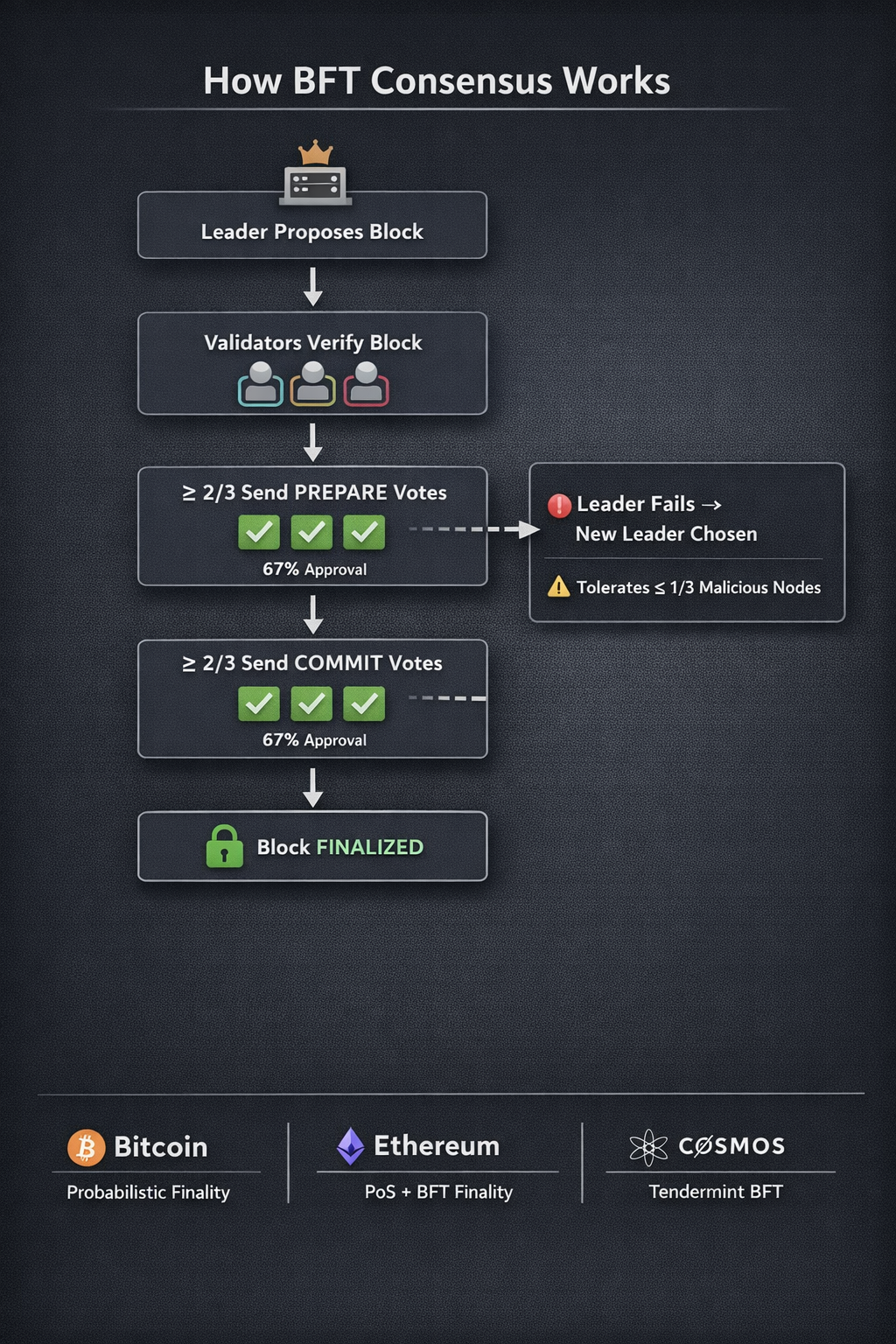
This structure enables deterministic finality. Once confirmed, the block is permanent.
How Major Blockchains Use BFT Concepts
Different networks implement BFT differently. Some use pure models. Others use economic or probabilistic adaptations.
Bitcoin – Probabilistic BFT via Proof-of-Work
Bitcoin doesn’t run classical BFT. Instead, it uses Proof-of-Work:
-
- Miners compete using hash power
-
- The longest valid chain wins
-
- Security assumes no entity controls 51% of the hashrate
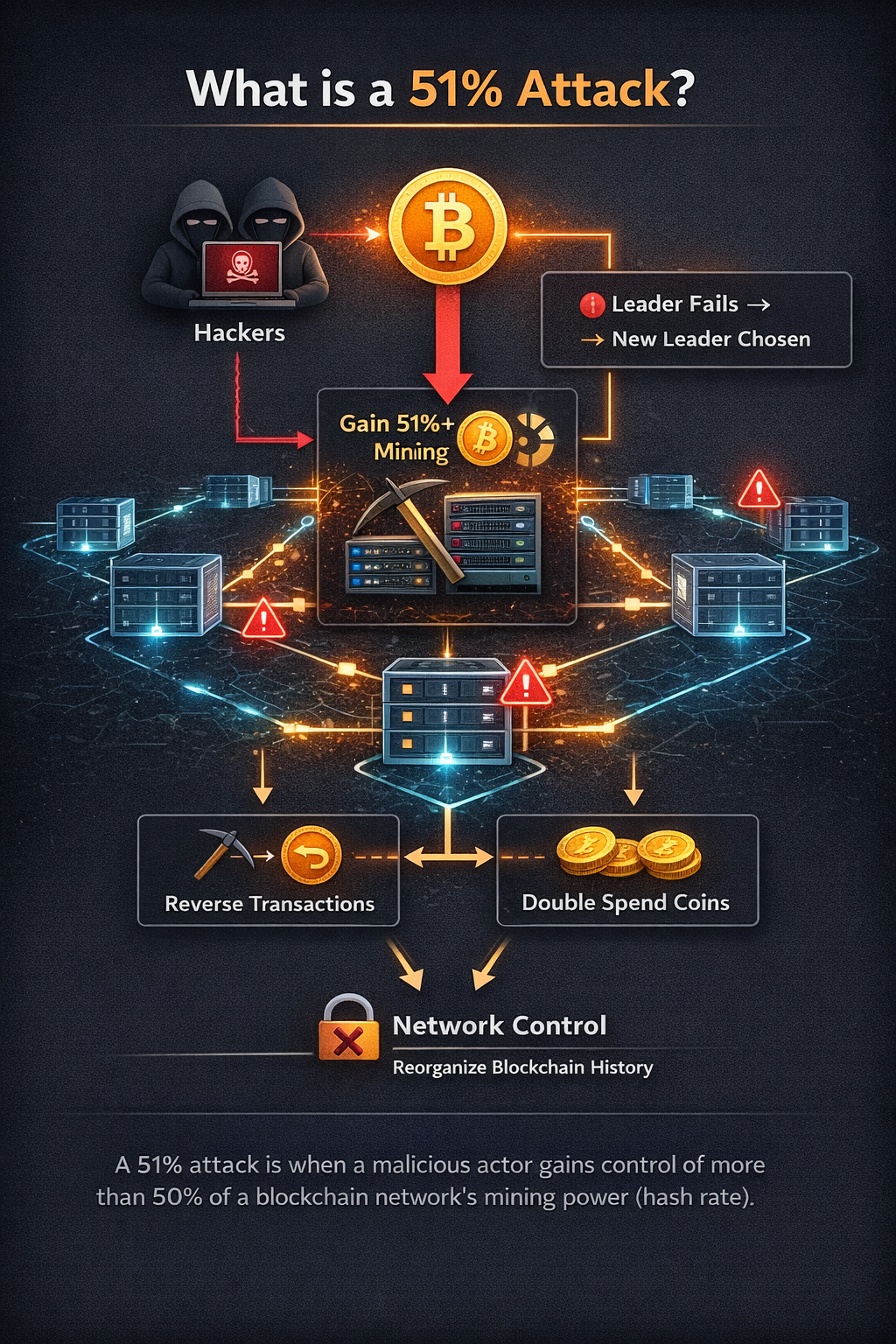
Finality is probabilistic:
-
- More confirmations = lower chance of reorg
-
- Economic cost makes sustained attacks irrational
Ethereum – Proof-of-Stake with BFT Finality
After the 2022 Merge, Ethereum moved to Proof-of-Stake with Casper finality.
Key features:
-
- 32 ETH required to run a validator
-
- Finality requires two-thirds of staked ETH to agree
-
- Malicious validators get slashed (economic penalties)
-
- Blocks finalize in minutes instead of relying on probability
This structure closely follows BFT assumptions: tolerate up to one-third faulty stake.
Cosmos – Classical BFT at Scale
Cosmos uses Tendermint (now CometBFT), a Practical BFT (PBFT)-inspired engine.
Characteristics:
-
- Tolerates up to one-third malicious validators
-
- Fast finality (1–2 seconds)
-
- Thousands of transactions per second
-
- Designed for app-specific chains
Cosmos proves BFT can deliver both speed and security in modular ecosystems.
Hedera – Asynchronous BFT (aBFT)
Hedera Hashgraph implements asynchronous BFT (aBFT), the strongest known model.
Highlights:
-
- No assumptions about message timing
-
- Formal mathematical proofs of safety
-
- High throughput (10,000+ TPS reported)
-
- Fast finality (~3 seconds)
aBFT systems aim to remain secure even under extreme network conditions.
Why BFT Matters for Everyday Crypto Users
BFT delivers real-world benefits:
-
- Deterministic finality – once confirmed, it’s final
-
- Attack resistance – tolerates up to one-third malicious actors
-
- Energy efficiency – especially in PoS systems
-
- Faster DeFi execution
-
- More secure cross-chain bridges
Without BFT-style protections, decentralized finance would collapse under adversarial pressure.
The Trade-Offs
BFT isn’t magic. It comes with design challenges:
-
- Communication complexity grows quickly (O(n²))
-
- Harder to scale to thousands of validators
-
- Requires strong economic incentives
That’s why many networks use hybrids:
-
- Sharding
-
- Layer-2 rollups
-
- PoW + BFT combinations
-
- Rotating validator sets
The Future of BFT in Crypto
Innovation is accelerating:
-
- Lower communication overhead
-
- Faster leader rotation
-
- Dynamic validator sets
-
- Quantum-resistant signatures
-
- Parallel BFT models
-
- AI-assisted validator monitoring
As crypto infrastructure matures, BFT systems are becoming faster, leaner, and more scalable without sacrificing security.
-
Decentralized Security
- Byzantine Fault Tolerance is the quiet force that keeps decentralized systems from imploding.
It ensures:
-
- Honest majority wins
-
- Malicious minorities fail
-
- Transactions become final
-
- Networks stay operational
Every time your transaction confirms in seconds, that’s BFT doing its job. Not magic. Just game theory, cryptography, and brutally efficient math keeping the system honest.