
 English
  Nederlands
  Deutsch
Cardano is a decentralized blockchain platform designed to support secure digital transactions, smart contracts, and decentralized applications (dApps). Built with a strong focus on scientific research and peer-reviewed development, Cardano aims to deliver a scalable, sustainable, and highly secure infrastructure for the future of blockchain technology.
Unlike many earlier blockchain projects that evolved rapidly through experimentation, Cardano follows a more structured and academically driven approach. Its development process relies on formal methods, cryptographic research, and rigorous testing before new features are deployed. This methodical strategy has helped position Cardano as one of the most technically ambitious networks in the cryptocurrency ecosystem.
The platform’s native cryptocurrency, ADA, plays a central role in the network. It is used to pay transaction fees, participate in staking, and contribute to governance decisions that influence the network’s future development.
Origins and Background
Cardano was founded by Charles Hoskinson, one of the early co-founders of Ethereum. After leaving the Ethereum project due to disagreements about its direction, Hoskinson began working on Cardano in 2015 with the goal of building a more research-driven blockchain platform.
The network officially launched in 2017 and quickly attracted attention for its emphasis on academic rigor and long-term design.
Cardano’s ecosystem is supported by several major organizations:
- Cardano Foundation – promotes global adoption and governance of the network
- Input Output Global – leads research and engineering development
- EMURGO – focuses on commercial partnerships and business integration
Together, these entities collaborate with the broader community to guide Cardano’s growth.
Key Features of Cardano
Cardano was designed to address limitations found in earlier blockchain networks, such as Bitcoin and Ethereum. Its architecture includes several innovative components that improve scalability, sustainability, and decentralization.
1. Proof-of-Stake Consensus
Cardano uses a Proof-of-Stake (PoS) system called Ouroboros. Unlike Proof-of-Work mining used by Bitcoin, this approach relies on participants who lock up (stake) their ADA tokens to help validate transactions and secure the network.
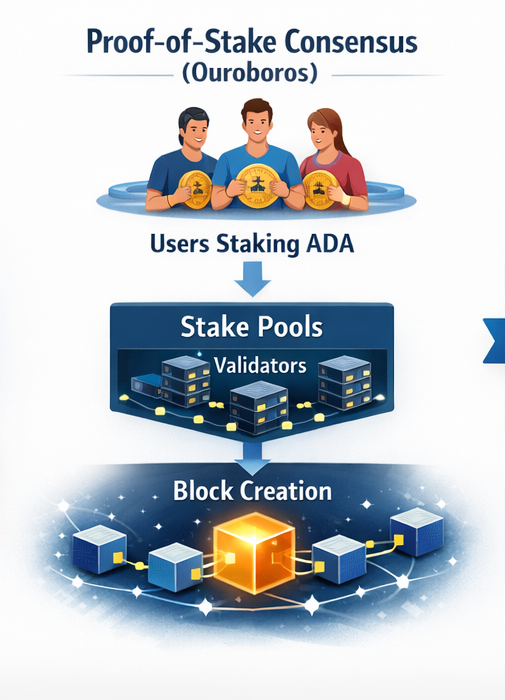
Key benefits of this model include:
- Lower energy consumption compared to mining-based systems
- Greater accessibility for users who want to participate in validation
- Incentive mechanisms that reward honest participation
Participants can either run their own validation nodes or delegate their ADA to staking pools that operate on their behalf.
2. Two-Layer Blockchain Architecture
One of Cardano’s distinguishing features is its layered design, which separates transaction processing from smart contract operations.
The network consists of two main layers:
- Cardano Settlement Layer (CSL)
Handles simple transactions such as sending and receiving ADA tokens. - Cardano Computation Layer (CCL)
Supports smart contracts and decentralized applications.
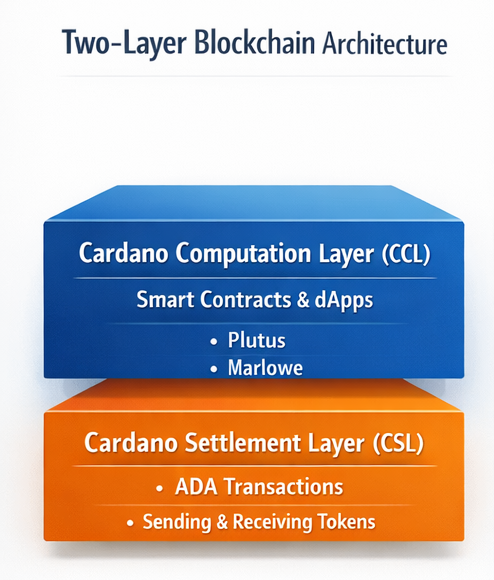
This separation provides several advantages:
- Improved flexibility for developers
- Easier upgrades without disrupting the entire system
- Greater scalability as the network grows
3. Smart Contracts and Decentralized Applications
Like Ethereum, Cardano enables developers to build decentralized applications. These applications run on self-executing code known as smart contracts.
Smart contracts on Cardano are written using:
- Plutus – a smart contract language based on the Haskell programming language
- Marlowe – a domain-specific language designed for financial contracts
These tools are designed to increase reliability and reduce vulnerabilities through formal verification methods.
Examples of applications built on Cardano include:
- Decentralized finance (DeFi) platforms
- NFT marketplaces
- Digital identity systems
- Supply chain tracking tools
4. Native Tokens
Cardano also supports the creation of native tokens, which are digital assets issued directly on the blockchain.
Unlike tokens on some other networks that rely heavily on smart contracts, Cardano native tokens operate at the protocol level. This design can improve efficiency and reduce transaction complexity.
Developers can use native tokens for various purposes:
- Launching new cryptocurrencies
- Creating NFTs and digital collectibles
- Developing decentralized financial services
- Building tokenized ecosystems for applications
The Role of ADA
The native cryptocurrency of Cardano, ADA, powers the entire network.
ADA serves several important functions:
- Transaction fees – Users pay fees in ADA when sending transactions or interacting with smart contracts.
- Staking rewards – ADA holders can earn rewards by participating in staking pools.
- Network security – Staked ADA helps maintain the integrity of the blockchain.
- Governance participation – Token holders can vote on future upgrades and proposals.
Because of these roles, ADA acts as both a utility token and a governance asset within the ecosystem.
Development Phases of Cardano
Cardano follows a structured development roadmap divided into major phases, each focused on expanding the network’s capabilities.
These stages include:
- Byron – Initial launch of the network and ADA token
- Shelley – Transition toward decentralized network participation through staking
- Goguen – Introduction of smart contracts and programmable functionality
- Basho – Improvements in scalability and network performance
- Voltaire – Implementation of decentralized governance and treasury systems
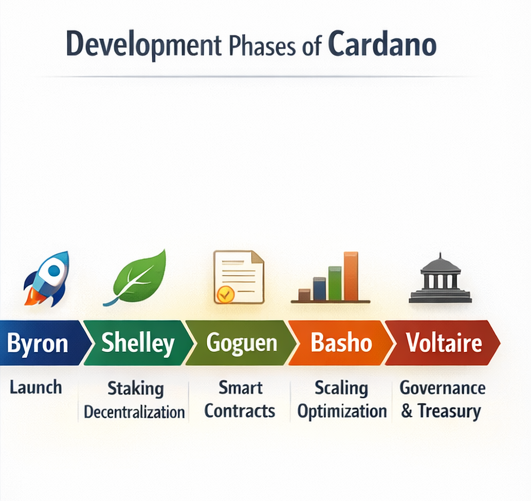
This phased approach allows the project to evolve gradually while maintaining security and stability.
Cardano vs Other Blockchains
Cardano is often compared with other leading blockchain platforms such as Bitcoin and Ethereum. While all three play important roles in the crypto ecosystem, they were designed with different goals in mind.
Bitcoin
- Primarily a digital currency and store of value
- Uses Proof-of-Work mining
- Focuses on security and monetary policy
Ethereum
- Introduced smart contracts and decentralized applications
- Hosts one of the largest blockchain ecosystems
- Transitioned to Proof-of-Stake in recent years
Cardano
- Emphasizes research-driven development
- Designed for scalability and sustainability
- Focuses on long-term infrastructure for decentralized systems
These distinctions make Cardano a unique platform within the broader blockchain landscape.
Real-World Use Cases
Beyond financial transactions, Cardano aims to support real-world applications across multiple industries.
Potential use cases include:
- Financial services – decentralized lending, payments, and asset management
- Digital identity – secure identity systems for governments and institutions
- Supply chain management – tracking goods from production to delivery
- Education records – verifying academic credentials on the blockchain
- Healthcare data systems – protecting sensitive medical information
Many of these initiatives focus on regions where traditional financial infrastructure is limited.
Advantages of Cardano
Several factors contribute to Cardano’s growing reputation in the blockchain industry:
- Strong foundation in academic research
- Energy-efficient Proof-of-Stake consensus
- Flexible layered architecture
- Secure smart contract design
- Growing ecosystem of applications
These features aim to create a blockchain platform capable of supporting large-scale global systems.
Challenges and Limitations
Despite its strengths, Cardano also faces certain challenges:
- Slower development pace compared to some competitors
- Smaller developer ecosystem than Ethereum
- Competition from newer high-performance blockchains
However, supporters argue that the platform’s research-focused approach prioritizes long-term reliability over rapid experimentation.
Research-Driven Blockchain
Cardano represents a distinctive approach to blockchain development. By combining academic research, energy-efficient consensus mechanisms, and a structured roadmap, the platform aims to build a sustainable foundation for decentralized technology.
With its native cryptocurrency ADA enabling staking, governance, and network security, Cardano continues to expand its ecosystem of decentralized applications and digital services.
As blockchain technology evolves, Cardano’s focus on scalability, transparency, and real-world utility positions it as an important player in the next generation of decentralized infrastructure.
 Stay Ahead in Crypto