

Cryptocurrency exchange rates play a crucial role in the global digital asset market. These rates determine the value of one cryptocurrency in terms of another or in relation to a fiat currency like USD.
Understanding how these rates are calculated and what factors influence them can help investors and traders make informed decisions.
What is a Crypto Exchange Rate?
A crypto exchange rate represents the value of one cryptocurrency relative to another or a fiat currency. For example, the exchange rate between Bitcoin (BTC) and USD shows how much one Bitcoin is worth in US Dollars. Similarly, the rate between Ethereum (ETH) and Bitcoin (BTC) indicates how much one ETH is worth in BTC, with rates shown as trading pairs (e.g., BTC/USD, ETH/BTC)
Crypto exchange rates can fluctuate frequently, depending on market conditions. Supply and demand for a particular cryptocurrency drive these changes, along with investor sentiment, news events, and technological advancements. For instance, if the demand for Bitcoin rises, its value in USD will also increase, resulting in a higher exchange rate for Bitcoin-to-USD.
How Are Crypto Exchange Rates Determined?
The primary factor behind crypto exchange rates is market demand. When demand for a particular cryptocurrency increases, its value rises, and so does its exchange rate. Similarly, when demand decreases, the value and exchange rate tend to fall.

In a decentralized crypto market, price differences can occur between exchanges due to variations in liquidity, trading volume, and user base. However, these discrepancies are usually short-lived. Arbitrage traders take advantage of price differences by buying an asset at a lower price on one exchange and selling it at a higher price on another.
This process quickly balances prices across exchanges. As traders exploit these gaps, they drive prices toward equilibrium, eliminating significant differences. Consequently, while exchange rates may differ slightly, the impact of arbitrage ensures that these differences are quickly corrected, keeping the market efficient.
For example, if you check the exchange rate for Bitcoin on two different platforms, such as Binance and Coinbase, you might notice small variations in the price. This happens because one exchange may have more buyers or sellers for Bitcoin, causing price differences.
Factors That Influence Crypto Exchange Rates
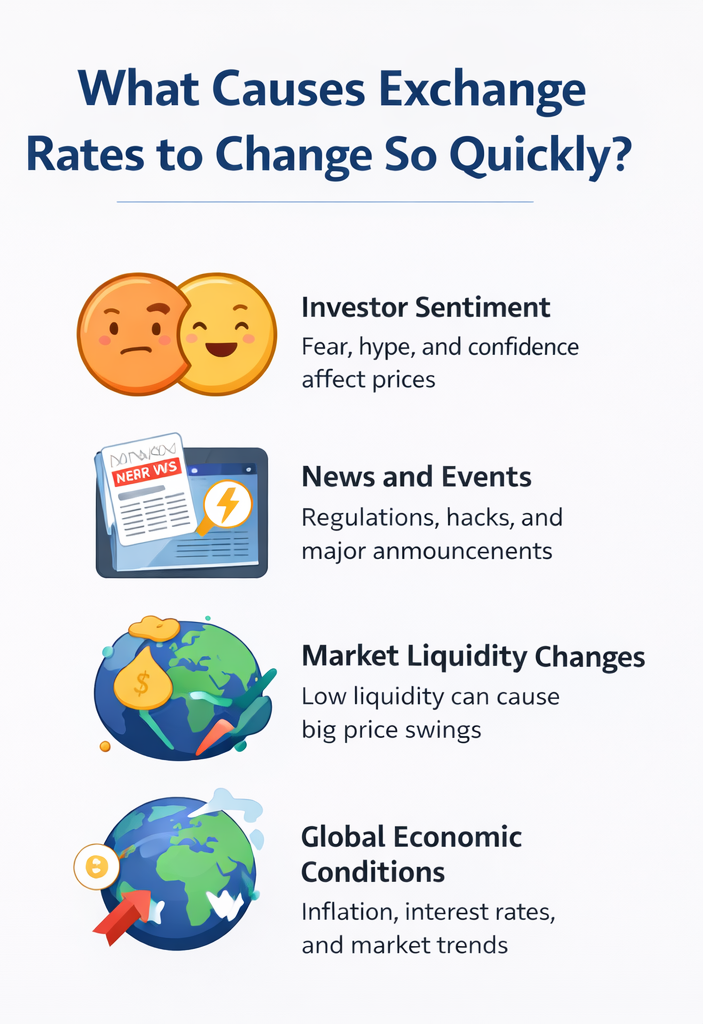
Crypto exchange rates don’t move in a vacuum. Several factors influence the rates, including:
- Market Demand: High demand for a cryptocurrency drives up its exchange rate. If more investors are looking to buy Bitcoin, for instance, its value will increase.
- Liquidity: Higher liquidity in a crypto market leads to more stable exchange rates. More liquid exchanges tend to have narrower price spreads, while less liquid exchanges may see more price fluctuation.
- Investor Sentiment: Public perception of a cryptocurrency can significantly affect its exchange rate. Positive news can drive prices up, while negative news can cause prices to fall.
- Regulatory Developments: Government regulations and legal frameworks can affect the exchange rates of cryptocurrencies. Positive regulations can boost confidence and lead to higher prices, while restrictive laws may result in price declines.
- External Market Conditions: Broader economic trends, such as inflation rates or stock market performance, can also influence the crypto market. Economic downturns or financial crises may cause cryptocurrencies to be seen as safe-haven assets.
For example, during times of high inflation, investors might flock to Bitcoin as a store of value, increasing demand and pushing up its exchange rate against the US Dollar.
How to Use Crypto Exchange Rates
Crypto exchange rates are important for traders, investors, and anyone dealing with cryptocurrencies. Understanding these rates helps individuals calculate the value of their holdings, determine when to buy or sell, and estimate the profit or loss of a transaction.
For instance, if you want to purchase a product or service with Bitcoin, you will need to convert its value to your local currency based on the current exchange rate. Similarly, traders often use exchange rates to analyze the potential profitability of a trade. If you buy Bitcoin at a lower price and sell it when the exchange rate increases, you can make a profit.
Let’s say you’re trading Bitcoin for Ethereum. If 1 BTC equals 25 ETH on one platform and 1 BTC equals 27 ETH on another platform, you can choose the exchange that offers the better rate, maximizing your trade.
Tracking Crypto Exchange Rates
Tracking crypto exchange rates is essential for anyone involved in the cryptocurrency market. There are multiple ways to keep up with the latest price changes:
- Cryptocurrency Exchanges: Most exchanges provide real-time price updates for various cryptocurrencies. These rates change frequently, reflecting the continuous trading activity on the platform.
- Crypto Price Tracking Apps: Many apps, such as Blockspot.io, allow users to track real-time crypto exchange rates across multiple platforms. These apps often offer customizable alerts to notify users of price changes.
- Financial News Websites: Websites like Bloomberg, CNBC, and others provide market updates on cryptocurrency exchange rates. These platforms often analyze price trends and offer insights into the reasons behind rate fluctuations.
For example, if you want to track Bitcoin’s exchange rate, you could use a price tracking app to monitor its value against USD, EUR, or other cryptocurrencies like Ethereum or Litecoin.
Why Do Crypto Exchange Rates Matter?
Crypto exchange rates have a significant impact on the profitability of investments and trades. For traders, the exchange rate is crucial to making informed decisions about when to enter or exit a market. A sudden drop in a cryptocurrency’s exchange rate could lead to losses, while a surge in the rate could result in a profit.
For long-term investors, understanding crypto exchange rates helps with portfolio management. If an investor holds Bitcoin and its exchange rate rises, their investment becomes more valuable in fiat terms. Conversely, if the exchange rate falls, the value of their holdings decreases.
For example, if you bought 1 BTC when the exchange rate was $8,000 and the rate increases to $10,000, your investment is now worth $10,000, reflecting the rise in exchange rate.
Risks Associated with Crypto Exchange Rates
While crypto exchange rates present opportunities for profit, they also come with risks. The cryptocurrency market is known for its volatility, and prices can change rapidly. This volatility makes crypto exchange rates more unpredictable than traditional assets like stocks or bonds.
Additionally, external factors such as government regulations, security breaches, or technological issues can also impact exchange rates. A sudden negative event, like a security hack on a popular exchange, can cause the exchange rate to drop significantly.
For example, if a country suddenly bans cryptocurrency trading, the news can lead to a sharp decline in crypto prices and exchange rates, affecting investors worldwide.
Decoding Exchange Rates
Understanding crypto exchange rates is vital for anyone participating in the cryptocurrency market. These rates are affected by supply and demand, liquidity, investor sentiment, and other market factors. Whether you’re a trader looking for the best buy or sell opportunity or an investor managing your portfolio, staying on top of exchange rates can help you make informed decisions.
By tracking exchange rates and understanding the forces driving them, you can navigate the volatile cryptocurrency market more effectively. Always consider factors like liquidity, trading volume, and external events that could influence rates before making any transactions. With careful monitoring, crypto exchange rates can become a valuable tool in your investment strategy.