English
  Nederlands
  Deutsch


Key Takeaways
- Optimistic Rollups are Layer-2 scaling solutions that run transactions off-chain and post compressed summaries back to Ethereum, cutting fees and boosting throughput.
- They are called “optimistic” because they assume transactions are valid and only verify when someone submits a fraud proof during a challenge window.
- They power major networks like Optimism, Arbitrum, and Base, but withdrawals can be slow because funds must wait out the fraud-challenge period.
In This Article
Imagine Ethereum, one of the biggest blockchains, as a super busy highway. When tons of cars (transactions) flood it, everything slows down and costs go up. Optimistic Rollups are like adding a fast lane that still connects back to the main highway but keeps cars moving smoothly.
What Are Optimistic Rollups?
At their core, optimistic rollups are Layer-2 (L2) scaling solutions that take transaction work off the main Ethereum blockchain (Layer-1) so things can run faster and cheaper. That is the main reason they are gaining attention in the crypto world.
Here is the simple idea:
- Transactions are executed off the main chain.
- The rollup batches them together and sends just a summary back to Ethereum.
- The system assumes transactions are valid unless someone proves otherwise.
This “assume valid” mindset is why they are called optimistic: the system does not check every detail immediately, it trusts most of the time.
How They Work, Step by Step
Optimistic Rollups still rely on Ethereum for security and decentralization. They just lighten the workload:
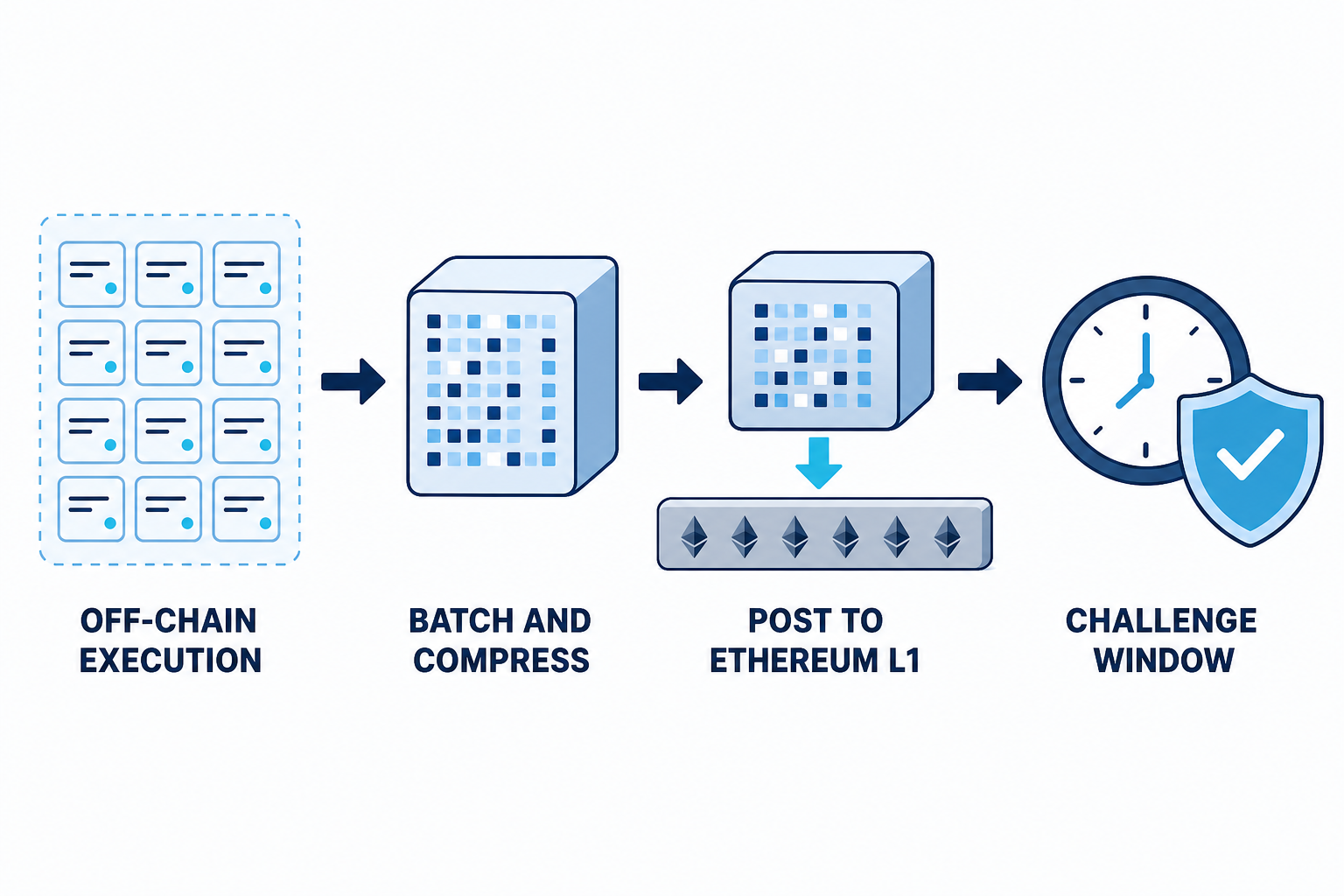
- Off-chain execution: transactions are processed outside Ethereum’s main chain, which reduces network congestion and lowers fees.
- Batched posting: instead of sending each transaction to Ethereum, rollups bundle many into one submission that includes compressed data and state updates.
- Fraud proofs: if someone spots a bad or fraudulent transaction, they can challenge it during a challenge period, and that threat keeps operators honest.
- Challenge window: users typically have some days, often up to a week, to raise disputes.
So instead of checking every transaction up front, optimistic rollups say “we will check only if there is trouble.” That is the big efficiency boost.
Why They Matter: Speed and Cost Savings
Ethereum’s own layer 1 can get really slow and expensive when lots of users interact with it. For example, gas fees can spike during high demand, sometimes making simple transactions costly. Rollups help by:
- Increasing throughput: rollups can handle many more transactions per second than Ethereum alone.
- Reducing fees: because thousands of transactions are bundled into one, the cost per transaction drops dramatically.
- Sharing Ethereum’s security: unlike sidechains, rollups inherit core security from Layer-1 Ethereum.
Some estimates suggest optimistic rollups can offer 10x to 100x improvements in scalability compared to the base layer.
What Makes Them Optimistic?
The optimistic part is really about trust assumptions. Let us break it down:
- Assume valid until proven fraudulent: optimistic rollups process transactions and optimistically claim they are correct. They only go back to check if someone disagrees.
- Fraud proofs kick in when needed: if someone spots an incorrect transaction, they submit a fraud proof that forces a check and a roll-back if necessary.
Contrast that with zk-rollups (another rollup type), which do not assume anything valid until it is proven with math proofs. This makes optimistic rollups typically easier and cheaper to implement than zk-rollups, but with one trade-off: you may wait longer for final confirmation because of the time window for fraud challenges.
Optimistic vs. ZK Rollups
A lot of people in crypto compare the two big rollup types. Here is the bite-sized version:
| Feature | Optimistic Rollups | ZK Rollups |
|---|---|---|
| Validity method | Assume valid; fraud proofs catch errors | Validity proofs (zero-knowledge math) |
| Finality | Slower: funds wait out a challenge window | Near-instant once the proof is verified |
| EVM compatibility | High: easy to port existing smart contracts | Improving, historically harder |
| Build complexity | Lower | Higher |
| Best for | General apps, DeFi, broad use | High-throughput, fast-withdrawal use cases |
Both approaches help scale Ethereum, but each fits different needs. Some apps care more about speed, others about cryptographic certainty.
Real-World Adoption
Optimistic rollups are not just theory; they are widely used right now in the Ethereum ecosystem. Some big Layer-2 networks using optimistic rollup tech include:


These platforms host thousands of decentralized apps, decentralized finance (DeFi) protocols, and NFT marketplaces, all benefiting from lower fees and faster transactions while still being secured by Ethereum.
Optimistic rollups have historically made up the large majority of the total value locked (TVL) in rollups, demonstrating real usage and adoption, with networks like Base and Arbitrum among the leaders in Ethereum’s scalability solutions.
Limitations to Know
Even though optimistic rollups are powerful, there are a few trade-offs worth mentioning:
- Challenge periods can slow withdrawals: since transactions need time to become final, users may wait to move funds back to Ethereum.
- Security still depends on honest participants: fraud detection is not automatic; it counts on observers watching for bad transactions.
These are not deal-breakers for most apps, but they are useful to understand if you are comparing rollup types.
Ethereum Scalability Boost
Optimistic rollups are a major piece of how Ethereum stays fast and affordable in a world of growing blockchain demand. They strike a smart balance between speed, cost, compatibility, and security, and they have helped push decentralized apps into real-world use.
By assuming transactions are valid until challenged, optimistic rollups reduce the work Ethereum has to do, which keeps fees low and throughput high, all while still anchoring security to the Ethereum mainchain.
Whether you are a developer deciding where to build, or just someone curious about how blockchains scale, understanding optimistic rollups is essential because they are already shaping the future of decentralized technology.
 Stay Ahead in Crypto