
Tron TRC-20 tokens have become a core part of the Tron blockchain, enabling fast and low-cost digital transactions. Built to support the next wave of decentralized applications and digital finance, TRC-20 tokens follow a specific technical standard that ensures compatibility within the Tron network. These tokens are widely used for stablecoins, DeFi platforms, gaming applications, and tokenized services.
TRC-20 tokens operate on the Tron Virtual Machine and use smart contracts to define their functions and interactions. Each token created under the TRC-20 standard can be transferred, stored, or exchanged seamlessly across Tron-compatible wallets and decentralized exchanges. With minimal transaction fees and high throughput, TRC-20 tokens offer a cost-efficient, scalable solution for developers and end users alike.
Adoption of TRC-20 tokens has accelerated due to the Tron blockchain’s performance and ease of integration. Developers prefer TRC-20 for applications requiring frequent token transfers, such as payments, staking, and governance. The growing ecosystem continues to support diverse use cases and attracts new platforms looking for lower operational costs.
Structure and Functionality of TRC-20 Tokens
TRC-20 is a smart contract-based token standard that defines how fungible tokens behave on the Tron blockchain. The standard is modeled after Ethereum’s ERC-20 but optimized for faster performance and lower fees. It ensures that all tokens created using TRC-20 share a consistent set of rules and functionalities.
Each TRC-20 token supports basic operations, including transfer, approval, and balance inquiries. These actions are coded into smart contracts and executed through the Tron Virtual Machine (TVM). The TVM processes commands efficiently, enabling the Tron network to handle thousands of transactions per second.
TRC-20 tokens rely on six required functions and three optional ones to meet the standard. These include:
- totalSupply: shows the total number of tokens in circulation
- balanceOf: displays a wallet’s token balance
- transfer: allows direct transfer of tokens
- approve: authorizes spending of tokens by another address
- allowance: checks the approved token amount
- transferFrom: allows an approved address to transfer tokens
Advantages of TRC-20 Tokens on Tron
TRC-20 tokens offer a range of benefits, especially for high-volume platforms and users. Their efficiency and integration capabilities make them highly attractive to both developers and businesses.
- High Speed: Tron supports up to 2,000 transactions per second, enabling rapid transfers and real-time dApp interactions.
- Low Fees: Transaction fees are extremely low or nearly zero due to Tron’s energy and bandwidth resource system.
- Interoperability: TRC-20 tokens work across all Tron-based apps, wallets, and exchanges without extra configuration.
- Smart Contract Control: Developers can define unique rules, logic, and interactions through programmable smart contracts.
- Decentralized Security: Tron uses Delegated Proof-of-Stake (DPoS), ensuring network security while maintaining high availability.
Because of these strengths, TRC-20 tokens are widely used in payment systems, digital rewards, and gaming environments.
Common Use Cases for TRC-20 Tokens
TRC-20 tokens power many practical and commercial applications across the Tron blockchain. These tokens serve as critical building blocks for decentralized platforms and financial tools.
Some prominent use cases include:
- Stablecoins: USDT (TRC-20) is one of the most popular tokens used for transferring dollar-equivalent value quickly and affordably.
- Decentralized Exchanges (DEXs): TRC-20 tokens are the main assets traded on Tron-based exchanges like JustSwap.
- Gaming & NFTs: Many gaming dApps use TRC-20 tokens for in-game currencies and reward systems.
- Governance: Some tokens allow holders to vote on protocol changes or participate in ecosystem decision-making.
- Loyalty & Rewards: Businesses issue TRC-20 tokens to reward users or incentivize behaviors within apps and platforms.
With Tron’s support for low-cost smart contract execution, these tokens enable scalable and efficient use of blockchain-based services.
How TRC-20 Tokens Compare to ERC-20 Tokens
While TRC-20 and ERC-20 follow similar design principles, they differ in performance, cost, and adoption. TRC-20 tokens are built on Tron, while ERC-20 tokens exist on Ethereum.
- Transaction Speed: Tron processes transactions faster, making TRC-20 suitable for real-time use cases.
- Fees: TRC-20 is significantly cheaper due to Tron’s energy system. ERC-20 often incurs higher gas costs.
- Adoption: ERC-20 tokens are more widely supported, but TRC-20 adoption is rising, particularly for stablecoins.
- Scalability: Tron’s network handles higher volumes better, offering smoother performance under stress.
- Security & Stability: Ethereum has a more mature ecosystem, while Tron offers efficiency at scale.
For users prioritizing speed and cost, TRC-20 presents a practical alternative to ERC-20, especially in cross-border transactions and micro-payments.
Wallets That Support TRC-20 Tokens
To store and manage TRC-20 tokens, users must use wallets compatible with the Tron blockchain. Several wallets offer strong support and user-friendly features.
- TronLink: Popular browser extension and mobile app, fully integrated with Tron dApps.
- Gem Wallet: An open-source, self-custodial wallet with strong support for TRC-20 tokens and direct token swaps.
- Ledger: Hardware wallet that provides cold storage for TRC-20 tokens via integration with TronLink.
- Trust Wallet: Offers secure storage and user-friendly features for TRC-20, ERC-20, and other token standards.
- Atomic Wallet: Includes TRC-20 token support along with staking and built-in exchange options.
These wallets enable users to send, receive, swap, and store TRC-20 tokens securely, whether online or offline.
Creating and Launching a TRC-20 Token
Developers can create a TRC-20 token by writing a smart contract in Solidity and deploying it on the Tron blockchain. The contract must include all required functions and set parameters such as name, supply, and decimals.
Once developed, the smart contract is deployed through Tron’s network, typically requiring a small fee in TRX. After deployment, the token becomes active and can be distributed to wallet addresses or integrated into applications.
The creation process includes:
- Defining token attributes (name, symbol, total supply)
- Writing the smart contract using Solidity
- Verifying the contract meets TRC-20 standard
- Deploying it via the Tron Virtual Machine
- Funding the deployment with a TRX transaction
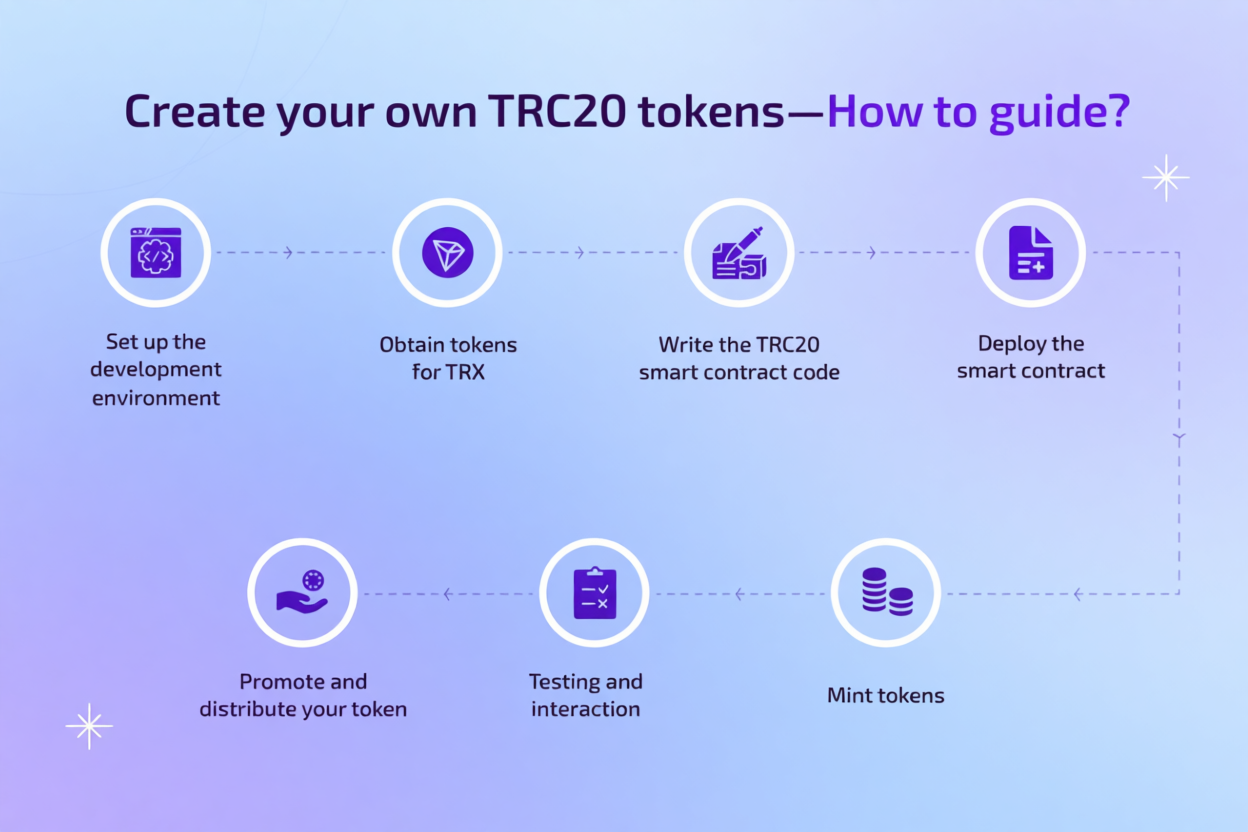
The Tron development environment and community tools help simplify token deployment and testing.
TRC-20 and Stablecoin Growth on Tron
TRC-20 tokens have driven the rise of stablecoins on Tron, making it the second-largest stablecoin blockchain after Ethereum. USDT (TRC-20) plays a central role in this growth, with its fast transfers and low fees attracting global users.
Tether launched USDT on Tron in 2019 to provide faster and cheaper alternatives to Ethereum-based stablecoins. The combination of low-cost smart contracts and stablecoin functionality has led to explosive adoption, especially in Asia and emerging markets.
Tron now holds a significant share of the global stablecoin market, with increasing volumes processed daily through TRC-20 tokens. This expansion reinforces the network’s position in payments and decentralized finance.
Pros and Cons of TRC-20 Tokens
Understanding the strengths and limitations of TRC-20 tokens can help users and developers choose the right token standard.
Pros:
- High transaction speed (up to 2,000 TPS)
- Low fees due to Tron’s energy and bandwidth model
- Seamless integration with Tron-based apps and wallets
- Efficient smart contract execution using TVM
- Growing ecosystem of dApps, exchanges, and tools
Cons:
- Limited interoperability outside Tron without bridges
- Smaller developer community compared to Ethereum
- Network centralization concerns among critics
- Reliance on Tron Foundation and leadership decisions
- Potential exposure to regulatory risks involving stablecoins
Despite some limitations, the advantages of TRC-20 often outweigh the drawbacks for developers seeking fast and affordable solutions.
Scalable Token Power
TRC-20 tokens have emerged as a powerful digital asset standard within the Tron blockchain. Their high performance, low transaction fees, and broad dApp compatibility make them a compelling choice for projects aiming to scale quickly and cost-effectively.
As decentralized finance and tokenized applications continue to grow, TRC-20 tokens will likely play a larger role in driving adoption, particularly in emerging markets and high-volume use cases. With more platforms integrating support for TRC-20 tokens and stablecoins like USDT gaining traction, Tron’s influence in the blockchain industry is set to expand further.
TRC-20 offers a future-proof, flexible standard for developers and users seeking speed, affordability, and smart contract functionality all critical components for the next wave of Web3 innovation.