
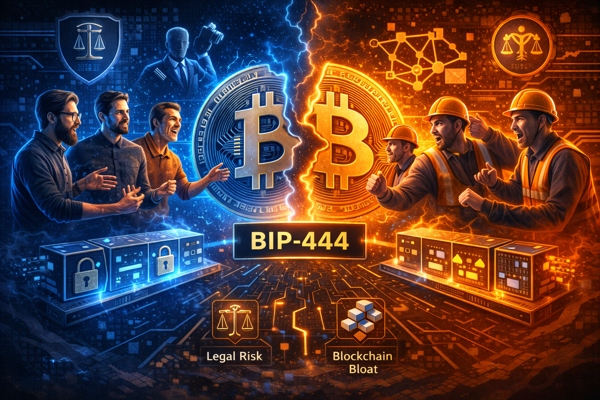
Bitcoin Improvement Proposal 444, commonly called BIP‑444, has become one of the most polarizing ideas in Bitcoin’s recent history. Far from a minor technical tweak, this proposal has reignited deep debates about Bitcoin’s purpose, its neutrality, and how or whether the network should balance freedom with legal risk. The controversy is sharp enough that some experts warn it could lead to a chain split if a consensus isn’t reached.
What Is a Bitcoin Improvement Proposal (BIP)?
Before diving into BIP‑444 itself, it helps to understand what a BIP is. Bitcoin Improvement Proposals are documents used to propose changes or enhancements to the Bitcoin protocol. They are written, reviewed, and discussed by developers in the open, often through Bitcoin’s official GitHub repository and the bitcoin‑dev mailing list.
Not every BIP becomes part of Bitcoin. Some are rejected, some are adopted after a broad consensus, and some remain in limbo. Major past BIPs include SegWit (BIP141), a soft fork that fixed transaction malleability and enabled innovations like the Lightning Network.
BIP‑444: Overview and Core Proposal
Title & Author
- Name: Reduced Data Temporary Softfork
- BIP Number: 444
- Author: Pseudonymous developer Dathon Ohm
- Publication: October 24, 2025
- Status: Draft/proposal, under active debate
At its core, BIP‑444 proposes a temporary soft fork to drastically restrict the amount of arbitrary, non‑financial data that can be stored on the Bitcoin blockchain. It would put new limits on how big certain data fields can be in transactions, a response to concerns about unrestricted data use in recent Bitcoin Core updates.
What It Would Change
Under BIP‑444:
- OP_RETURN outputs (used to attach extra data to transactions) would be capped at 83 bytes.
- Most scriptPubKeys (the outputs defining how Bitcoin can be spent) would be limited to 34 bytes.
- Push data operations (OP_PUSHDATA) would be capped at 256 bytes.
- Certain script features, such as Taproot annexes and conditional branches like OP_IF, would be prohibited during the temporary period.
- Many paths that could embed larger data, including potential workarounds, would be closed or limited.
- Proposed duration: roughly one year (until block 987,424).
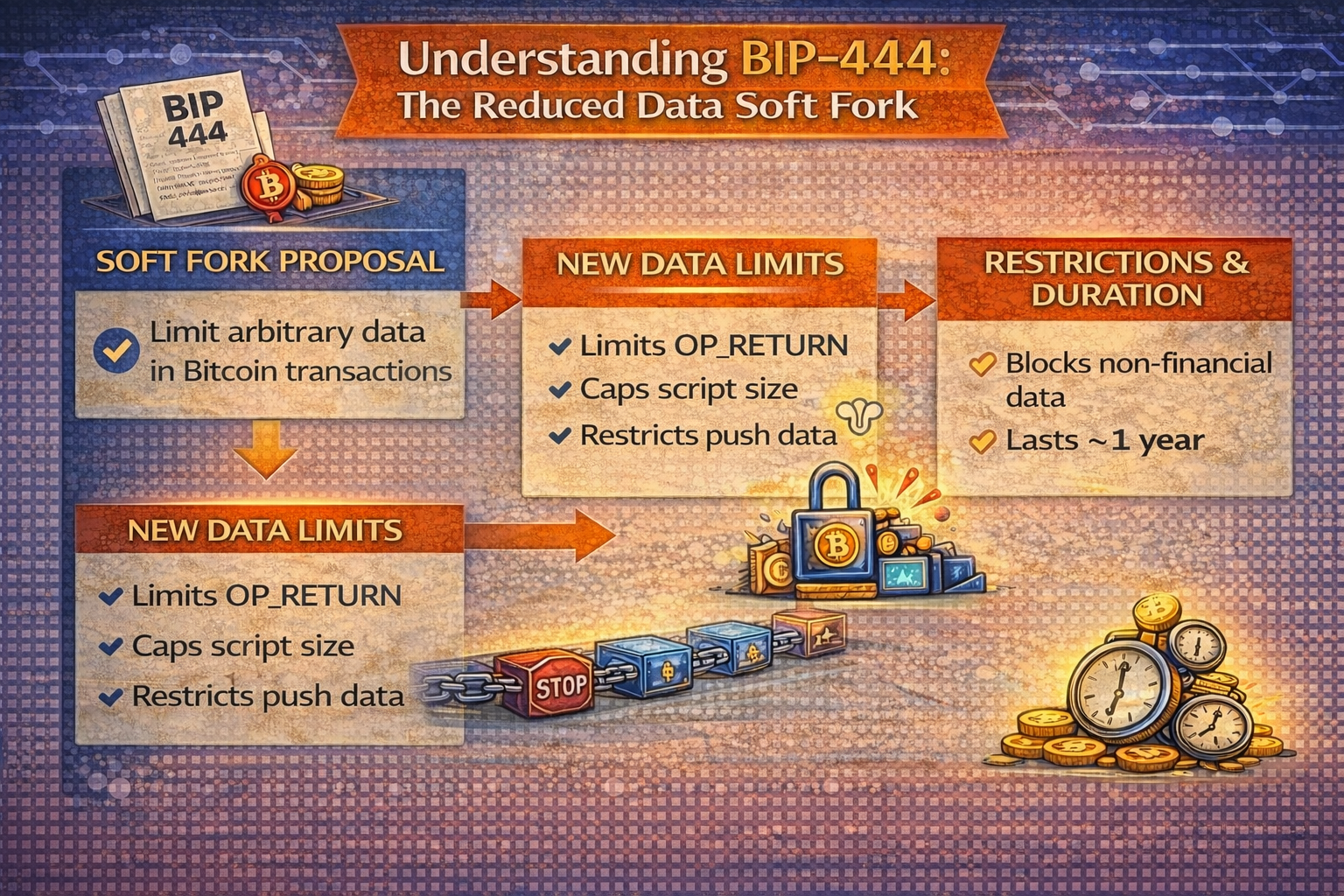
Technically, BIP‑444 is a soft fork, meaning it tightens the consensus rules so that new blocks under the fork would still be considered valid by upgraded nodes, while rejecting certain types of data payloads that were previously allowed.
Why Was BIP‑444 Proposed?
A Reaction to Bitcoin Core v30
In 2025, Bitcoin Core v30 removed longstanding limits on how much data could be stored in OP_RETURN outputs, effectively allowing users to embed up to 100 kilobytes of arbitrary data in transactions. This opened the door to creative use cases like Ordinals, BRC‑20 tokens, and on‑chain JPEGs, but also drew criticism.
BIP‑444 proponents, including well‑known Bitcoin developer Luke Dashjr, argue that this expansion of on‑chain data is a problem for two major reasons:
1. Legal and Regulatory Risks
They say that storing arbitrary data on the blockchain, especially if it includes illegal content (such as copyrighted works or child sexual abuse material), could create liability for full node operators. Node operators who hold a complete copy of Bitcoin’s blockchain might be considered in possession of illegal material, even if they did not create it. This, supporters argue, could force operators offline and centralize the network.
2. Blockchain Bloat and Spam
Supporters contend that unrestricted data storage turns Bitcoin into a de‑facto storage network instead of a pure monetary settlement layer, increasing blockchain size and costs for participants.
The Controversy: Why Many Oppose BIP‑444
While supporters focus on legal risk and data bloat, critics have launched a broad attack on BIP‑444 both technical and philosophical.
A. Threat to Bitcoin’s Neutrality
Bitcoin’s design philosophy emphasizes neutrality: the protocol should treat all valid transactions the same, without judging content or use cases. Critics argue that limiting certain types of valid data, even with good intention,s is a form of censorship. They fear this sets a dangerous precedent where developers or powerful actors could later block other things they dislike.
B. Controversial Language in the Proposal
One of the flashpoints in the debate is the BIP’s wording. Critics point out that the proposal suggests moral or legal consequences for those who reject the soft fork, raising eyebrows and accusations that the proposal is coercive or threatening. This prompted strong pushback from the community and veteran developers.
C. Technical Arguments Against Effectiveness
Prominent observers have also pointed out that the restrictions in BIP‑444 might not even achieve the goal of eliminating illicit content. For example, Bitcoin developer Peter Todd demonstrated that it’s possible to embed arbitrary data including parts of BIP‑444 itself, in ways that would not be blocked by the proposed limits.
D. Risk of Splitting the Network
While a soft fork is technically non‑breaking, if enough miners, exchanges, or users refuse to adopt it, the network could end up with two competing chains. Critics warn BIP‑444 could become a flashpoint like the 2017 scaling debates or earlier contentious proposals, threatening a chain split if consensus isn’t found.
Why This Debate Matters
1. Decentralization vs. Practical Risk
At the heart of the BIP‑444 debate lies a core tension in Bitcoin: should protocol rules be changed to address external legal and social risks, or should Bitcoin remain neutral above all else?
Proponents say that ignoring real legal liabilities could drive node operators offline, indirectly centralizing the network and undermining security. Critics say Bitcoin’s strength is its neutrality and resistance to external pressures, even when uncomfortable.
2. Precedent for Future Governance
The outcome could shape how Bitcoin handles other social or legal policy questions in the future. If rules can be rewritten to limit undesirable data, could future proposals limit financial transactions themselves? Many in the community fear this slippery slope.
3. Impact on Layered Ecosystems (Ordinals, Runes, BRC‑20)
BIP‑444 would directly restrict the data structures that Ordinals, Runes, and other “inscription‑style” assets rely on. These innovations have grown into a significant ecosystem, and the proposal is seen as a direct challenge to their existence on Bitcoin’s primary chain.
What Happens Next?
As of early 2026:
- BIP‑444 is still under discussion, but not formally accepted or activated.
- Key network participants, including major mining pools, exchanges, and wallet developers, are weighing in publicly.
- Some, like F2Pool’s co‑founder, have publicly refused to support the soft fork, calling it a bad idea.
- Others continue to argue over whether legal risk is significant enough to warrant such a change.
At this stage, BIP‑444 remains a live debate in Bitcoin’s development forums, with consequences for community cohesion and future governance.
Bitcoin’s Identity Debate
BIP‑444 is much more than a technical suggestion; it is a philosophical battleground about Bitcoin’s identity. It raises questions about neutrality, risk, innovation, censorship, and decentralized governance that go far beyond bytes and script limits.
Whether BIP‑444 succeeds or dies on the vine, the debate it sparked will reverberate through Bitcoin’s culture for years and may well shape how future proposals are evaluated and argued. The discussions reveal not just technical disagreement but deep ideological divisions on what Bitcoin should be in a world where on‑chain data, regulation, and legal liability intersect in complex ways.
For anyone following Bitcoin’s evolution, BIP‑444 is proof that even after more than 16 years, Bitcoin’s core debates are far from settled.