 English
  Nederlands
  Deutsch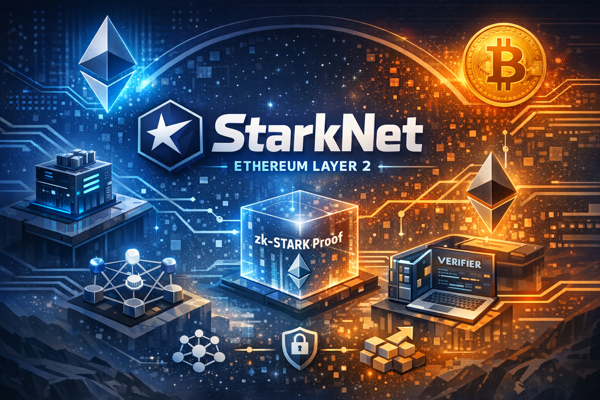
In the ever-evolving blockchain space, scalability remains one of the most significant challenges, particularly for Ethereum. As the number of users and applications grows, so does the congestion, resulting in slower transaction times and higher gas fees. While Ethereum prioritizes decentralization and security, its performance bottlenecks have led to the rise of Layer 2 (L2) scaling solutions. Among them, StarkNet has emerged as one of the most promising technologies.
Built by StarkWare, StarkNet is a next-generation L2 network that leverages advanced zero-knowledge proof technology, specifically zk-STARKs (Scalable, Transparent Arguments of Knowledge), to help Ethereum scale efficiently without compromising its foundational principles.
Why Layer 2s Exist: The Ethereum Trilemma
Ethereum is often caught in what’s known as the blockchain trilemma, the challenge of optimizing for scalability, decentralization, and security all at once. Typically, achieving two means sacrificing the third. Ethereum has chosen to focus on decentralization and security, meaning it can struggle to scale efficiently during periods of high demand.
Layer 2 solutions like StarkNet aim to solve this scalability issue by processing transactions off-chain, while still inheriting the security of Ethereum’s Layer 1. They reduce congestion on the Ethereum mainnet, enabling faster and cheaper transactions.
What is StarkNet?
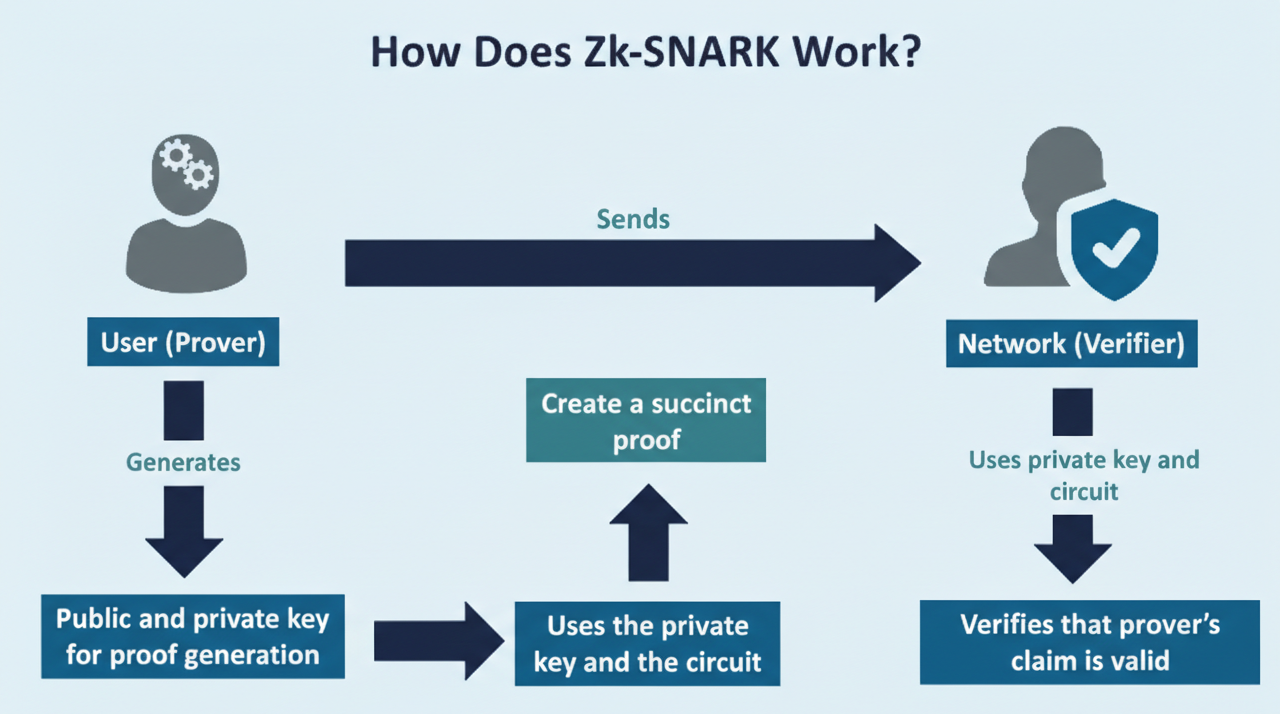
StarkNet is a validity rollup, also referred to as a zk-rollup (zero-knowledge rollup). It operates as a Layer 2 network on Ethereum, processing transactions off-chain and then batching them into a single proof (a cryptographic certificate of correctness), which is submitted to Ethereum for verification.
What makes StarkNet special is its use of zk-STARKs instead of zk-SNARKs, an upgrade in both transparency and security. Unlike zk-SNARKs, STARKs don’t require a trusted setup and are resistant to quantum computing threats. This positions StarkNet as one of the most secure, transparent, and scalable L2 solutions available.
How StarkNet Works: Under the Hood
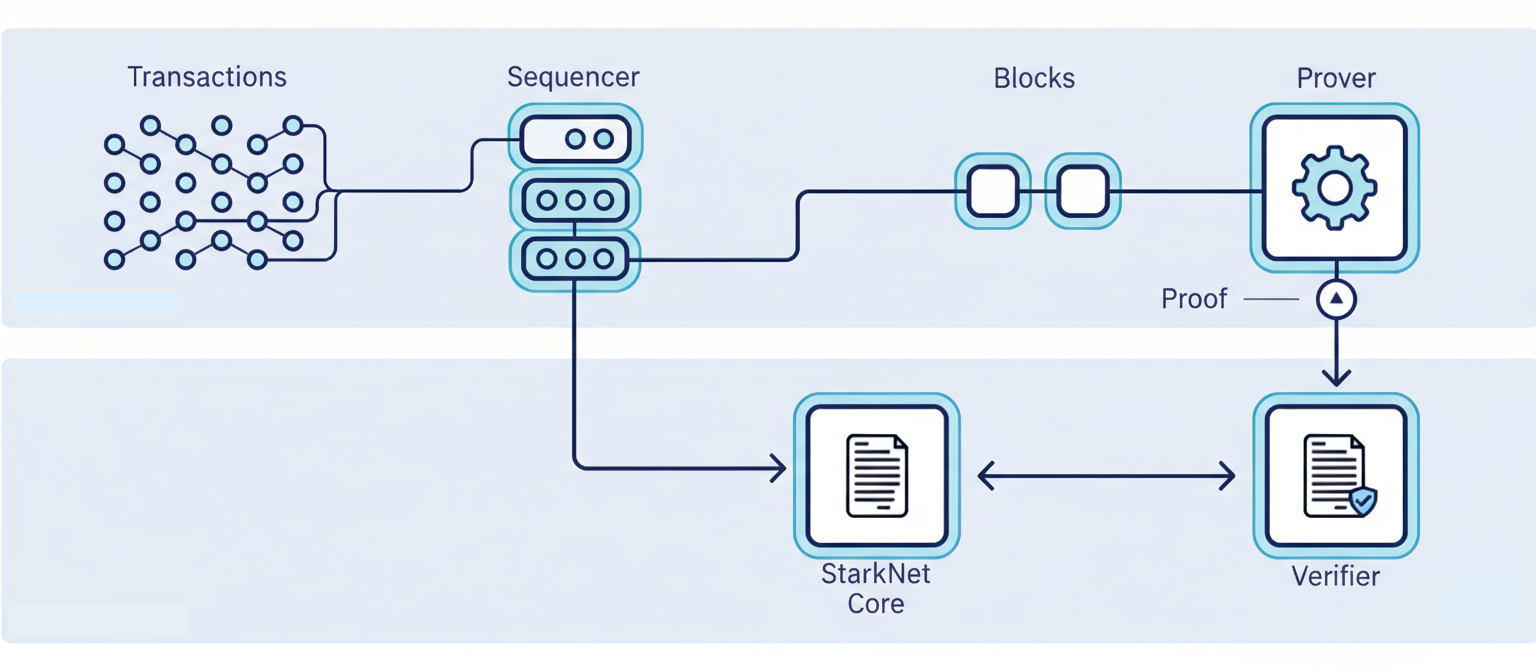
StarkNet’s architecture is made up of several key components that work together to enable fast and secure off-chain transaction processing:
1. Sequencers
Sequencers are the first point of contact when users submit transactions. They:
- Order and batch transactions
- Execute them to form blocks
- Maintain consistency in transaction flow
Think of them as the conductors of the orchestra, making sure all operations are performed in the right order.
2. Provers
Once the sequencer completes a block, the prover steps in. It takes the block data and creates a zk-STARK proof, a mathematical proof that all the transactions were valid and executed correctly.
This proof is succinct and easy to verify, allowing Ethereum to validate thousands of transactions with minimal effort.
3. Verifier (on Ethereum)
The zk-STARK proof is submitted to the Ethereum mainnet, where a verifier smart contract checks it. If valid, Ethereum updates its own state to reflect the transactions processed off-chain.
4. Cairo Language & Virtual Machine
To facilitate this flow, StarkNet uses Cairo, a custom programming language designed for writing provable programs. It compiles into what’s known as an Algebraic Intermediate Representation (AIR), ideal for creating efficient zero-knowledge proofs.
Benefits of StarkNet
StarkNet brings together scalability, privacy, and programmability in a unique way:
- Scalability: Thousands of transactions can be bundled into a single Ethereum transaction, dramatically reducing congestion and fees.
- Security: By publishing validity proofs to Ethereum, StarkNet inherits its base layer security.
- Transparency: zk-STARKs don’t require trusted setups, making the system more trustless and decentralized.
- Quantum Resistance: STARKs are built with cryptographic primitives that resist attacks from quantum computers an edge over zk-SNARK-based systems.
- Developer-Friendly: Cairo offers flexibility to build any business logic, from DeFi protocols to NFT platforms.
Native Account Abstraction
Unlike Ethereum, where account behavior is hardcoded, StarkNet features native account abstraction. This means all accounts are smart contracts, giving developers flexibility to create more user-friendly wallets, advanced security models, and features like multi-signature or social recovery without protocol-level changes.
It’s a game-changer for onboarding new users, especially those unfamiliar with the complexities of traditional crypto wallets.
The STRK Token: Utility and Governance
At the heart of the StarkNet ecosystem is its native token, STRK. It serves three primary purposes:
- Transaction Fees: Users pay gas fees in STRK for processing transactions on StarkNet.
- Governance: STRK holders can participate in protocol governance by converting their tokens into vSTRK (voting STRK) and proposing or voting on protocol upgrades.
- Staking (Planned): While not yet implemented, STRK is expected to play a role in future Proof-of-Stake (PoS) mechanisms, contributing to network security and decentralization.
Token Allocation:
- 20.04%: Core contributors
- 18.17%: Early investors
- 12.93%: Grants for protocol development
- 10.76%: StarkWare treasury
- 10%: Strategic reserve
- 9% each: Provisions and rebates
- 8.1%: Starknet Foundation treasury
- 2%: Donations
A significant portion of tokens were subject to lock-up periods, ensuring long-term alignment between stakeholders and the protocol’s success.
StarkNet Expanding to Bitcoin?
While StarkNet was born on Ethereum, it’s now expanding its vision to Bitcoin, positioning itself as a potential execution layer for Bitcoin-based DeFi (BTCFi). This would bring smart contract capabilities and programmability to Bitcoin, something that has long been limited by its design.
Partnerships like the one with Xverse and Lombard Protocol aim to bridge Bitcoin assets into the StarkNet ecosystem, offering a taste of trustless, scalable DeFi using BTC.
StarkNet vs Other Layer 2s
StarkNet is often compared with other Ethereum L2s like Optimism, Arbitrum, and zkSync. Here’s how it differs:
| Feature | StarkNet | Optimism / Arbitrum | zkSync |
| Proof Type | zk-STARK | Optimistic Rollup | zk-SNARK |
| Trusted Setup | No | Not applicable | Yes |
| Quantum Resistance | Yes | No | No |
| Custom Language | Cairo | Solidity | zkSync DSL |
| Account Abstraction | Native | Partial | Native |
Scaling Ethereum Securely
StarkNet represents a powerful evolution in Ethereum scalability. By using cutting-edge cryptography, it allows developers and users to enjoy fast, low-cost transactions without compromising on security or decentralization.
Its combination of zk-STARK proofs, native account abstraction, and developer flexibility via Cairo makes it a standout among Ethereum Layer 2s. And with expansion plans into the Bitcoin ecosystem, StarkNet is positioning itself not just as a solution for Ethereum, but as a cross-chain execution layer that could redefine DeFi.
As blockchain infrastructure continues to mature, solutions like StarkNet will be crucial in driving mainstream adoption by solving the very limitations that once held these networks back.
 Stay Ahead in Crypto