

At their simplest, euro stablecoins are cryptocurrencies designed to keep their value closely tied to the euro (EUR), commonly on a 1:1 peg. That means 1 unit of a euro stablecoin should always be worth about €1, much like how the USDC or USDT stablecoins attempt to stay at $1 for the US dollar.
They combine the benefits of blockchain (speed, programmability, global transfers) with the price stability of a fiat currency. Because the euro is the world’s second‑most traded currency after the U.S. dollar, euro stablecoins are crucial if you’re dealing with European settlements, trading, or decentralized finance (DeFi) denominated in euros.
However, the euro‑stablecoin market is still much smaller than the dollar stablecoin market. Nearly all global stablecoin value (about 99 %) is pegged to the U.S. dollar rather than the euro.
The Landscape in Numbers
While specific figures change over time, here’s a snapshot of the euro stablecoin ecosystem:
- Market cap (total value) for all euro‑stablecoins is under $1 billion, far smaller than the combined USDC/USDT supply in the hundreds of billions.
- There are only a handful of widely recognized euro stablecoins, compared to dozens of USD‑pegged tokens.
- Some lists include 10+ euro‑pegged stablecoins that are compliant with the European Markets in Crypto‑Assets (MiCA) framework or expected to be soon.
For perspective: the total market capitalization of euro‑denominated stablecoins is quite small compared to the total crypto market ($4 trillion).
Why Euro Stablecoins Matter
Bitcoin and other highly volatile cryptocurrencies aren’t great stores of value for everyday use. Stablecoins fix this:
- Fast transactions: Move euros across borders in minutes instead of days.
- Lower fees: Especially useful for global remittances or DeFi apps.
- Programmability: You can build smart contracts that automatically interact with euro‑denominated money.
- Hedging: Traders use them to protect portfolios from price swings in crypto.
But regulators in Europe have also been cautious as of late 2025, the European Central Bank and legislative bodies continue refining rules that govern stablecoin issuance and auditing.
Major Euro Stablecoins
Here’s a breakdown of the most notable euro‑stablecoins, including current and emerging ones:
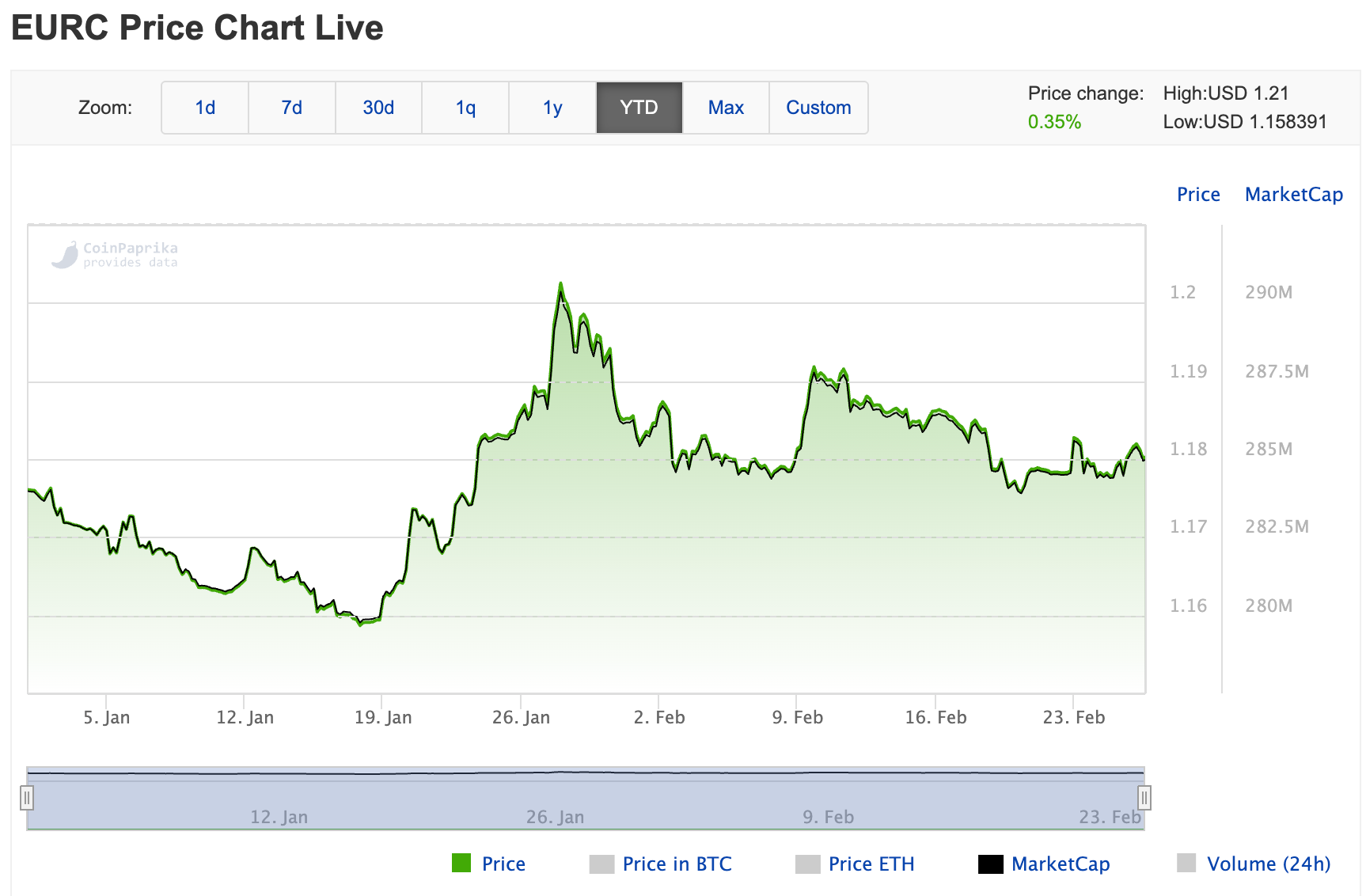
EURC (Circle)
- Issued by Circle, the same company behind USDC.
- Fully backed 1:1 with euros held in regulated financial institutions.
- Transparent publishes monthly attestations of reserves.
- Circulating supply is often quoted at around €382.9 M.
 Source: Coinpaprika
Why it’s important: EURC is widely supported on exchanges, DeFi platforms, and wallets and is considered among the most reliable euro‑pegged tokens currently available.
STASIS EURO (EURS)
- One of the oldest euro stablecoins and widely referenced in industry reviews.
- Designed to combine euro stability with blockchain efficiency.
- Originally issued on Ethereum as an ERC‑20 token.
Usage: Commonly used for trading pairs and liquidity on exchanges.
Euro Tether (EUR₮ / EURT)
- Issued by Tether, the same company behind USDT.
- Pegged to the euro similarly to how USDT is pegged to USD.
Note: While EURT exists, it generally has much lower liquidity than EURC or USD‑stablecoins.
Other Euro‑Pegged Tokens
There are several smaller or newer euro stablecoins, either MiCA‑compliant or emerging:
- AEUR (Anchored Coins) — euro‑backed token with deposit backing and guarantees.
- EURA — another euro stablecoin gaining attention in DeFi contexts.
- EURCV (Euro CoinVertible) — issued by Société Générale via SG Forge.
Tip: Some are more experimental or less liquid — not all are available on every exchange.
How These Compare to USD Stablecoins
To put euro stablecoins in context:
| Metric | USD Stablecoins (e.g., USDC, USDT) | EUR Stablecoins |
| Total Market Cap | Hundreds of billions | Under $1B |
| Global Adoption | Very High | Lower but growing |
| Regulation | Mature in many jurisdictions | Evolving under MiCA |
| Liquidity | Extremely deep | Often thin |
Why the difference? The U.S. dollar dominates global trade and payments. Euro stablecoins are catching up, especially in Europe, but have much smaller adoption so far.
Where You Can Use Euro Stablecoins
Euro stablecoins are mostly used in:
- Cryptocurrency exchanges: To trade crypto without touching volatile coins.
- Decentralized finance (DeFi): Liquidity pools, lending/borrowing, yield farming.
- Cross‑border payments: Faster than traditional bank transfers with lower fees.
- Tokenized assets: Buying digital bonds, shares, or other euro‑denominated tokens.
Regulation & The Future
Europe’s MiCA (Markets in Crypto‑Assets) framework seeks to regulate stablecoins more strictly than before, requiring reserve transparency, audits, and consumer protections.
Meanwhile, major European banks are collaborating to launch a new euro stablecoin, expected in late 2026, which could boost adoption further.
In addition to privately issued ones, the European Central Bank (ECB) is exploring a central bank digital euro (CBDC), but that’s a separate project not yet deployed.
The Future of Euro Stablecoins
Euro stablecoins are an exciting but still developing corner of crypto:
- They bridge traditional fiat (euros) with blockchain capabilities.
- Fewer choices and lower liquidity than USD stablecoins today.
- Regulatory frameworks like MiCA are improving trust and safety.
- Leading examples include EURC, EURS, EURT, and newer entrants like AEUR and EURCV.
Whether you’re using them for trading, DeFi, or payments, always check liquidity, peg stability, and whether the issuer offers transparent reserve data before buying or using any euro stablecoin.