

Arbitrage trading operates by exploiting small price differences for the same asset across different markets. Traders buy low in one market and simultaneously sell high in another to make risk-free profits. This strategy plays a vital role in maintaining market efficiency and improving liquidity.
Due to its potential for profit, arbitrage trading remains a popular strategy among institutional investors, hedge funds, and high-frequency traders. Technological tools and advanced algorithms allow professionals to execute large volumes within milliseconds. However, while arbitrage offers low risk, it requires speed, accuracy, and substantial capital to succeed.
Arbitrage: A Simple Yet Powerful Concept
Arbitrage arises when identical or similar assets trade at different prices in different markets or under different conditions. Traders quickly identify these discrepancies and act before the prices adjust. This helps bring the prices in both markets into alignment.
Markets occasionally reflect temporary inefficiencies due to demand and supply gaps, slow data updates, or regulatory differences. As a result, these short-term pricing mismatches offer small but real profit opportunities. Traders who spot these gaps can earn profits without taking on traditional market risks.
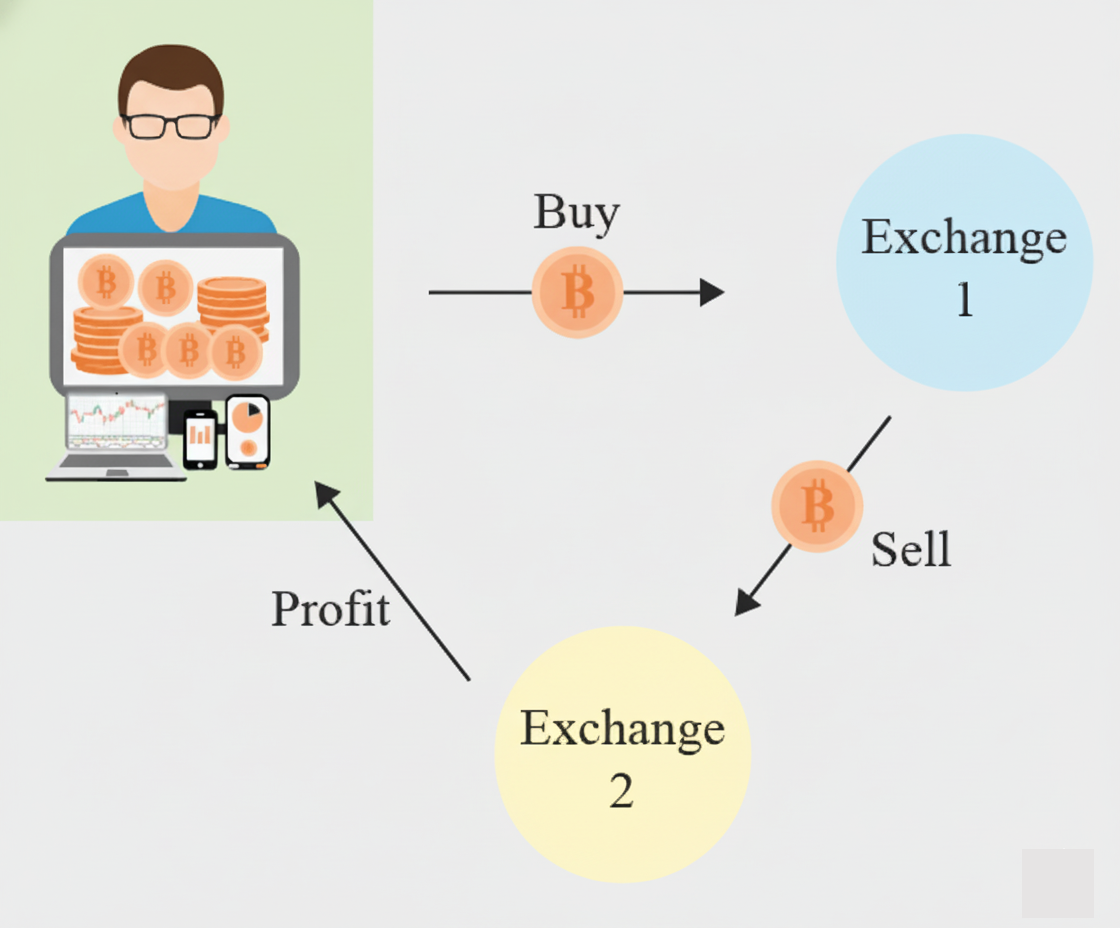
Arbitrageurs use automated systems to scan for price variations and execute trades nearly instantly. Because arbitrage profits are often measured in cents, even minor delays can eliminate the advantage. Therefore, speed and precision remain crucial to success.
Key Conditions for Arbitrage to Occur
Several conditions must be present for an arbitrage opportunity to exist. Without these, markets remain efficient and free of pricing gaps.
- The same asset must trade at different prices in separate markets.
- Trades must happen simultaneously to avoid exposure to price changes.
- Transaction costs must not exceed the price difference between markets.
If these requirements are met, the opportunity becomes viable. But in many cases, additional costs, such as taxes or fees, eliminate any potential gains. Therefore, only well-resourced traders or firms usually capitalize on real arbitrage opportunities.
How Arbitrage Trading Works in Practice
In a typical arbitrage trade, a trader identifies a price difference between two markets. The trader buys the asset where it’s cheaper and sells it where it’s higher. The profit equals the price gap minus any costs.
For example, if a stock trades at $50 on Exchange A and $50.30 on Exchange B, the trader could buy from A and sell on B. The 30-cent profit per share may seem small, but it adds up with large volumes. Automated trading systems help execute these transactions in milliseconds.
In global markets, currency exchange rate movements also create opportunities. Forex arbitrage traders move quickly to convert between currencies using real-time exchange rates. This method requires precise calculations and ultra-fast systems.
Different Types of Arbitrage Trading
Arbitrage strategies vary depending on asset class, complexity, and market structure. Some strategies require simple trades, while others use advanced tools.
Common Types of Arbitrage Include:
- Pure Arbitrage: Involves buying and selling the same asset in different markets simultaneously.
- Triangular Arbitrage: Uses three currency pairs to profit from exchange rate differences within one or more exchanges.
- Merger Arbitrage: Traders buy shares in companies being acquired to profit from post-merger price movements.
- Statistical Arbitrage: Uses mathematical models and historical data to find pricing inefficiencies.
- Convertible Arbitrage: Combines long positions in convertible bonds with short positions in the underlying stock.
Each strategy has different requirements and risks, but all depend on temporary market inefficiencies. While some strategies are used by individuals, most are applied by institutional investors using powerful trading platforms.
Crypto Arbitrage Trading
Cryptocurrency markets, due to their decentralised nature, offer significant arbitrage potential. Prices for the same crypto asset can vary widely between platforms. This occurs due to liquidity differences, varying demand, and slower data synchronisation.
For instance, Bitcoin might trade at $98,500 on Exchange X and $98,800 on Exchange Y. A trader can buy from X and sell on Y, capturing a $300 profit per unit. However, blockchain transfer times, withdrawal fees, and volatility can quickly erase this margin.
Types of crypto arbitrage include:
- Spatial Arbitrage: Buying on one exchange and selling on another.
- Triangular Arbitrage: Exploiting price differences between three cryptocurrencies.
- DEX Arbitrage: Taking advantage of price differences across decentralized exchanges like Uniswap or PancakeSwap.
Arbitrage in the Futures and Options Markets
In futures trading, arbitrage takes the form of cash-and-carry and reverse cash-and-carry strategies. These trades involve buying in the spot market and selling in the futures market, or vice versa, to lock in price differences.
When the future price of an asset exceeds its current price, traders use cash-and-carry arbitrage. They buy the asset now and sell the futures contract. On the other hand, reverse cash-and-carry involves shorting the asset and buying the futures contract when the future price is lower.
Risks Associated with Arbitrage Trading
Despite its reputation for low risk, arbitrage trading does carry certain risks. These can reduce or even eliminate potential profits.
Common Risks Include:
- Execution Risk: Delays in trade execution can eliminate price differences before completion.
- Transaction Costs: High fees can surpass the profit margin.
- Liquidity Risk: Lack of buyers or sellers may prevent a timely exit.
- Model Risk: In statistical arbitrage, incorrect models can lead to misjudgments.
- Regulatory Risk: Cross-border transactions may face legal restrictions or compliance issues.
Technology can reduce many of these risks, but traders must always consider worst-case scenarios before executing large trades.
The Role of Technology in Arbitrage Trading
Modern arbitrage depends heavily on advanced technology. High-frequency trading (HFT) firms use sophisticated algorithms and direct data feeds to gain speed advantages. These tools allow traders to act in milliseconds, often before humans can respond.
Retail traders can now access similar tools, though on a smaller scale. Platforms like MetaTrader 5 support algorithmic trading strategies and connect users to live market data. These features help spot arbitrage opportunities in real-time.
But increased access also means more competition. As more traders use bots, opportunities become rarer and disappear faster. Therefore, traders must combine speed with accuracy and strong risk controls.
Real-World Arbitrage Use Cases
Traders and firms have used arbitrage for decades in both simple and complex ways. Here are a few real examples:
- Commodity Arbitrage: Traders buy gold in London and sell it in New York to capture slight pricing differences during volatile periods.
- Currency Arbitrage: Banks and large investors trade currency pairs between different brokers when exchange rate quotes mismatch.
- Crypto Arbitrage: During high market activity, cryptocurrencies like ETH or SOL often trade at different prices across exchanges.
- Merger Arbitrage: Hedge funds buy stocks of companies set for acquisition to benefit from closing price gaps.
Advantages of Arbitrage Trading
Arbitrage helps markets work better by correcting inefficiencies and aligning prices. Some of the main benefits include:
- Low-Risk Profits: When executed correctly, arbitrage provides consistent but small returns with minimal risk.
- Improved Market Efficiency: It narrows price gaps across markets and strengthens pricing fairness.
- Increased Liquidity: Arbitrage trading often involves high volumes, adding liquidity to financial systems.
Challenges of Arbitrage Trading
Although arbitrage is simple in concept, applying it successfully is difficult. The key challenges include:
- High capital requirements to make profits from small margins.
- Competition from firms with faster systems and better infrastructure.
- Constant changes in fees, spreads, and market rules.
- Need for accurate and fast data access to act quickly.
These challenges make arbitrage best suited for experienced traders and institutions.