 English
  Nederlands
  Deutsch
The word token gets used everywhere today, AI, crypto, apps, programming, security, and that’s exactly why it can feel confusing. Depending on where you hear it, a token can mean slightly different things. But the core idea is always the same.
A token is a small unit of value or meaning that a system can recognize, track, and transfer.
Think of tokens like digital building blocks. On their own, they’re simple. But when used together, they power entire systems, languages, apps, economies, and even online identity.
The Simple Definition
At the highest level:
A token is a digital unit that represents something of value, access, ownership, or meaning inside a system.
That “something” depends on the context:
- In AI, tokens represent pieces of text
- In programming, tokens represent parts of code
- In security, tokens represent identity or permission
- In blockchain, tokens represent assets, rights, or utility
Different worlds, same idea.
Tokens in Everyday Tech (Non-Crypto)
Before crypto, tokens already existed in tech; you just didn’t call them that.
Tokens in AI and language models
AI doesn’t read text like humans do. It breaks everything into small chunks called tokens.
For example:
- A word can be one token
- A long word might be split into parts
- Even punctuation can be a token
Tokens are how machines understand language. They’re the reason AI can process meaning instead of just letters.
Tokens in programming
When you write code, the computer doesn’t immediately “understand” it. First, it breaks your code into tokens.
Examples of programming tokens:
- Keywords (if, return)
- Identifiers (total, score)
- Operators (+, =)
- Values (10, “hello”)
Without tokens, software wouldn’t know what your code is supposed to do.
Tokens in security
In security, tokens act like digital passes.
Examples:
- Session tokens keep you logged in
- API tokens let apps talk to each other
- Access tokens control what actions you’re allowed to perform
Instead of showing your password every time, you show a token that proves you’re allowed in.
Tokens in Blockchain and Crypto
Now let’s talk about the type of token most people are curious about today: crypto tokens.
What is a crypto token?
A crypto token is a digital asset created on a blockchain, usually using smart contracts.
Unlike coins (which power a blockchain), tokens live on top of an existing blockchain.
In simple terms:
- Coins run the blockchain
- Tokens use the blockchain
Token vs Coin
| Feature | Coin | Token |
| Has its own blockchain | Yes | No |
| Built on another chain | No | Yes |
| Main purpose | Payments, fees | Utility, access, ownership |
| Creation difficulty | High | Much easier |
Coins are like highways.
Tokens are like vehicles using those highways.
Why Tokens Became So Popular
Tokens exploded in popularity because they’re easy to create and extremely flexible.
With tokens, projects can:
- Raise funds
- Represent ownership
- Give users access to services
- Create digital items
- Enable community voting
All without building a new blockchain from scratch.
What Can a Token Represent?
This is where tokens get powerful. A token doesn’t have to be “money.”
A token can represent:
- A right to use a service
- Ownership of a digital item
- A vote in a protocol
- Access to a community
- A share of an asset
- Proof of participation
That flexibility is what makes tokens useful far beyond trading.
Common Types of Crypto Tokens
Not all tokens are the same. Here are the main categories you’ll come across.
Utility tokens
These tokens let you use a product or service.
Examples of what they’re used for:
- Paying fees inside an app
- Unlocking features
- Accessing platforms
Think of them like arcade tokens; you use them inside a system.
Governance tokens
Governance tokens give holders decision-making power.
With these tokens, users can:
- Vote on upgrades
- Propose changes
- Influence how a project evolves
More tokens usually mean more voting weight.
Security tokens
Security tokens represent real-world financial assets like:
- Shares
- Bonds
- Real estate
- Revenue rights
These often follow strict laws, just like traditional investments.
Non-Fungible Tokens (NFTs)
NFTs are unique tokens.
Unlike normal tokens:
- They can’t be exchanged 1:1
- Each one is different
NFTs are used for:
- Digital art
- Collectibles
- Game items
- Certificates
- Identity and credentials
Stable tokens
Some tokens are designed to stay stable in value.
They’re often used for:
- Payments
- Savings
- Trading without volatility
These tokens aim to feel more like digital cash than speculative assets.
How Tokens Actually Work
Here’s a simplified flow of how tokens function on a blockchain:
- A smart contract defines the token rules
- Tokens are minted (created)
- Tokens are sent to wallets
- Transactions are verified by the network
- Ownership updates are recorded permanently
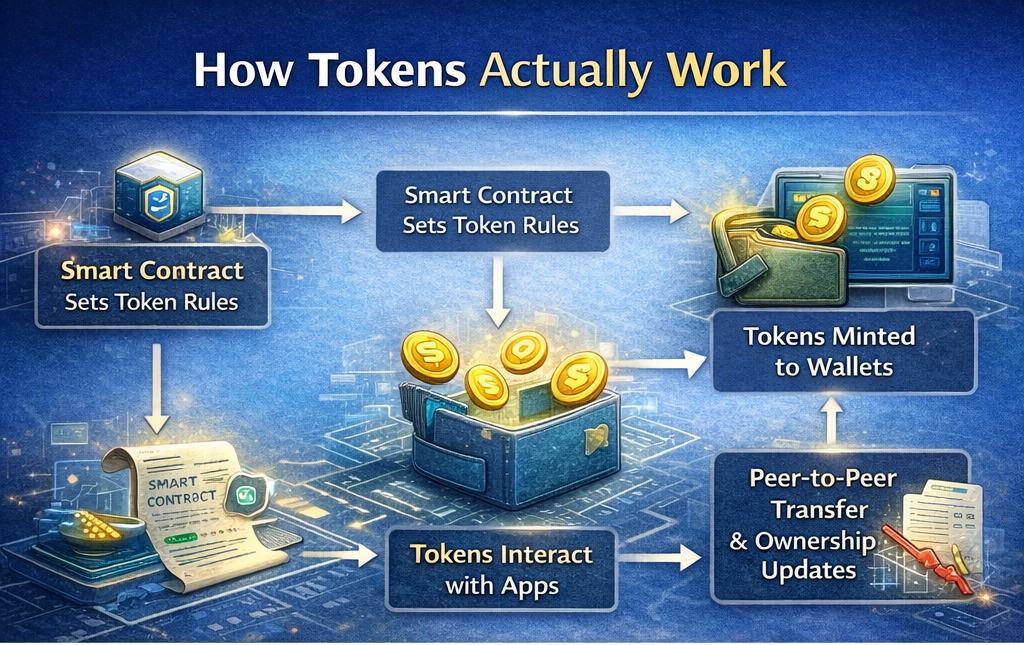
Once created, tokens:
- Can’t be duplicated
- Can be transferred peer-to-peer
- Can interact with apps automatically
That automation is what removes middlemen.
Why Smart Contracts Matter for Tokens
Smart contracts are the engine behind tokens.
They allow:
- Automatic transfers
- Built-in rules (like limits or permissions)
- Royalties and rewards
- Voting and governance
- Lending and staking
Instead of trusting people, systems trust code.
How People Get Tokens
There are several ways people usually acquire tokens:
- Buying them on exchanges
- Earning them by using platforms
- Receiving them through rewards or airdrops
- Participating in fundraising rounds
- Providing services like validation or liquidity
Once you have tokens, you can:
- Hold them
- Trade them
- Use them inside apps
- Vote or stake them
Risks You Should Know About
Tokens aren’t magic. They come with risks.
Some common ones:
- Scams pretending to be legit projects
- Poorly written smart contracts
- Extreme price volatility
- Regulatory uncertainty
- Projects that disappear
A good rule:
If you don’t understand what the token does, be careful.
Why Tokens Matter for the Future
Tokens are changing how value moves online.
They’re already being explored in:
- Finance
- Gaming
- Art and media
- Identity systems
- Supply chains
- Online communities
Instead of just reading or watching online, users can now own, vote, earn, and participate.
That’s a big shift.
The Big Picture
At the end of the day, a token is just a tool, but a powerful one.
- In AI, tokens build understanding
- In software, tokens build logic
- In security, tokens build trust
- In blockchain, tokens build economies
They’re small, flexible units that make large digital systems possible.
 Stay Ahead in Crypto