English
  Nederlands
  Deutsch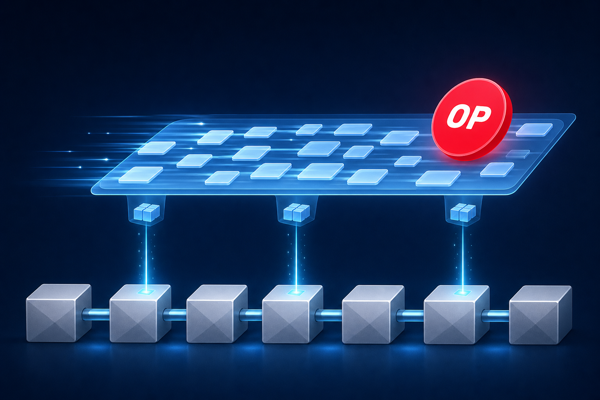

Key Takeaways
- Optimism is an Ethereum Layer 2 that uses optimistic rollups to cut gas fees and speed up transactions while inheriting Ethereum’s security.
- The OP token governs the Optimism Collective through a two-tier system (Token House and Citizens’ House) and funds the Superchain ecosystem.
- The OP Stack is an open-source framework powering a growing Superchain of L2s, including Coinbase’s Base and several other production chains.
In This Article
Optimism is a Layer 2 (L2) scaling solution built on top of Ethereum that dramatically reduces transaction costs and speeds up processing times without compromising Ethereum’s core security. Designed with developers in mind, Optimism maintains full compatibility with the Ethereum Virtual Machine (EVM), allowing Ethereum-based applications to migrate with minimal changes.
As Ethereum’s network traffic increases, so do its gas fees and congestion. Optimism solves this by executing transactions off-chain while posting compressed data back to the Ethereum mainnet. It uses a mechanism known as optimistic rollups, which assumes transactions are valid unless proven otherwise. This approach delivers faster speeds, lower costs, and a smoother experience for users and developers alike.
How Optimism Works
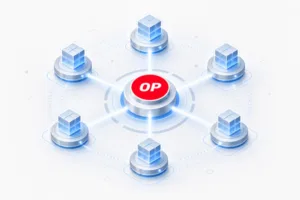
At its core, Optimism uses optimistic rollup technology, a system that executes many transactions on a separate chain (Layer 2), then batches them together and posts the results to Ethereum (Layer 1).
- Transactions happen off-chain, reducing pressure on Ethereum.
 Data is compressed and submitted back to Ethereum’s mainnet.
- Fraud proofs allow users to challenge invalid transactions during a 7-day window.
- Ethereum secures the system, maintaining decentralization and trust.
 Data is compressed and submitted back to Ethereum’s mainnet.
Unlike traditional blockchains, where each transaction must be validated individually, Optimism’s approach assumes all transactions are legitimate unless someone proves otherwise. This assumption dramatically improves speed and efficiency.
Key Features and Benefits
Optimism is built for scalability and usability. It offers several distinct benefits that make it a powerful alternative for Ethereum users:
- Far lower fees than Ethereum mainnet, often by a factor of 10 to 100.
- Transaction finality on L2 within seconds.
- Fully compatible with Ethereum tools, languages, and apps.
- Open-source and modular, ideal for developers.
- Uses Ethereum’s security model for maximum reliability.
This combination of speed, cost-efficiency, and Ethereum alignment has made Optimism one of the leading L2 networks.
Governance and the OP Token
 Governance and the OP Token
Optimism uses the OP token as a governance token. Token holders play an active role in shaping the future of the ecosystem by voting on decisions via the Optimism Collective, a two-tier governance system.
- Token House handles technical proposals and protocol upgrades.
- Citizens’ House focuses on public goods and ecosystem development.
A key initiative supported by the OP token is Retroactive Public Goods Funding (RetroPGF), which rewards projects that deliver positive impact to the ecosystem after the fact, rather than relying on upfront promises.
Optimism Ecosystem and TVL
Optimism has grown into one of the most active L2 ecosystems, with hundreds of applications spanning DeFi, NFTs, bridges, wallets, and infrastructure. While exact total value locked (TVL) figures shift with market conditions, Optimism consistently ranks among the top Ethereum L2s.
- Among the largest L2 ecosystems by TVL.
- Hundreds of active apps across DeFi, NFTs, bridges, wallets, and infrastructure.
- Supported by major protocols like Uniswap, Aave, Velodrome, and Stargate.
- Powers a growing Superchain of OP Stack chains, including Coinbase’s Base.
Its most significant competitors include Arbitrum and Polygon, but Optimism continues to gain ground due to its strategic partnerships and developer-centric approach.
Optimism vs Arbitrum
 Optimism vs Arbitrum
Optimism and Arbitrum are the two leading optimistic-rollup L2s on Ethereum. They share the same core security model but differ in governance, ecosystem strategy, and developer focus.
| Aspect | Optimism | Arbitrum |
|---|---|---|
| Rollup type | Optimistic rollup | Optimistic rollup |
| Governance token | OP | ARB |
| Ecosystem strategy | Superchain of OP Stack chains (Base, Mode, Zora, others) | Arbitrum Orbit chains and Arbitrum Nova for gaming/social |
| Developer language | Solidity (EVM-equivalent) | Solidity, plus Stylus for Rust, C, and C++ |
| Challenge window | 7 days | 7 days |
| Public goods focus | RetroPGF funding rounds | Arbitrum DAO grants |
The two networks have grown side by side, and many DeFi protocols deploy on both. For an end user, the choice often comes down to which chain a favorite dApp is on, rather than deep technical differences.
The OP Stack and Superchain Vision
Optimism is not just a single L2 solution; it is the foundation of a broader vision called the Superchain. The Superchain is a collection of OP-based chains (OP Chains) that share core infrastructure and standards.
- OP Stack: a modular, open-source framework for building L2s.
- Base: Coinbase‘s L2 chain, built on the OP Stack.
- Other chains: Mode, Redstone, and Zora have also joined the Superchain.
 Base:
Base:  Other chains: Mode,
 This interoperable network design allows each chain to innovate independently while benefiting from shared tools, infrastructure, and liquidity.
Major Updates: Bedrock and Beyond
The Bedrock upgrade, deployed in June 2023, was a critical evolution for the Optimism network. It introduced several important changes:
- Roughly 40% lower data publishing costs.
- Faster deposit confirmation times, often under 10 minutes.
- Support for multiple client software implementations.
- Improved modularity and reliability for developers.
Subsequent upgrades have continued to lower fees and improve interoperability across the Superchain, positioning Optimism as long-term infrastructure for Ethereum-based applications.
Using Optimism: Transactions and Bridges
To interact with Optimism, users need ETH on the Optimism network. This can be done through multiple methods:
- Bridge funds from Ethereum using the Optimism Bridge.
- Buy directly on a crypto exchange that supports the Optimism network for withdrawals.
- Transfer from another Optimism-compatible wallet.

Once connected, users can swap tokens, interact with DeFi platforms, mint NFTs, or engage with dApps, all at a fraction of mainnet fees.
For example, a small token swap that costs several dollars on Ethereum mainnet typically costs cents on Optimism, with confirmations in seconds rather than minutes.
Tokenomics of OP
The OP token is designed for long-term sustainability and community empowerment. Its total supply is capped at roughly 4.29 billion tokens, allocated as follows:
- 25% Ecosystem Fund.
- 20% RetroPGF for public goods.
- 19% for airdrops across multiple rounds.
- 19% for contributors.
- 17% for investors.
Circulating supply has grown steadily as scheduled unlocks reach the market. Live circulating and market data is tracked on the Optimism coin page.
Challenges and Risks
While Optimism offers significant benefits, users should be aware of potential challenges:
- 7-day withdrawal delays when moving funds back to Ethereum L1 through the native bridge.
- Reliance on a centralized sequencer, with decentralization still a work in progress.
- Competitive pressure from zk-rollups, which offer near-instant finality and growing adoption.
- Token unlock schedules can add sell pressure on OP over time.
Still, Optimism’s focus on open-source infrastructure, developer support, and Ethereum alignment gives it strong fundamentals for long-term relevance.
Bottom Line
Optimism is a production-ready Layer 2 that is reshaping Ethereum’s scalability. With optimistic rollups, open governance, and a growing Superchain of OP Stack chains, it delivers both performance and decentralization while staying aligned with Ethereum’s core values.
Whether you are a DeFi user, a developer, or a long-term investor, Optimism represents a meaningful step toward making blockchain technology faster, cheaper, and more accessible.
 Stay Ahead in Crypto