English
  Nederlands
  Deutsch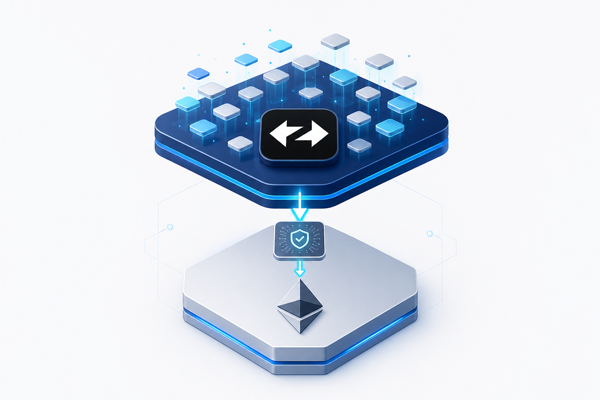

Key Takeaways
- zkSync is an Ethereum Layer 2 network that uses zero-knowledge (zk) rollups to bundle transactions off-chain and post a single cryptographic proof back to Ethereum.
- Validity proofs give zkSync near-instant finality and fast withdrawals, avoiding the multi-day challenge period that Optimistic Rollups rely on.
- The network has grown into the Elastic Network, a multi-chain system with its own ZK token for governance, fees, and incentives.
In This Article
- Why zkSync?
- Key Features of zkSync
- How zkSync Works
- From zkSync Era to Elastic Network
- zkSync Architecture & Components
- Security: Cryptographic vs. Economic
- Ecosystem Growth & Institutional Adoption
- ZK Token and Governance
- Developer Experience
- Zero-Knowledge Proofs, Simply Explained
- zkSync vs Optimistic Rollups
- Bottom Line
zkSync is a Layer 2 scaling solution built on Ethereum that uses zero-knowledge (ZK) rollups to make blockchain transactions faster, cheaper, and more scalable without compromising on security. Created by Matter Labs, zkSync tackles Ethereum’s biggest pain points: high gas fees, slow transaction speeds, and limited throughput, all while maintaining Ethereum’s decentralization and security model.
Why zkSync?
Ethereum is secure and decentralized, but it’s often congested. This leads to high fees and slow confirmations, especially during network spikes. As a Layer 2 network, zkSync offers a solution by processing transactions off-chain and posting compressed proofs back to the Ethereum mainnet, allowing Ethereum to scale while still being secure.
- zkRollups bundle thousands of transactions off-chain and send a single cryptographic proof to Ethereum.
- Security is preserved through cryptographic validity proofs (zk-SNARKs).
- zkSync supports Ethereum Virtual Machine (EVM) compatibility, meaning developers can build using familiar tools like Solidity.
Key Features of zkSync
zkSync has gone through major upgrades starting from zkSync Lite, to zkSync Era (formerly zkSync 2.0), and now the Elastic Network. Each upgrade brought new features and increased performance.
Some standout features include:
- Super low fees: As low as $0.0001 per transaction.
- Fast finality: Transactions can finalize in roughly 1 second thanks to zkSNARKs.
- High throughput: Thousands of transactions per second after the Atlas upgrade.
- Native account abstraction: Users can pay gas in any token, use FaceID or fingerprint logins, and enjoy a more app-like Web3 experience.
- EVM equivalence: Full compatibility with existing Ethereum smart contracts, with options for better gas optimization via the native EraVM.
- Open source: Full open-source code under MIT and Apache 2.0 licenses.
How zkSync Works
At its core, zkSync works through zk-Rollups, which are a type of Layer 2 solution. Here is how it works:
- Users submit transactions on zkSync (like sending ETH, minting NFTs, or interacting with dApps).
- zkSync processes and batches these transactions off-chain.
- It then generates a validity proof using a cryptographic algorithm called a zkSNARK.
- This proof is sent back to Ethereum Layer 1, where it is verified by a smart contract.
- Once verified, Ethereum updates its state, confirming all the included transactions at once.

Unlike Optimistic Rollups (which assume transactions are valid until proven fraudulent), zkSync proves everything up front, offering instant finality and better security.
From zkSync Era to Elastic Network
In 2023, zkSync rebranded its second major version to zkSync Era, which was the first zkEVM (a ZK-rollup compatible with Ethereum smart contracts). In 2024, zkSync took a huge leap forward by transforming into the Elastic Network.
The Elastic Network is a modular, multi-chain system where developers can launch their own ZK chains (using the ZK Stack) that are:
- Interoperable with each other at the protocol level.
- Able to share security and liquidity.
- Designed to feel like a single chain to end users.
This solves one of blockchain’s biggest problems: liquidity fragmentation. Assets and dApps can move easily between zkSync-based chains without relying on slow or insecure bridges.
zkSync Architecture & Components
- Node implementation: Manages Layer 2 state and transaction batching.
- ZK circuits: Mathematical logic used to verify transactions.
- Prover: Generates zkSNARKs to prove the validity of transactions.
- Smart contracts on Ethereum: Verify proofs and update Layer 1 state.
All assets remain secured by Ethereum smart contracts, meaning zkSync inherits Ethereum’s base layer security.
Security: Cryptographic vs. Economic
Unlike Optimistic Rollups that rely on fraud proofs and week-long dispute periods, zkSync uses cryptographic validity proofs to verify transactions with mathematical certainty. This means:
- Faster withdrawals (minutes to hours, not 7 days).
- No need for challenge periods or third-party watchers.
- Safer bridging between Layer 2 chains.
Ecosystem Growth & Institutional Adoption
zkSync has grown far beyond just a scaling solution. Its ecosystem now supports hundreds of projects, including DeFi, NFTs, wallets, gaming, and enterprise tools.
Notable partners and use cases include:
- Deutsche Bank: Building regulated fund issuance on zkSync.
- UBS: Exploring tokenized gold with zkSync Validium.
- Tradable: $2.1B in tokenized private credit on zkSync.
- SyncSwap: One of zkSync’s leading DEXs with capital-efficient liquidity pools.
- ZeroLend: A top lending protocol with its own insurance fund.
- GRVT (Gravity): A high-speed Layer 3 trading platform with 600k TPS potential.
ZK Token and Governance
The ZK token was launched in June 2024, with an initial airdrop to nearly 700,000 wallets. It is used for governance, network fees, and soon, staking and economic incentives.
Governance is managed by ZK Nation with a unique three-body model:
- Token Assembly: Votes on upgrades, funding, and token distribution.
- Security Council: Handles urgent or security-critical situations.
- Guardians: Ensure the protocol operates within its intended scope.
A recent proposal aims to use network revenue to buy back, burn, and reward ZK token holders, giving it real economic value beyond governance.
Developer Experience
zkSync makes it easy for developers to build on Layer 2 with familiar tools:
- Solidity support and reusable smart contracts.
- zkSync CLI, SDKs, and developer docs.
- Native support for account abstraction, enabling custom wallets and payment flows.
- ZK Stack lets teams build custom ZK rollup or Validium chains with shared infrastructure.
Zero-Knowledge Proofs, Simply Explained
Think of a zero-knowledge proof like showing someone you know the answer to a puzzle without revealing the answer itself. zkSync uses these cryptographic proofs to verify that all batched transactions are valid without revealing all transaction data or re-running computations.
zkSync vs Optimistic Rollups
zkSync is a ZK-rollup, while networks like Arbitrum and Optimism are Optimistic Rollups. Both scale Ethereum, but they prove transactions in very different ways:
| Feature | zkSync (ZK-Rollup) | Optimistic Rollups (Arbitrum, Optimism) |
|---|---|---|
| Proof type | Validity proofs (zkSNARKs) | Fraud proofs (optimistic) |
| Withdrawal time | Minutes to hours | Around a 7-day challenge period |
| Security model | Cryptographic certainty | Economic: valid unless challenged |
| EVM support | zkEVM (EVM equivalence) | Full EVM compatibility |
| Best suited for | Fast finality and secure bridging | Mature tooling and broad ecosystems |
Bottom Line
zkSync is no longer just a “scaling solution.” It is becoming Ethereum’s multi-chain backbone, combining Web2-level speed and UX with Web3-level security and decentralization. With features like 1-second finality, gasless transactions, and enterprise-grade privacy, zkSync is paving the way for real-world, mainstream blockchain adoption.
 Stay Ahead in Crypto