 English
  Nederlands
  Deutsch


So, you’ve probably heard the term “arbitrage” thrown around in the world of trading, but what does it actually mean? Simply put, arbitrage trading is all about spotting and capitalizing on price differences of the same asset in different markets. Think of it like a smart shopper who finds a great deal at one store and flips it for a higher price at another.
In the world of crypto, it’s pretty much the same thing, except instead of buying a vintage watch, you’re buying something like Bitcoin or Ethereum. You spot a price gap on two different exchanges, buy low on one, and sell high on the other. The key here is that these price differences don’t last long. They disappear almost as quickly as they appear, making speed the secret weapon.
The Basics of Arbitrage Trading
At its core, arbitrage trading is about taking advantage of price discrepancies. When the same asset, like Bitcoin, Ethereum, or any altcoin, is priced differently on different exchanges, an arbitrage opportunity arises. Here’s how it works in simple terms:
- Buy low in one market (exchange).
- Sell high in another market (exchange).
Sounds easy, right? Well, it can be, but the trick is finding the right opportunities and acting on them before someone else does. The price difference might only last a few seconds, so it’s a race against time.
Example: Crypto Arbitrage in Action
Imagine Bitcoin is trading for $89,000 on Binance but $89,200 on Coinbase. A savvy trader can buy Bitcoin on Binance for $89,000 and immediately sell it on Coinbase for $89,200, making a $200 profit for each Bitcoin. If you’re trading in high volume, that small difference could add up quickly!
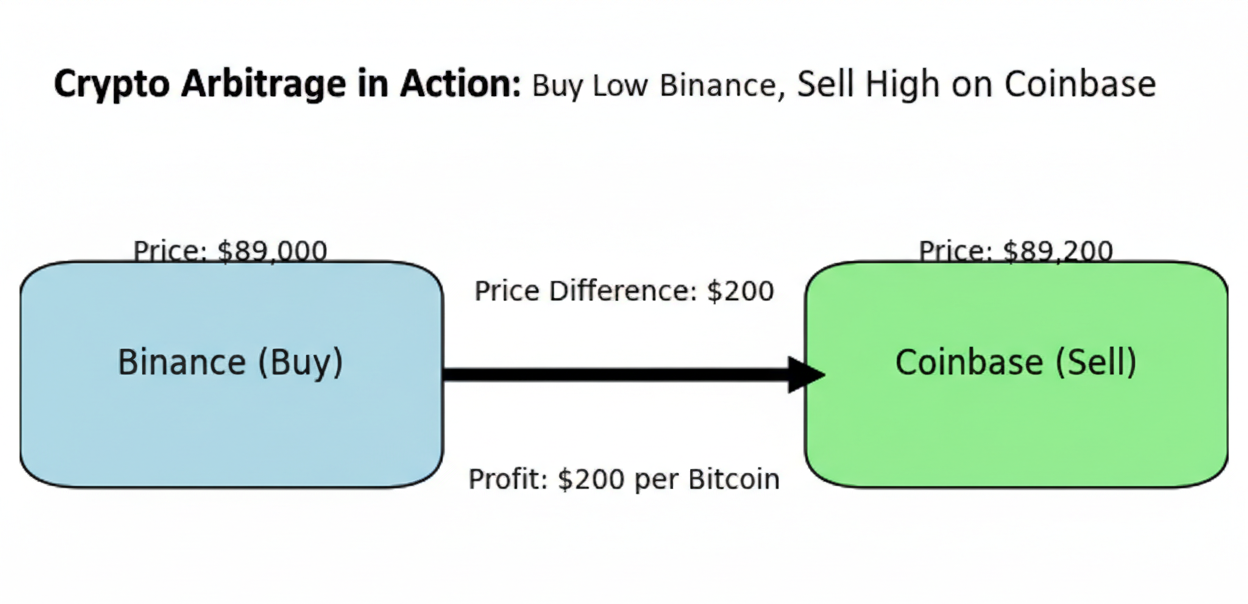
The catch? The market moves fast. This $200 gap might close in a matter of seconds, which means the trader needs to be quick to lock in that profit before the market catches up and adjusts the prices.
Why Does Arbitrage Happen in Crypto?
Great question. If we’re talking about perfectly efficient markets, arbitrage wouldn’t exist. But guess what? Crypto markets are anything but perfect. Here are some reasons why price discrepancies happen:
- Different Exchange Liquidity: Not all exchanges have the same volume of traders or the same liquidity, which can lead to price differences. A low-volume exchange might list Bitcoin a little cheaper or more expensive than a higher-volume exchange.
- Global Time Zones: Crypto is a 24/7 market, but different exchanges are based in different parts of the world. So, while one exchange might have just reacted to some news, another might still be catching up.
- Market Inefficiencies: Sometimes, prices just don’t match up due to market inefficiencies. These inefficiencies could be because of things like sudden demand spikes or delays in price updates across platforms.
How Do Arbitrage Traders Spot Opportunities?
Arbitrage traders don’t just randomly guess where the price discrepancies will appear. They use tools and sometimes algorithms to spot these opportunities. Some traders build automated bots that monitor multiple exchanges for price differences and execute trades within milliseconds. Others may just manually track prices using charts or alerts. But one thing’s for sure: you need to be quick and have access to real-time data.
Here’s a step-by-step of how it typically goes:
- Scan Exchanges: The trader looks at two or more exchanges where the asset (like Bitcoin) is traded. They monitor the prices for discrepancies.
- Identify a Gap: Once a price difference appears, the trader quickly checks if it’s enough to cover transaction fees and make a profit.
- Execute the Trade: The trader buys low on one exchange and sells high on the other, completing the arbitrage trade before the prices converge.
It’s like spotting a sale on one exchange and flipping that sale to make a profit on another exchange fast!
The Risks of Arbitrage Trading in Crypto
If it sounds too good to be true, it’s because arbitrage isn’t risk-free. While the concept is to lock in a risk-free profit, the reality is a bit more complicated. Here are some of the risks involved:
- Execution Risk: As mentioned earlier, prices can change in the blink of an eye. Even if you spot a price discrepancy, if you don’t act quickly enough, the opportunity may be gone before you can execute the trade.
- Transaction Fees: Each exchange has its own set of transaction fees, withdrawal fees, and network fees. These can eat into your profits if they’re too high. Always calculate the fees before pulling the trigger on a trade.
- Liquidity Risk: If an exchange doesn’t have enough liquidity (meaning there aren’t enough buy or sell orders), you might not be able to trade at the price you want, leading to slippage (a less-than-ideal price).
- Regulatory Risk: Regulations around crypto are constantly evolving. Sometimes, exchanges may impose restrictions, or certain countries may block access to specific exchanges. These changes can affect your ability to complete arbitrage trades.
Examples of Different Types of Arbitrage in Crypto
There are different ways to approach arbitrage trading, and depending on your experience and trading style, you might choose one over the other.
1. Spatial Arbitrage
This is the most basic form of arbitrage. It involves buying and selling the same asset (e.g., Bitcoin) across different exchanges to profit from the price discrepancy. This is the classic “buy low, sell high” scenario.
Example: Let’s say Bitcoin is priced at $90,000 on Binance and $90,100 on Coinbase. The trader buys on Binance and sells on Coinbase, pocketing the $100 difference.
2. Triangular Arbitrage
This is a bit more complicated but can yield bigger profits, especially in the crypto world. It involves three different assets. You convert one currency into another, then into a third, and back to the first one, exploiting price discrepancies along the way.
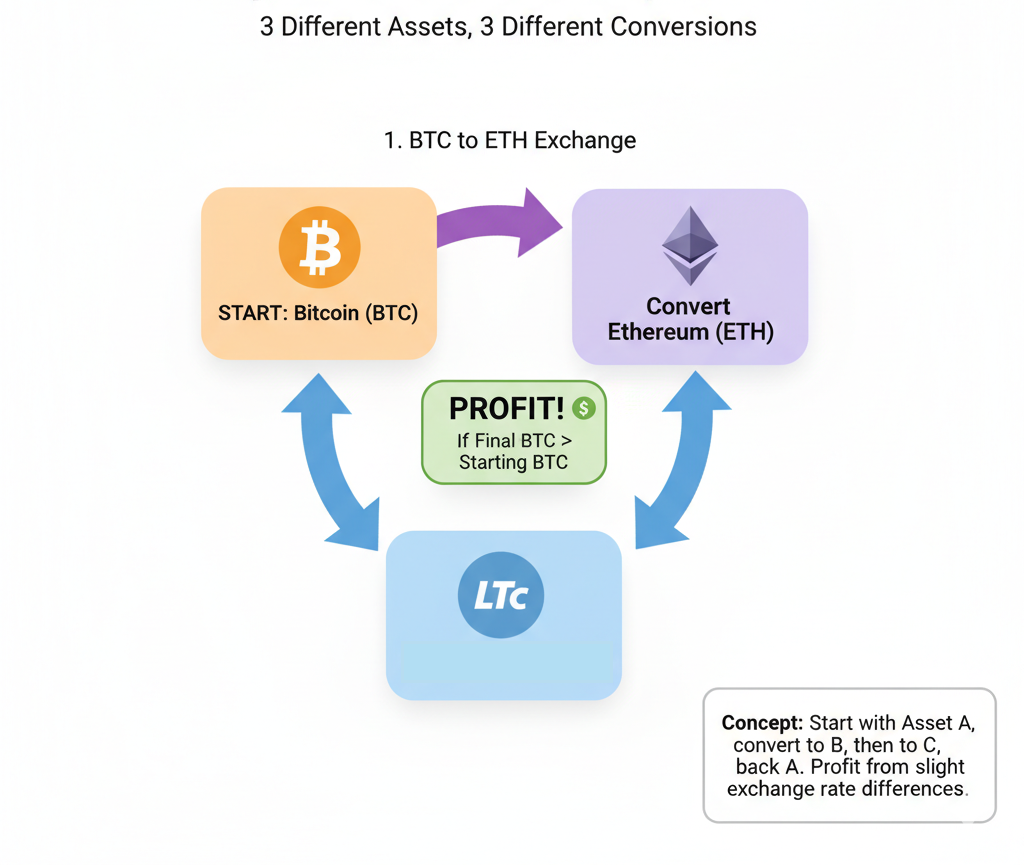
Example: A trader can start with Bitcoin, convert it to Ethereum on one exchange, then Ethereum to Litecoin on another, and finally, Litecoin back to Bitcoin. If the exchange rates don’t perfectly match up, the trader can profit from the differences.
3. Cross-Border Arbitrage
Crypto markets are global, and sometimes regulations or demand can create price differences in different regions. Cross-border arbitrage takes advantage of these regional price gaps.
Example: Bitcoin may be trading for $90,000 in one country but $90,500 in another due to local demand or market conditions. A trader buys Bitcoin in the country where it’s cheaper and sells it in the higher-priced market, profiting from the difference.
The Role of Technology in Arbitrage Trading
In today’s world, technology plays a huge role in arbitrage. High-frequency trading algorithms and bots can scan multiple exchanges in real-time, executing trades in milliseconds. This gives institutional traders a massive advantage over individual traders. But don’t worry, there are still plenty of opportunities for retail traders, especially if you have the right tools in place.
If you’re serious about arbitrage, using automated tools or bots can help you act faster and spot opportunities that would be impossible to catch manually.
Is Arbitrage Trading Worth It?
Arbitrage trading in crypto can be an exciting way to make profits, but it’s not as simple as it sounds. The opportunities are real, but they require speed, precision, and a bit of luck. With the right knowledge and tools, however, anyone can dive into arbitrage trading. Just remember to start small, track fees, and stay on top of market trends. The crypto market moves fast, but if you stay ahead of the curve, you could find yourself making profitable trades with arbitrage.
 Stay Ahead in Crypto