English
  Nederlands
  Deutsch


Key Takeaways
- Quantum computers could one day break the public-key cryptography that secures crypto wallets and transactions, using Shor’s algorithm to derive private keys from public keys.
- The threat is not immediate: today’s machines lack the stable, error-corrected qubits needed, and most researchers estimate a real risk is still years away.
- Developers are already preparing with post-quantum cryptography, hybrid systems, and quantum-safe address formats, so networks can migrate before the threat matures.
In This Article
As cryptocurrencies like Bitcoin and Ethereum continue to change the financial world, a new technology is emerging that could threaten their very foundation: quantum computing. Quantum computers are still in their early stages, but they have the potential to completely disrupt the way we secure digital currencies.
If you have ever wondered how quantum computing could affect crypto, you are not alone. This guide breaks down the risk, how close it really is, and what the industry is already doing about it.
What Exactly Is Quantum Computing?
To understand how quantum computing could impact crypto, we first need to know what it is. Regular computers, the kind we use every day, process data in bits that are either 0 or 1. Quantum computers use quantum bits, or qubits, which can exist in multiple states at once thanks to superposition. This makes quantum computers incredibly powerful at solving certain complex problems, especially ones that would take classical computers millions of years to crack.
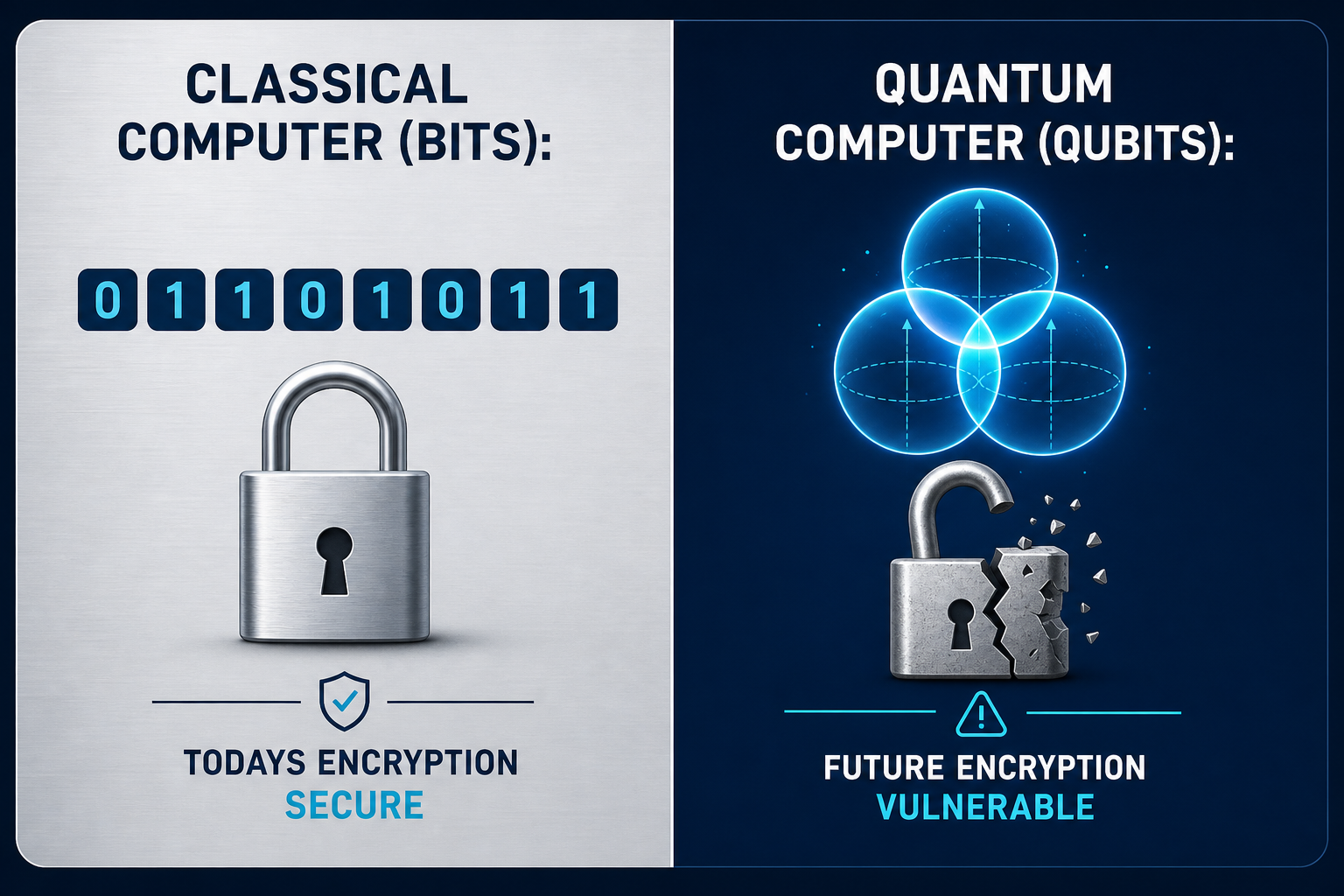
For example, a regular computer might need a very long time to break a large number down into its factors. Quantum computers, however, can tackle these large numbers much faster using algorithms like Shor’s algorithm. Why does this matter? Because many of the encryption methods that secure cryptocurrencies today rely on math problems that are extremely hard for classical computers to solve, but far easier for a powerful quantum computer.
How Quantum Computers Could Threaten Cryptocurrencies
Cryptocurrencies rely on complex cryptographic methods to protect transactions and wallets. These methods are hard to crack with traditional computers, but a powerful quantum computer could undermine them. Here is how:
- Breaking public-key encryption: When you make a transaction, your private key signs it and your public key verifies it. The system assumes nobody can work out the private key from the public one. Shor’s algorithm changes that, factoring the large numbers behind schemes like RSA and ECDSA fast enough to expose a private key from a visible public key, which could let an attacker drain a wallet.
- Forging digital signatures: Every blockchain confirms transactions with cryptographic signatures created from a private key. A quantum computer could forge these signatures, faking transactions or rewriting the ledger and shaking the trust the network depends on.
- Harvest now, decrypt later: Even before quantum computers are powerful enough, attackers can store encrypted data today and decrypt it once the hardware catches up. Transaction data intercepted now could be unlocked years from now, and the funds behind it stolen.
Not every part of crypto is equally exposed. The table below shows which building blocks are most at risk and how the industry plans to defend each one:
| Cryptographic element | How quantum could break it | Quantum-safe fix |
|---|---|---|
| Public-key encryption (RSA, ECDSA) | Shor’s algorithm derives the private key from the public key | Lattice-based post-quantum cryptography |
| Digital signatures | Forged signatures fake transactions and rewrite history | Hash-based signature schemes |
| Hash functions (SHA-256) | Grover’s algorithm roughly halves the effective security | Larger hash outputs (mining stays relatively safe) |
Current Quantum Computing Power vs. Crypto
So how close are we to quantum computers that can actually crack cryptocurrency encryption? The technology is not there yet. Today’s largest machines have crossed 1,000 physical qubits (IBM’s Condor chip reached 1,121 qubits in 2023), but those qubits are noisy and error-prone. What matters for breaking crypto is the number of stable, error-corrected logical qubits, and on that measure researchers are still a long way behind.
To break the encryption used in crypto, a machine would likely need thousands of stable logical qubits, which in turn could require millions of physical qubits. Most researchers estimate that is still 5 to 15 years away. This does not mean we can relax: progress is fast, and in late 2024 Google’s Willow chip showed that error rates can fall as more qubits are added, a milestone that suggests the timeline could shorten.
What’s at Stake?
Let’s look at some specifics to grasp what is at risk. Bitcoin, for example, uses the Elliptic Curve Digital Signature Algorithm (ECDSA) for transaction verification. The strength of this scheme rests on the elliptic curve discrete logarithm problem (ECDLP) being computationally tough. But quantum computers, able to perform certain calculations exponentially faster, could in theory solve this problem quickly.
Here is a quick look at what a powerful quantum computer could potentially do:
- Breaking Bitcoin’s ECDSA: Bitcoin’s security currently relies on a 256-bit key. If a quantum computer can run Shor’s algorithm, it could reduce that 256-bit key’s security to roughly 128 bits, which is still tough but no longer out of reach with enough computing power.
- Exposed Bitcoin addresses: Older Bitcoin addresses (such as Pay-to-PubKey, or P2PK) reveal the public key directly. That makes them especially vulnerable, because a quantum computer could use Shor’s algorithm to find the private key and steal the coins. Estimates suggest about 2 million Bitcoins, worth hundreds of billions of dollars at today’s prices, could be exposed if a powerful quantum computer existed right now.
What’s Being Done to Protect Crypto?
The good news is that the crypto world is not sitting idle. Developers and researchers are preparing for the day quantum computers can break today’s encryption in several ways:
- Post-quantum cryptography (PQC): The aim is to replace current encryption with quantum-resistant algorithms. In August 2024, the National Institute of Standards and Technology (NIST) finalized its first post-quantum standards (ML-KEM, ML-DSA, and SLH-DSA), giving developers vetted, lattice-based and hash-based schemes to adopt.
- Hybrid systems: Some projects combine traditional cryptography with quantum-resistant algorithms, allowing a smoother transition to a quantum-safe future without disrupting current users.
- Quantum-safe addresses: Networks like Bitcoin are upgrading wallet formats to resist quantum threats. Addresses that hide the public key (such as Pay-to-PubKeyHash, or P2PKH) are safer than older ones that expose the public key directly.
- Quantum key distribution (QKD): This uses the principles of quantum mechanics to exchange keys in a way that is secure against eavesdropping. It is still early, but QKD could eventually create near-unbreakable encryption channels.
The Future of Crypto in a Quantum World
It is clear that quantum computing poses a serious long-term threat to cryptocurrencies, but it is not all doom and gloom. As quantum technology advances, the crypto world is evolving to stay ahead. There is still time to prepare, and it matters that both developers and users stay aware of the risks.
In the end, quantum computing is a reminder of how important security is in the digital age. Cryptocurrencies rely on complex cryptography to keep their networks safe, and as quantum computers get better at solving these problems, new defenses will keep being developed.
As users and investors, the key is to stay informed and be ready to adapt as quantum-safe solutions become available. The road to a quantum-safe crypto world may be long, but it is one worth traveling.
 Stay Ahead in Crypto