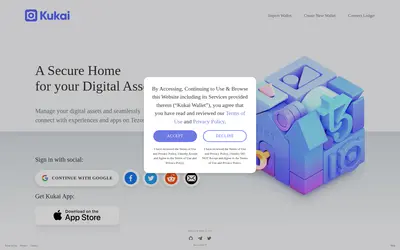
Kukai is an open-source, non-custodial web wallet for the Tezos ecosystem, launched in 2018. The wallet runs in the browser at wallet.kukai.app. Because it is non-custodial, private keys never leave the user’s device and the Kukai team has no access to funds. The source code is published on GitHub under the kukai-wallet organisation and has been independently audited by Least Authority.
Kukai supports the full range of Tezos (XTZ) functionality including transfers, delegation to bakers for staking rewards, and management of FA1.2 and FA2 tokens. NFT collections held across Tezos marketplaces such as objkt and fxhash are displayed natively inside the wallet, with the ability to send and receive them directly. Connections to decentralised applications are handled through the Beacon SDK, the standard wallet-to-dApp protocol on Tezos, giving access to DeFi platforms, NFT marketplaces, and on-chain games without requiring a browser extension.
A defining feature of Kukai is its Direct Auth onboarding, which lets users create or restore a Tezos account using social logins including Google, Reddit, and Twitter. Direct Auth is built on threshold cryptography (the approach used by Web3Auth), distributing the private key across multiple nodes so no single party can reconstruct it alone. This provides the convenience of social sign-in while keeping the wallet fully non-custodial. Hardware wallet users can connect a Ledger device, and private keys can be imported or exported for compatibility with other Tezos wallets.
Kukai also supports Etherlink, the EVM-compatible Layer 2 network built on Tezos Smart Rollups. Through the Etherlink integration, users can manage EVM-compatible assets and interact with Solidity-based applications from the same interface used for native Tezos accounts. Supported assets include XTZ and FA2 tokens on Tezos mainnet, plus ERC-20 tokens and other EVM assets on Etherlink.
 English
  Nederlands
  Deutsch

 Stay Ahead in Crypto



 Stay Ahead in Crypto