 English
  Nederlands
  Deutsch

Imagine the internet as a story unfolding across three big chapters.
In the first chapter, people mostly visited websites to read information. In the second phase, social platforms took over, and everyone started creating content; however, a few big companies quietly gained control over most of our data. Now, a new chapter is being written, and many people refer to it as Web3.
Web3 isn’t a single app, product, or company. Instead, it’s an idea for a different kind of internet, one where users own their digital stuff, communities help run platforms, and data doesn’t live on just one company server, but across many computers working together.
It’s still being built, but the vision behind it is changing how people think about identity, money, creativity, and online communities.
How the web evolved
Understanding Web3 makes more sense when viewed alongside earlier internet eras.
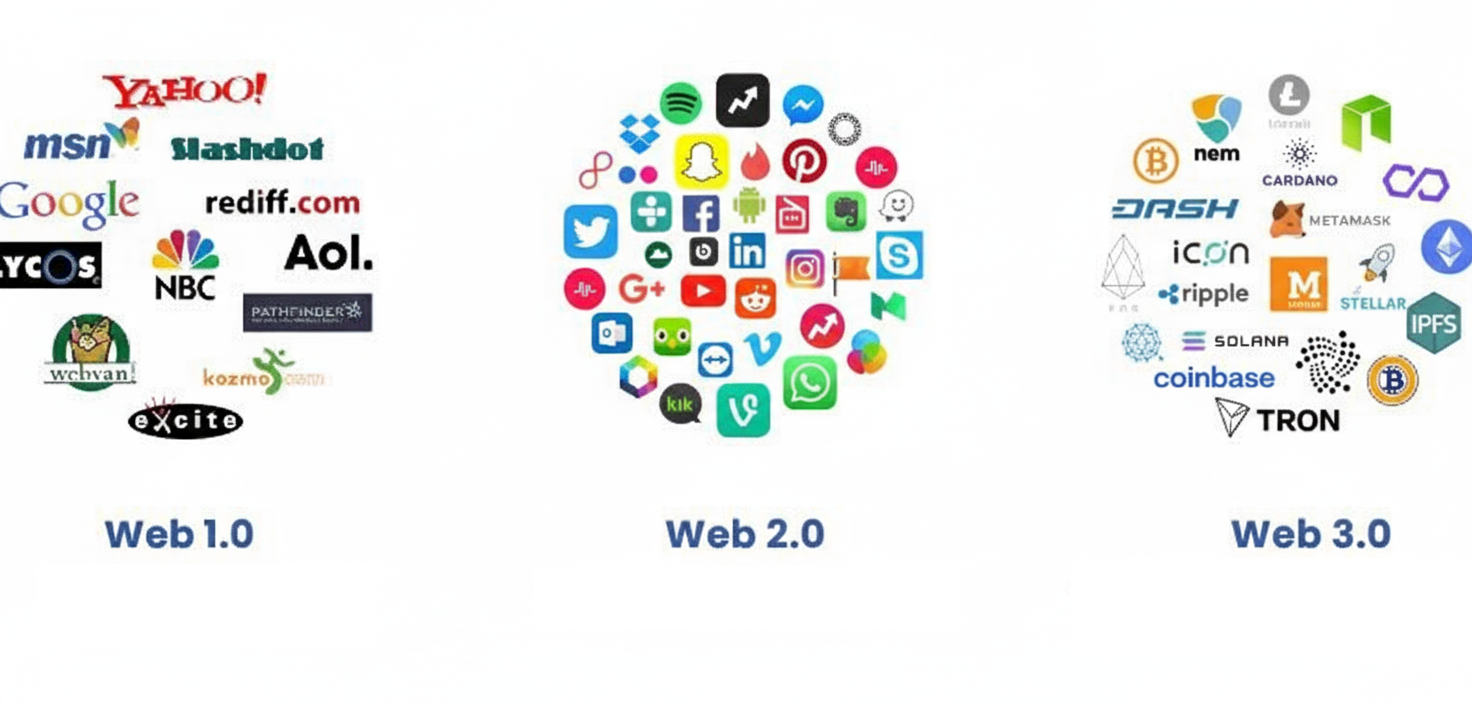
Web 1.0 The Static Web (1991–2004)
The early internet was mostly read-only. Websites displayed information, but users rarely interacted beyond browsing.
- Static pages
- Limited user participation
- Early search, email, and simple publishing tools
Think early Yahoo pages, forums, and basic company websites.
Web 2.0 The Platform Web (2004–Present)
The internet became social, interactive, and application-driven.
- Social networks and content sharing
- Cloud platforms and mobile apps
- User data controlled by companies
Major examples include:
- Facebook / Meta
- Google & YouTube
- Twitter / X
- Amazon
- TikTok
These platforms allowed people to create and share content but also centralized control, advertising, and data ownership.
Web3 The Decentralized Web (Emerging)
Web3 shifts control away from platforms and toward users and networks.
- Data stored across distributed nodes
- Digital wallets replace platform logins
- Tokens enable community ownership and governance
Development is ongoing, but adoption is growing across finance, gaming, identity, and digital economies.
Core principles of Web3
Web3 is guided by several foundational ideas designed to rethink how online systems are built and managed.
Decentralized data storage
Instead of storing information on a single company server, data is distributed across independent nodes. This reduces single-point failures and makes records publicly verifiable.
Technologies supporting this include:
- Blockchain networks
- Distributed ledgers
- Decentralized storage systems (such as IPFS)
This model allows multiple parties to access the same record without requiring a central authority.
User-controlled identity and assets
In Web2, users log in through accounts controlled by platforms.
In Web3, identity is tied to a digital wallet that stores:
- cryptocurrencies
- NFTs
- identity credentials
- governance tokens
Users keep ownership even when switching platforms.
Popular wallet providers include:
This creates portability instead of platform lock-in.
Trustless and permissionless participation
Web3 systems rely on mathematical verification rather than institutional trust.
- Networks validate transactions collectively
- Smart contracts execute rules automatically
- Participation does not require approval from a gatekeeper
This allows peer-to-peer interaction across financial, social, and digital environments.
Key technologies behind Web3
Web3 is powered by several technologies working together rather than a single system.
Blockchain networks
A blockchain records transactions in permanent, time-ordered blocks shared across a network. Once verified, entries cannot be altered without consensus.
Widely-used blockchains include:
These systems enable transparent public record-keeping.
Smart contracts
Smart contracts are programs stored on the blockchain that execute automatically when conditions are met.
They power:
- decentralized exchanges
- on-chain voting
- automated financial systems
- NFT marketplaces
Real-world examples include:
These remove reliance on centralized intermediaries.
Token-based systems
Tokens can represent:
- ownership
- access rights
- governance votes
- network participation
Some ecosystems distribute tokens to contributors rather than shareholders, allowing communities to influence development.
Well-known token ecosystems include:
- Ethereum (ETH)
- Solana (SOL)
- Chainlink (LINK)
- Uniswap (UNI)
This structure supports collaborative, user-driven networks.
Where Web3 is used today
Although Web3 remains early-stage, several sectors are actively building with it.
Decentralized finance (DeFi)
DeFi replicates financial tools without banks or brokers.
Examples include:
- lending platforms
- decentralized exchanges
- stablecoin systems
- yield markets
Notable platforms:
At several points, daily DeFi trading volume has exceeded $10 billion, demonstrating significant market participation.
Digital ownership & NFTs
NFTs allow unique digital items to be owned, transferred, and authenticated.
Used in:
- digital art
- gaming assets
- music rights
- collectibles
Companies experimenting in this space include:
- Nike (NFT sneakers and digital wearables)
- Starbucks (loyalty collectibles)
- Reddit (avatar collectibles)
These projects test new creator-economy revenue models.
Decentralized identity
Web3 identity systems aim to give users greater control over personal data.
Applications include:
- login credentials
- proof-of-personhood
- selective identity sharing
Projects working in this space include:
- Worldcoin
- Polygon ID
- ENS (Ethereum Name Service)
These tools reduce reliance on centralized authentication providers.
Advantages associated with Web3
Supporters believe Web3 provides several meaningful benefits.
- Users own their data instead of platforms
- Assets remain portable across applications
- Transactions are transparent and verifiable
- Communities can participate in governance
It may also support new economic participation models, especially in creator and community-driven ecosystems.
Challenges and real-world constraints
Despite its potential, Web3 faces significant obstacles.
Scalability & performance
Some blockchains struggle with:
- high transaction costs during congestion
- limited throughput
- energy efficiency considerations
Layer-2 solutions and alternative networks work to improve this.
Usability barriers
Web3 tools can feel complex or unfamiliar for mainstream users.
Common friction points include:
- private-key security
- wallet recovery risks
- unclear platform interfaces
Improving accessibility remains a major development focus.
Regulatory uncertainty
Global policies around:
- digital assets
- token-based fundraising
- decentralized finance
are still evolving, impacting adoption and compliance design.
Centralization risks within ecosystems
Even decentralized networks may rely on:
- centralized infrastructure providers
- concentrated token ownership
- third-party development teams
This creates ongoing debate about what “true decentralization” means in practice.
Web3 developments by year
Here is a simplified milestone overview:
- 2009 — Bitcoin introduces decentralized ledger technology
- 2014 — Web3 term coined by Ethereum co-founder Gavin Wood
- 2015 — Ethereum launches smart contract platform
- 2017 — ICO boom accelerates token-based funding
- 2020 — DeFi activity expands across networks
- 2021 — NFT market and Web3 awareness surge
- 2023–2025 — Institutional adoption & Layer-2 scaling increase
Progress continues in waves rather than linear growth.
Current outlook
Web3 is not a replacement for the existing internet but a parallel ecosystem developing alongside it. Many applications combine Web2 usability with Web3 infrastructure, creating hybrid models that balance decentralization with practicality.
Adoption depends on:
- regulatory environments
- security maturity
- improved user experience
- real-world utility
For now, Web3 represents a technological shift still in motion, combining distributed networks, user ownership, and programmable digital economies into an evolving framework that will continue to change as new systems, platforms, and governance models develop.
 Stay Ahead in Crypto