English
  Nederlands
  Deutsch


Key Takeaways
- An airdrop is a free distribution of cryptocurrency tokens to multiple wallets, used as a marketing strategy or as a reward for early users of a protocol.
- The most valuable airdrops in crypto history rewarded early DeFi users retroactively with tokens worth thousands of dollars, with Uniswap and Arbitrum being the standout examples.
- Airdrops carry serious risks: scammers use fake airdrops to collect personal data, steal private keys, or trick you into signing a malicious transaction that drains your entire wallet.
In This Article
What is an airdrop?
An airdrop is a distribution of tokens or cryptocurrencies to a large number of wallets. The coins are usually given away for free to the participants. The name ‘airdrop’ originates from the Second World War, when troops, food and equipment were distributed from an airplane using a parachute. In crypto, the airdrop coins are dropped directly into the wallet of the receiver. Generally, they are tokens on an existing blockchain, but they can also be coins of a new blockchain. Airdrops can also be obtained through a hard fork, which is a split of an existing blockchain that creates a new coin. In the crypto community this is also referred to as an airdrop.What is the purpose of an airdrop?
There are many strategies behind the decision of developers to perform an airdrop. Developers have to allocate resources to successfully complete an airdrop, in time and often in money. Additionally, for the distribution of a token on a blockchain there are transaction costs to be paid. There are several reasons for doing an airdrop:#1 Marketing
The main reason to implement an airdrop is as part of a marketing strategy. An airdrop can provide brand awareness in the crypto community, where obtaining free coins is popular. Often there is also a referral program linked to the airdrop. Such a program allows participants to invite others to join via a personal link or code. In return, they receive more coins if someone signs up via their link. This can grow exponentially and increase awareness of the coin.#2 Collecting contact details
Conducting an airdrop allows developers to collect a large amount of contact information such as email addresses and social media accounts. These are very valuable as they connect the project with potential buyers and community members. This is especially useful if the team is planning to raise money later. Using standard advertising to promote a crypto project is difficult, as many platforms have restrictions against such promotions.#3 Network effect
The airdrop can also create a network effect. There is a relevant group of followers right from the start, who will promote the coin if they like the development and progress of the project. As soon as the coin has an official use case, many of the first participants are likely to be among this group, and a strong beginning can create immediate ripple effects.#4 Rewarding early users
One of the most important uses of airdrops in modern crypto is rewarding people who used a protocol before it had its own token. This is called a retroactive airdrop. Projects like Uniswap, Arbitrum and dYdX distributed tokens to early users as a way of giving them ownership in the protocol they helped grow. These have been some of the most valuable airdrops in crypto history.What types of airdrops are there?
#1 Unsolicited airdrop
These just appear in the participants’ wallets without any action required. If you see unknown tokens appearing in your wallet or on your address in a blockchain explorer, you have received an unsolicited airdrop. The example below shows such an airdrop on Etherscan. The token name is a domain name: a clear marketing tactic hoping users will visit the website. The total supply is astronomically large, meaning the tokens are unlikely to hold any value. This particular airdrop went out to over 77,000 Ethereum wallets.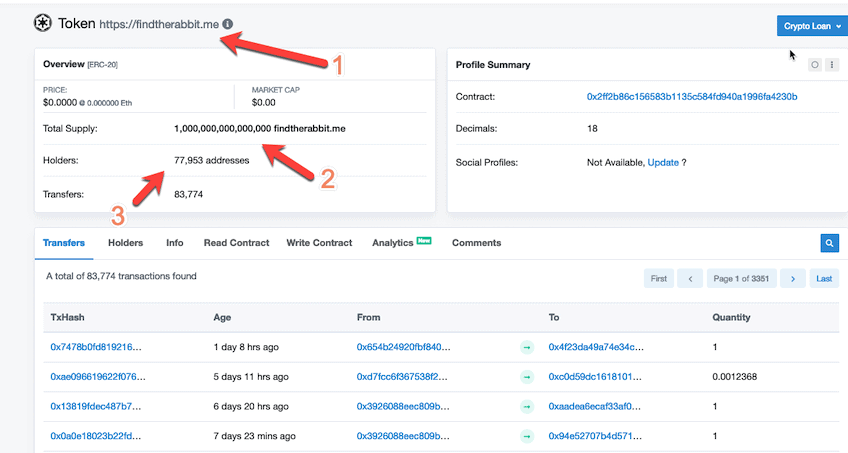
Source: etherscan.io
#2 Task-based airdrop
This is the most common method for new project launches. The participant signs up or completes a task and receives coins into their wallet. Tasks can include subscribing to a newsletter, following a project on social media, or sharing content with your followers. After completing the task, participants are placed on a list to receive the airdrop once the token launches. An example of such a launch airdrop is Ontology:“There will be no public sale of ONT. Those who subscribed to our newsletter will receive 1000 ONT for free. The details of token distribution, including the date, will be confirmed at a later date.”
#3 Hard fork airdrop
A hard fork occurs when a blockchain splits into two separate chains. Everyone who held coins on the original chain at the time of the split automatically receives the same number of coins on the new chain, effectively a free airdrop. Two well-known hard fork airdrops: Ethereum Classic In 2016, a hack drained approximately $60 million worth of Ether from the DAO smart contract. The Ethereum Foundation decided to reverse the transactions, but part of the community disagreed and kept the original blockchain running. This split-off chain became Ethereum Classic. Everyone who held Ethereum at the time of the fork received the same number of ETC for free, and both chains continued operating independently, each with its own development team and tokens. Bitcoin Cash In 2017, a dispute over Bitcoin’s block size led a portion of the community to create Bitcoin Cash with a larger block size. Every Bitcoin holder at the time of the fork automatically received an equivalent amount of BCH. At its all-time high, each BCH was worth over $4,300.#4 Snapshot airdrop
In a snapshot airdrop, the team behind a new coin selects a specific block on an existing blockchain and distributes tokens proportionally to all holders at that moment. This method is used to give a broad initial distribution to an established community of holders, without requiring them to sign up for anything.#5 Retroactive DeFi airdrop
The most significant category of airdrops today. A protocol distributes governance tokens to wallets that used it before the token existed, retroactively rewarding early adopters. These airdrops are not announced in advance, which means you can qualify simply by using DeFi applications. The two most prominent examples: Uniswap’s 2020 airdrop of 400 UNI tokens to every past user (worth over $16,000 at the peak), and Arbitrum’s 2023 airdrop of ARB tokens to early users of its Layer 2 network, which distributed over $1.8 billion worth of tokens in total. These events turned everyday users into significant token holders overnight.Top 10 biggest airdrops in crypto history
These are the most valuable airdrops to date, based on the approximate value distributed at launch or at peak price:| # | Project | Year | Type | Notable value |
|---|---|---|---|---|
| 1 |  Uniswap Uniswap |
2020 | DeFi retroactive | 400 UNI per wallet (~$16,000 at ATH) |
| 2 |  Arbitrum Arbitrum |
2023 | DeFi retroactive | ~$1.8 billion total distributed |
| 3 |  Optimism Optimism |
2022 | DeFi retroactive | 266 million OP distributed |
| 4 |  dYdX dYdX |
2021 | DeFi retroactive | Up to ~$50,000 for power users |
| 5 |  Bitcoin Cash Bitcoin Cash |
2017 | Hard fork | 1 BCH per BTC held (~$4,355 at ATH) |
| 6 |  Blur Blur |
2023 | NFT marketplace | 360 million BLUR, avg. ~$2,000 for active traders |
| 7 |  Aptos Aptos |
2022 | Testnet participation | 150 APT per wallet (~$1,300 at launch) |
| 8 |  1inch 1inch |
2020 | DeFi retroactive | Avg. ~$1,500 per wallet at launch |
| 9 |  Ethereum Classic Ethereum Classic |
2016 | Hard fork | 1:1 with ETH held at time of fork |
| 10 |  Stellar Stellar |
2019 | Marketing giveaway | 2 billion XLM distributed via Blockchain.com |
How do you get coins via an airdrop?
Coins can generally be obtained in exchange for performing a task, by owning certain coins, or simply by using a protocol before its token launches. Some examples:- Subscribe to a newsletter.
- Follow the project on social media.
- Share a post with your followers.
- Invite people using a referral link.
- Create content about the project, such as a blog post or video.
- Install a mobile application.
- Use a DeFi protocol, DEX, or Layer 2 network regularly.
- Tokens can appear in your wallet without any action, because you already hold other tokens in that wallet.
- New coins can be claimed using your private key when a hard fork airdrop occurs.
ATTENTION: never give your private key to an airdrop website, form, or anyone claiming to help you claim coins. If you do, assume your coins will be gone almost immediately.
Do you have to pay taxes on an airdrop?
When it comes to cryptocurrency airdrops, a crucial question arises: are they taxable? In many countries, tax authorities treat airdrops as a taxable event at the moment you receive them. In the United States, for example, the IRS considers airdropped tokens as ordinary income based on their fair market value at the time of receipt. Tax rules differ significantly by country, so it is important to check the regulations in your jurisdiction. For an overview of how different countries approach crypto regulation and taxation, see our crypto regulation by country page.What are the risks of airdrops?
Airdrops are popular in the crypto community because everyone likes free coins. Unfortunately, this popularity also makes them a prime target for fraud. The main dangers are:#1 Malicious token approvals
This is one of the fastest-growing scam types in crypto. You receive tokens in your wallet and are then directed to a website to “claim,” “swap,” or “activate” them. The site asks you to sign a transaction using your wallet. What you are actually signing is a token approval, granting the contract unlimited permission to spend all assets in your wallet. The moment you confirm, the attacker’s contract drains your entire wallet in a single transaction. There is no reversal. This type of attack is known as an approval scam or wallet drainer, and the fake airdrop is simply the bait. Never sign a transaction from a website you did not seek out yourself, and always read what you are approving before confirming in your wallet.#2 Identity fraud
Despite an airdrop not being a paid event, some projects still ask for KYC (Know Your Customer) verification. You may be asked for personal data such as your address and a copy of your ID. Be very careful when providing this information, as it can be sold on marketplaces or used for identity fraud at other platforms.#3 Social media permissions
Airdrop portals sometimes ask you to log in via your social media account and request wide permissions, ranging from reading your posts to posting on your behalf. These permissions are rarely actually needed for the airdrop. Creating a dedicated account for airdrops is the safest option.#4 Data collection
Many airdrops ask for far more personal data than needed: name, age, address, hobbies, and the ability to invite your contacts. This data is typically sold to third parties. You may start receiving spam, phishing emails, or unsolicited phone calls as a result.#5 Spam and phishing
If you participate in many airdrops, you will almost certainly receive spam emails tailored to your interests, sometimes containing phishing links. A common tactic creates urgency around a fake investment opportunity to exploit FOMO. Always verify the source before clicking any link.#6 Private key theft
In crypto, you are your own bank. If someone gains access to your private key, your balance is almost always gone with no recourse. Some examples: Send crypto to receive more Bots on social media pose as well-known figures and promise to send you coins if you send a small amount first. These scams are so widespread that Ethereum founder Vitalik Buterin publicly warned about them in his social media bio: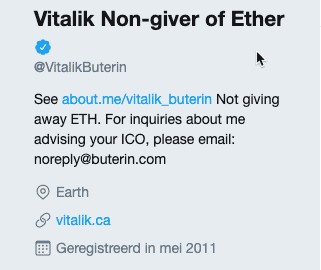 Private keys requested online
Malicious actors try to convince you to enter your private key in an online form, a private chat, or a bot. If you do this, your coins will be gone almost immediately. Never share your private key with anyone, for any reason.
Rogue wallet software for hard forks
When claiming coins from a blockchain fork, you often need to use the new coin’s wallet software and enter your private key. There have been fake hard fork wallets that silently sent private keys to their creators, draining the original coins as well. Always wait for established hardware wallet or exchange support before claiming fork coins.
Private keys requested online
Malicious actors try to convince you to enter your private key in an online form, a private chat, or a bot. If you do this, your coins will be gone almost immediately. Never share your private key with anyone, for any reason.
Rogue wallet software for hard forks
When claiming coins from a blockchain fork, you often need to use the new coin’s wallet software and enter your private key. There have been fake hard fork wallets that silently sent private keys to their creators, draining the original coins as well. Always wait for established hardware wallet or exchange support before claiming fork coins.
Tips to prevent losses
- Always move your original coins to a new wallet before using your private key to claim a fork airdrop.
- Claim airdrops in an isolated environment, such as a separate browser profile or virtual machine.
- Read the experiences of other users on forums and community channels before participating.
- Wait until established hardware wallets or exchanges support the airdrop before claiming.
- Keep your device and antivirus software up to date.
- Before signing any transaction, carefully read what you are approving. Never grant unlimited token approvals to unknown contracts.
 Stay Ahead in Crypto