

Blockchain technology has revolutionized the way data is stored and transacted. However, for decentralized applications (dApps) and smart contracts to react to real-world events, they need access to off-chain data. This is where oracles come into play. Oracles act as a bridge, bringing off-chain information to blockchain networks, enabling smart contracts to function beyond the blockchain environment. Without oracles, blockchain ecosystems would be isolated, limiting their capabilities.
Oracles are essential in many industries, including finance, insurance, gaming, and supply chain management. They enable the seamless integration of external data with blockchain networks. The use of decentralized oracles ensures that data remains secure, reliable, and resistant to manipulation.
What is a Blockchain Oracle?
A blockchain oracle is a third-party service that provides external data to smart contracts. This data can come from various off-chain sources like APIs, sensors, or traditional systems. The oracle retrieves the data, verifies its accuracy, and feeds it into a blockchain in a way that smart contracts can understand.
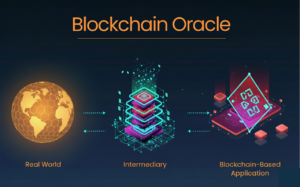
Oracles expand the functionality of smart contracts by enabling them to interact with the real world. For example, an oracle can fetch the price of a cryptocurrency, weather data, or a sports result and deliver it to a blockchain network. These interactions make blockchain technology more versatile and capable of supporting complex applications.
Types of Blockchain Oracles
Blockchain oracles come in various forms, each serving specific purposes. The two main types of oracles are centralized and decentralized. Decentralized oracles are crucial for ensuring the integrity and security of the data they provide. Below are the key types of blockchain oracles:
-
- Software Oracles: These oracles fetch data from online sources such as APIs. They are used to access price feeds, weather information, and more
-
- Hardware Oracles: These are integrated with physical devices like sensors or RFID tags. They provide data from the physical world to the blockchain, such as supply chain data or sensor readings
-
- Cross-Chain Oracles: These enable the transfer of data between different blockchains, ensuring interoperability. They allow smart contracts to trigger actions on one blockchain based on events happening on another blockchain
-
- Compute-Enabled Oracles: These oracles perform off-chain computations and provide services that are impractical on-chain. Examples include generating zero-knowledge proofs or verifiable randomness functions for secure and fair applications
The Importance of Oracles in Crypto
Oracles are critical for the functionality of decentralized finance (DeFi) applications. These applications require access to real-time data to execute financial transactions. Without oracles, smart contracts in DeFi could not access accurate asset prices or market conditions, rendering them ineffective.
In the insurance industry, oracles verify the occurrence of events like natural disasters, triggering automatic payouts. Similarly, in gaming, oracles provide verifiable randomness, ensuring fairness in NFT drops or random in-game events. In supply chains, oracles can track goods in transit, providing real-time updates to stakeholders.
The decentralized nature of oracles ensures that there is no single point of failure. This is especially important in smart contract execution, where bad data can lead to incorrect outcomes. Decentralized oracles use multiple nodes to verify data, ensuring that it is accurate and trustworthy before being sent to the blockchain.
How Do Oracles Work?
Oracles function as intermediaries between smart contracts and the external world. When a smart contract requires data, it sends a request to an oracle. The oracle then fetches the necessary data from an off-chain source and transmits it to the smart contract.
For example, in a betting contract, the smart contract needs to know the outcome of a sports match. An oracle fetches the data from an off-chain source, such as a sports API, and delivers it to the blockchain. Once the contract receives the correct information, it can execute the agreed-upon action, such as paying out the bet.
There are also two primary models for oracle data retrieval: pull-based oracles and push-based oracles. Pull-based oracles fetch data when requested, while push-based oracles push data to smart contracts in real-time as events occur.
The Oracle Problem
The “oracle problem” refers to the challenges that arise from connecting blockchains to off-chain data. Blockchains are isolated from the outside world, and smart contracts cannot directly access off-chain data. To solve this issue, oracles bridge the gap, but they must do so securely and reliably.
One of the main concerns is ensuring that the data provided by oracles is accurate. A corrupted or compromised oracle can deliver false information to the blockchain, leading to the wrong outcomes for smart contracts. This is why decentralizing the oracle process is so important. Decentralized oracles use multiple nodes and data sources, ensuring that the data is accurate and secure.
Centralized vs. Decentralized Oracles
While centralized oracles are easier to implement and manage, they pose significant risks. A centralized oracle is a single point of failure, and if it goes offline or is compromised, it can disrupt the smart contract ecosystem. Centralized oracles also make it easier for bad actors to manipulate data, which could result in financial loss or incorrect contract execution.
Decentralized oracles eliminate these risks by distributing the data collection process across multiple nodes. This way, if one oracle node fails or provides incorrect data, the system can still function correctly. By using multiple data sources and nodes, decentralized oracles ensure that the data fed to the blockchain is accurate, available, and secure.
Use Cases for Blockchain Oracles
Oracles have a wide range of applications across various industries. Some of the most common use cases include:
-
- Decentralized Finance (DeFi): Oracles provide real-time price data to DeFi platforms, enabling them to execute financial transactions based on current market conditions.
-
- Gaming and NFTs: Oracles are used to generate verifiable randomness for gaming and to update the value or traits of NFTs based on external data.
-
- Insurance: Oracles can verify real-world events like weather conditions or accidents, triggering automated payouts in insurance contracts.
-
- Supply Chain Management: Oracles tracks products in the supply chain, providing real-time updates and ensuring transparency.
- Sustainability: Oracles are used to verify environmental data, such as carbon emissions, and help enforce sustainability measures through smart contracts.
Top Crypto Projects Related to Oracles
Several cryptocurrencies are directly linked to oracle technology:
Coin | Role |
Chainlink (LINK) | Market-leading decentralized oracle network for data feeds and smart contracts. |
Band Protocol (BAND) | Cross-chain oracle network focused on scalability. |
Pyth Network (PYTH) | Delivers high-frequency financial market data, popular in trading platforms. |
Chainlink remains the dominant oracle project, widely integrated across DeFi protocols. Band Protocol and Pyth also offer strong solutions with different scaling and performance advantages.
Challenges in Oracle Security
Despite their usefulness, oracles are not without risks. One of the main concerns is data manipulation. If an oracle node is compromised, it can feed incorrect or manipulated data to the blockchain, leading to incorrect smart contract outcomes. To mitigate this risk, decentralized oracles use multiple nodes and data sources, making it much harder for bad actors to manipulate the system.
Another challenge is ensuring that the data provided by oracles is reliable and timely. Smart contracts depend on accurate and up-to-date information, so any delay in data delivery can disrupt contract execution. To address this, oracles use reputation systems and performance metrics to track the reliability of individual oracle nodes.
Bridging Blockchain Realities
Oracles play a fundamental role in connecting blockchain networks to the real world. They enable smart contracts to access and react to off-chain data, making blockchain ecosystems more versatile and powerful. Decentralized oracles provide the security and reliability needed to ensure that smart contracts function as intended.
As the use of blockchain technology expands, oracles will continue to play a critical role in enabling more advanced and secure decentralized applications. Their ability to bridge the gap between on-chain and off-chain worlds will be essential in the ongoing evolution of the blockchain ecosystem.