 English
  Nederlands
  Deutsch

In the world of cryptocurrency and blockchain technology, the term “nonce” plays a crucial role, especially in securing transactions and maintaining the integrity of the network. The nonce, short for “number used once,” is a fundamental part of various blockchain protocols, including Proof of Work (PoW) systems like Bitcoin. But what exactly does a nonce do, and why is it so important?
Understanding the Nonce in Blockchain
A nonce is a unique, one-time-use number that miners use to validate blocks of transactions in a blockchain network. It ensures the integrity of the data stored in the blockchain by preventing the possibility of reusing old hashes or creating duplicate transactions. Nonces are crucial for creating the cryptographic hash values needed to meet the network’s difficulty target, a key part of the mining process.
- Purpose in Mining: Miners use the nonce as part of the block header, along with other data, to generate a hash that satisfies the network’s difficulty level. The hash must meet a specific target set by the blockchain, which is a measure of the work done to validate the block.
- Prevention of Replay Attacks: In cryptographic terms, the nonce is used to prevent replay attacks. These occur when valid messages or transactions are intercepted and maliciously resent to exploit the system.
How Nonces Work in Proof of Work
In a Proof of Work (PoW) blockchain like Bitcoin, miners must solve complex cryptographic puzzles to add a new block to the blockchain. The nonce plays a critical role in this process:
- Block Header Components: A block in the Bitcoin network contains various fields, including the previous block’s hash, a timestamp, and the nonce.
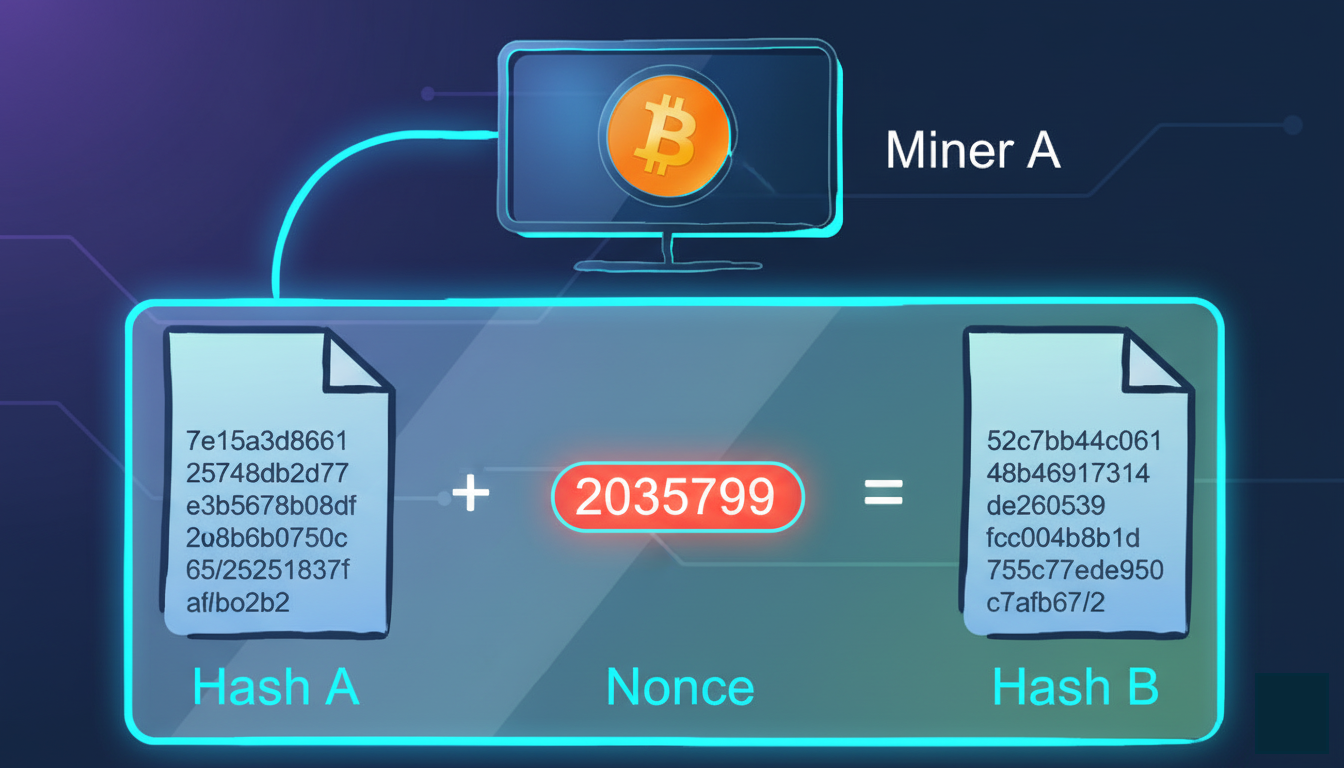
- Hash Generation: Miners combine the block data and the nonce to produce a cryptographic hash. This hash must have a specific number of leading zeros, as defined by the network’s difficulty target.
- Nonce Adjustment: When the hash does not meet the target, miners increment the nonce and try again. This process continues until a valid hash is found.
Nonce and Block Security
Nonces are vital for securing the blockchain because they ensure that each block’s hash is unique. Even the slightest change in the block data or the nonce produces a completely different hash. This makes it nearly impossible for anyone to alter the information in a block once it’s been added to the blockchain.
- Data Integrity: If a miner tries to modify the data in a block, the hash will change, signalling that the block has been tampered with.
- Immutable Ledger: Since altering the data would require re-mining all subsequent blocks, it would be computationally infeasible to attack the blockchain, ensuring its immutability.
Extra Nonces and Other Adjustments
The nonce in cryptocurrency mining is typically a 32-bit number, which means that it can only range up to around 4.29 billion. However, because miners can generate millions of hashes per second, this number is not always enough. To overcome this limitation, miners use an “extra nonce,” a value added to the coinbase transaction data.
- Extra Nonce: This random number is used to modify the Merkle root, which in turn changes the block’s hash, allowing miners to continue adjusting until they find a valid solution.
- Timestamp Adjustments: When the nonce and extra nonce aren’t enough, miners also adjust the block’s timestamp to help find a valid hash.
Nonces Beyond Bitcoin: Cryptographic Security
While the nonce is most famous for its role in Bitcoin mining, it is also crucial in other areas of cryptography, such as authentication protocols. A nonce helps prevent replay attacks by ensuring that a specific message or transaction can only be used once. This is important for maintaining the security of digital communications and transaction systems.
- Authentication Protocols: Nonces are used in systems like HTTPS to prevent replay attacks. Each transaction or request is paired with a unique nonce, ensuring its authenticity and preventing any malicious reuse of data.
- Session Tokens: Nonces also play a key role in generating unique session tokens in secure communications and applications, adding an extra layer of privacy and security.
Clarifying the Term “Nonce” in Bitcoin vs. Ethereum
Although the term nonce is used in both Bitcoin and Ethereum, it refers to two different concepts depending on the context.
- Bitcoin – Mining Nonce
In Bitcoin, the nonce refers to the mining nonce. This is a number that miners repeatedly change while hashing a block in the Proof-of-Work (PoW) process. The goal is to find a hash that meets the network’s difficulty target. This nonce has no relationship to individual user transactions; it exists solely to help miners discover a valid block. - Ethereum – Account Nonce
In Ethereum, the nonce discussed here is the account nonce. This is a counter stored on each account that tracks how many transactions have been sent from that address. Every new transaction must use the next sequential nonce. This ensures transactions are processed in order and prevents replay attacks or double-spending.
Why This Distinction Matters
Even though both are called “nonce,” they serve entirely different purposes:
- Bitcoin’s mining nonce is part of block creation and consensus.
- Ethereum’s account nonce is part of transaction ordering and account security.
| Feature | Mining Nonce (Bitcoin/PoW) | Account Nonce (Ethereum) |
| Primary Goal | Solving a mathematical puzzle | Ordering transactions |
| Who Uses It? | Miners | Individual Users/Accounts |
| Action | Iterated until a solution is found | Incremented by 1 for each new transaction |
| Protection | Protects against data tampering | Protects against “replay attacks” |
Nonce and the Future of Blockchain
The nonce may seem like a simple concept, but it is essential for maintaining the security and efficiency of blockchain networks. From ensuring that cryptographic hashes are valid in Proof of Work systems to preventing replay attacks and enabling secure communication protocols, the nonce is a cornerstone of modern blockchain technology.
As blockchain continues to evolve, the role of the nonce will remain crucial in ensuring the integrity and decentralization of the network. Whether in mining, transaction ordering, or cryptographic authentication, nonces will continue to play a vital role in the world of crypto.
 Stay Ahead in Crypto