English
  Nederlands
  Deutsch

Key Takeaways
- Polkadot connects independent blockchains through a Relay Chain and parachains, letting them share security and exchange data without trusted intermediaries.
- Polkadot 2.0 introduced Asynchronous Backing, Agile Coretime, and Elastic Scaling, and Kusama’s Spammening stress test reached a record 143,343 TPS on a live network in December 2024.
- In March 2026 a Polkadot governance vote capped DOT supply at 2.1 billion and cut annual issuance by 53.6%, making DOT a disinflationary asset for the first time.
In This Article
- What are Polkadot’s best features?
- Who created Polkadot?
- How does Polkadot work?
- Polkadot 2.0
- Polkadot Hub and PolkaVM
- JAM: The future of Polkadot
- Why does the Polkadot coin (DOT) have value?
- Staking DOT
- DOT supply cap and the Pi schedule
- Governance
- The Polkadot ecosystem
- DOT ETF: TDOT goes live on Nasdaq
- Where can you buy Polkadot?
Polkadot is a next-generation blockchain protocol that enables independent blockchains to communicate and work together seamlessly. Launched on May 26, 2020, Polkadot was created to solve one of blockchain’s biggest challenges: interoperability. The platform allows different blockchains to exchange data and assets without requiring a trusted third party, creating a truly interconnected web of blockchains.
Developed by Parity Technologies and supported by the Web3 Foundation, Polkadot has evolved significantly since its launch. With the rollout of Polkadot 2.0 in 2024 and 2025 and the upcoming JAM protocol, the network is transforming from a multi-chain ecosystem into what founder Gavin Wood describes as a “decentralized supercomputer.”
What are Polkadot’s best features?
Most blockchain projects operate in isolation until they establish connections with the broader ecosystem. Building this infrastructure from scratch is complex and expensive, which has caused many promising initiatives to fail. Polkadot’s architecture was designed from the ground up to solve these challenges.
 Interoperability
 Interoperability
Polkadot’s core innovation is enabling different blockchains to communicate natively. Through its Cross-Consensus Messaging (XCM) protocol, parachains and applications can share data, tokens, and functionality across the network. The latest XCM v5 upgrade has elevated cross-chain communication to new heights, with improved asset transfer predictability.
Shared security
 Shared security
All blockchains connected to Polkadot benefit from the security of the entire network. Instead of each chain needing to bootstrap its own validator set, they inherit security from the Relay Chain’s validators. This pooled security model makes it much easier for new projects to launch with robust protection.
Scalability
 Scalability
By processing transactions across multiple parallel chains simultaneously, Polkadot achieves remarkable throughput. In the December 2024 “Spammening” stress test, Kusama (Polkadot’s canary network) hit a measured peak of 143,343 transactions per second on a live blockchain while using only 23% of the network’s capacity. At full 100-core utilisation the theoretical ceiling sits around 623,000 TPS, and the longer-term ambition of reaching one million TPS is now tied to the JAM upgrade rather than the current architecture.
Forkless upgrades
 Forkless upgrades
Unlike most blockchains that require hard forks to implement major changes, Polkadot can upgrade seamlessly through its on-chain governance system. This eliminates community splits and ensures the network can evolve continuously without disruption.
Customization
 Customization
Each parachain can be optimized for specific use cases while remaining connected to the broader network. Whether building for DeFi, gaming, identity, or enterprise applications, developers have full control over their chain’s design.
Who created Polkadot?
Polkadot was created by Dr. Gavin Wood, one of the co-founders of Ethereum and the author of the Ethereum Yellow Paper. After leaving Ethereum, Wood founded Parity Technologies and the Web3 Foundation to realize his vision for a more interconnected and scalable blockchain ecosystem.
The concept for Polkadot emerged in late 2016 when Wood and early Parity team members discussed what a next-generation blockchain protocol should look like. The Polkadot whitepaper was published shortly after, and the first code appeared on GitHub in November 2017.
Development progressed through several milestones: the first parachain was deployed in July 2018, and after extensive testing, Polkadot launched in May 2020. Token transfers were enabled in August 2020, marking the network’s full operational status.
In August 2024, Gavin Wood announced he would resume his role as Parity CEO, signaling renewed focus on delivering Polkadot’s ambitious technical roadmap.
How does Polkadot work?
Polkadot’s architecture consists of several interconnected components working together to create a unified multi-chain ecosystem.
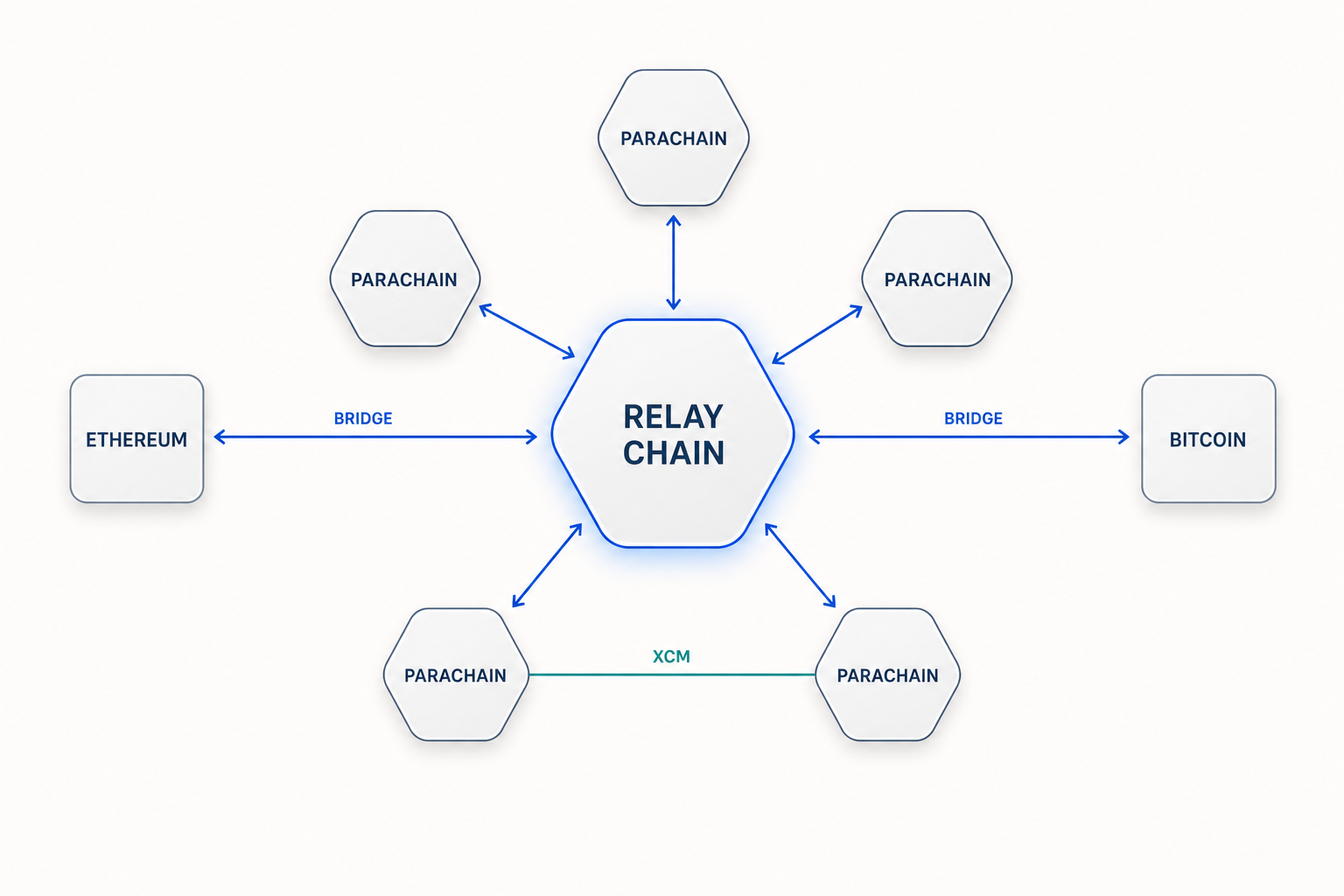
The Relay Chain is the heart of Polkadot. It provides consensus, security, and cross-chain communication for the entire network. The Relay Chain does not support smart contracts directly; instead, it coordinates all the connected chains and ensures they operate securely.
Parachains (parallel chains) are independent blockchains that connect to the Relay Chain. Each parachain can have its own tokens, governance, and functionality optimized for specific use cases. They process transactions independently and submit results to the Relay Chain for validation, enabling massive parallel processing.
Bridges connect Polkadot to external networks like Ethereum and Bitcoin, enabling token transfers and communication without centralized exchanges. The Polkadot-Kusama bridge went live in 2024, enabling seamless DOT and KSM transfers between networks. Bridge security remains an active risk area for the wider industry: in April 2026, an attacker exploited the Hyperbridge gateway to mint roughly one billion bridged DOT on Ethereum before the issue was contained, a useful reminder that cross-chain infrastructure carries different trust assumptions than the underlying chains themselves.
XCM (Cross-Consensus Messaging) is the native protocol that allows parachains to send messages and transfer assets to each other securely and efficiently.
Polkadot 2.0
Polkadot 2.0 represents a comprehensive upgrade to the network’s capabilities, rolled out in phases throughout 2024 and 2025. This upgrade fundamentally changes how developers and projects interact with Polkadot.
Asynchronous Backing
 Asynchronous Backing
Launched in May 2024, this upgrade reduced parachain block time from 12 seconds to 6 seconds while increasing block space by 5 to 10 times. This enabled parallel validation of transactions and block production, dramatically improving throughput.
Agile Coretime
 Agile Coretime
Launched in September 2024, Agile Coretime replaced the old parachain slot auction system. Instead of bidding for expensive long-term slots, projects can now purchase “coretime” flexibly, buying compute resources on-demand like renting cloud servers. This dramatically lowers the barrier to entry for new projects and improves overall network efficiency.
Elastic Scaling
 Elastic Scaling
Rolled out through 2025 and reinforced by the Revive and Elastic Scaling upgrade in January 2026, this feature lets parachains dynamically allocate block-space resources based on demand. During high-traffic periods, chains can tap into multiple cores for additional capacity, then scale back during quieter times. This ensures optimal resource utilization across the network.
Additional improvements
 Additional improvements
Polkadot 2.0 also introduced a unified address format that works across Polkadot and all rollups, fast unstaking to reduce DOT unlocking wait times, and DOT as a universal fee token that can be used for gas across all connected chains.
Polkadot Hub and PolkaVM
Polkadot Hub is the network’s new home for decentralized applications, consolidating asset issuance, smart contracts, staking, governance, and bridging into a single L1 application layer that builds on the existing AssetHub chain. Originally proposed as “Polkadot Plaza,” the Hub turns Polkadot from a parachain host into a place where users and developers can deploy and use apps directly.
At the heart of the Hub is the Revive execution environment, which combines two engines. REVM is a Rust implementation of the Ethereum Virtual Machine that supports standard Solidity contracts, MetaMask, Remix, Hardhat, and Foundry, so existing Ethereum projects can deploy on Polkadot with minimal changes. PolkaVM is a RISC-V-based execution environment built from the ground up for higher performance and broader language support. PolkaVM smart contracts went live on Kusama in 2025 and were rolled into Polkadot’s mainnet via the Revive and Elastic Scaling upgrade on January 20, 2026.
The 2026 roadmap for the Hub focuses on a Just-In-Time compiler for PolkaVM, gas payments in any asset (auto-swapped to DOT), 500ms block times, and proof-of-personhood features. Together, these changes are intended to close the gap with Ethereum on developer experience while keeping Polkadot’s shared-security model.
JAM: The future of Polkadot
JAM (Join-Accumulate Machine) is Gavin Wood’s vision for Polkadot’s next evolution, detailed in the Gray Paper released in April 2024. JAM will transform Polkadot from a multi-chain relay network into a decentralized general computing platform, essentially a distributed supercomputer capable of running any kind of Web3 application or service.
The protocol combines elements of both Polkadot and Ethereum into a unified platform, offering a global permissionless computing environment with secure parallel computation. JAM introduces a pay-as-you-go model where anyone can deploy services without the complexity of launching a full parachain.
Development is progressing through multiple phases, with the JAM Gray Paper approaching version 1.0. A prototype called “JAM Toaster” has been built, multiple teams are writing independent client implementations in Rust, Go, and other languages, and the Web3 Foundation has allocated 10 million DOT and 100 thousand KSM to incentivize developers building on the new technology stack. After originally targeting Q1 2026, JAM mainnet activation is now expected between late 2026 and 2027, pending an OpenGov referendum and validator readiness.
Importantly, Gavin Wood has stated that no new JAM token will be issued. DOT remains the core token powering the ecosystem.
Why does the Polkadot coin (DOT) have value?
DOT is the native token of the Polkadot network and serves several essential functions:
Governance
DOT holders have voting power over all protocol changes, treasury spending, and network upgrades through Polkadot’s OpenGov system. This gives the community direct control over the network’s evolution.
Staking
DOT is staked by validators and nominators to secure the network. Validators process transactions and produce blocks, while nominators back validators with their stake. Both earn rewards for their participation.
Coretime purchases
With Agile Coretime, DOT is used to purchase compute resources on the network. Projects pay DOT to access Polkadot’s processing power for their applications.
Universal gas token
 Universal gas token
DOT now functions as a universal fee token across Polkadot and all connected rollups, simplifying the user experience across the ecosystem.
Staking DOT
Polkadot uses a Nominated Proof of Stake (NPoS) consensus mechanism. Token holders can participate in network security in two ways:
Validators run nodes that produce blocks and validate transactions. Running a validator requires technical expertise and a significant DOT stake.
Nominators back validators they trust with their DOT stake. If their chosen validators perform well, nominators share in the rewards. If validators misbehave, both validators and nominators can lose a portion of their stake through “slashing.”
For smaller holders, nomination pools allow users to pool their DOT together to collectively nominate validators. With over 250 pools and tens of thousands of members, this feature enables participation with as little as 1 DOT. The 2025 staking dashboard upgrade further simplified the experience with a unified wallet system, real-time reward projections, and support for 12 languages.
Staking yields vary based on network conditions and the total amount staked. They are also directly affected by the new issuance schedule introduced in March 2026, which is described in the next section.
DOT supply cap and the Pi schedule
For most of its history, DOT was an uncapped, inflationary token, with roughly 120 million new DOT minted per year and a circulating supply near 1.6 billion DOT by early 2026. That changed in March 2026, when Polkadot governance approved Referendum 1710 (and follow-up Referendum 1828) with 81% support.
Two structural changes took effect:
- A permanent hard cap of 2.1 billion DOT was written into the protocol via runtime version 2.1.0 on March 12, 2026. DOT is now a capped asset, similar in concept to Bitcoin’s fixed supply, though it remains a governance decision and could in principle be revisited by a future vote.
- An immediate 53.6% cut in annual issuance activated on March 14, 2026 (a Pi Day reference). Annual issuance dropped from about 120 million DOT to roughly 57 million DOT, and the annual inflation rate fell from around 10% to about 3.11% overnight.
From here, issuance follows what the community calls the “Pi schedule”: every two years the issuance rate applied to the remaining supply gap is reduced by 13.14%, with steps deliberately aligned to fall close to Bitcoin halving cycles. Inflation is projected to drop below 1% by the early 2030s and approach zero asymptotically as the network nears the 2.1 billion cap in the next century.
Operationally, all newly minted DOT, transaction fees, coretime revenue, and slashing penalties now flow through a single on-chain Dynamic Allocation Pool. Governance decides how that pool is split across validator rewards, staking incentives, treasury spending, and a strategic reserve, replacing the older approach of burning excess treasury funds.
Governance
Polkadot operates one of the most sophisticated on-chain governance systems in crypto, called OpenGov. Any DOT holder can submit proposals, vote on changes, and participate in decision-making.
The system includes multiple “tracks” for different types of proposals, from small treasury requests to major protocol upgrades. Each track has appropriate voting thresholds and timeframes. This allows routine decisions to pass quickly while ensuring major changes receive thorough community review.
The Polkadot Treasury, funded by transaction fees and inflation, supports ecosystem development. In 2024, the treasury spent roughly $133 million across development, marketing, and business development, and the runway has historically been counted in years rather than months. With the March 2026 issuance cut and the new Dynamic Allocation Pool, the treasury’s funding model has tightened, and how the community sets priorities under leaner conditions is one of the more interesting governance stories to watch.
The Polkadot ecosystem
Polkadot hosts a diverse ecosystem of more than 200 projects spanning DeFi, gaming, identity, and enterprise applications. Notable parachains include:
- Moonbeam – Ethereum-compatible smart contract platform
- Acala – DeFi hub with stablecoin and liquid staking
- Astar – Multi-chain smart contract platform supporting EVM and WebAssembly
- Phala – Privacy-preserving cloud computing
- Mythos – Gaming-focused chain that migrated from Ethereum
Kusama serves as Polkadot’s “canary network”, a live testing environment where new features are deployed before reaching Polkadot. Projects often launch on Kusama first to battle-test their technology with real economic stakes before deploying to Polkadot.
Polkadot continues to rank among the more active Layer 1 networks for core protocol development, with consistent contributions from Parity Technologies, the Web3 Foundation, and a growing set of independent client teams working on JAM implementations.
DOT ETF: TDOT goes live on Nasdaq
After more than a year of filings and SEC delays, the first U.S. spot Polkadot ETF began trading on March 6, 2026. 21Shares’ Polkadot ETF, ticker TDOT, listed on Nasdaq with around $11 million in seed capital and a 0.30% management fee that is waived through October 2026. The fund tracks the CME CF Polkadot-Dollar Reference Rate and gives traditional investors regulated exposure to DOT without managing a wallet themselves.
A competing Grayscale Polkadot ETF was filed via Nasdaq’s 19b-4 process and is still working through SEC review at the time of writing. The original 21Shares S-1 filing dates back to January 2025, and the Web3 Foundation spent considerable effort demonstrating that DOT does not qualify as a security under U.S. regulations. The arrival of TDOT places Polkadot alongside Bitcoin and Ethereum in the small group of crypto assets with a live U.S. spot ETF, and broadens the channels through which institutions can hold DOT.
Where can you buy Polkadot?
Before you can buy DOT, you need a place to store it. You can create a wallet in several ways:
- On a cryptocurrency exchange (Binance, Kraken, etc.)
- Using a browser extension wallet like Talisman or SubWallet
- Through the official Polkadot Vault mobile app (air-gapped security)
- By purchasing a hardware wallet (Ledger or Trezor)
For maximum security and true ownership of your DOT, using a hardware wallet or self-custody solution where you control the private keys is recommended. Remember the saying in crypto: “Not your keys, not your coins.”
Once you have a wallet, you can purchase DOT in several places:
- On a cryptocurrency exchange
- Through a broker or trading platform
- At a cryptocurrency ATM
- Through a DOT ETF such as 21Shares’ TDOT in your brokerage account
 Stay Ahead in Crypto