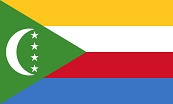
Country Information
 Capital: Moroni
 Continent: Africa
 Language: Comorian, French, Arabic
 Population: 850 688
 Surface (km2): 1861
Surface (sq mi): 719
Surface (km2): 1861
Surface (sq mi): 719Extra Information
 Currency: Comorian franc (KMF)
 ISO Code: KM
 Domain Extension: .km
 Calling Code: +269
 Time (CET): UTC+03:00
Time (CEST): UTC+03:00
Time (CET): UTC+03:00
Time (CEST): UTC+03:00Website
 Official Website: Beit-salam.km
 Info Website: Go2comoros.com
Extra Links
Social Media & News
 Coins: 2
 Total: 2
Ranking
 Overall Rank: 114
 Rank Per Capita: 66
Blockchain Overview
Category:
| Name | Category |
|---|
Frequently Asked Questions
Description
Disclaimer: The regulatory information provided below is for general informational purposes only and may not reflect the most current legal developments. Cryptocurrency regulations are rapidly evolving and can change frequently. This information should not be considered legal or tax advice. Before making any business or investment decisions, please consult with qualified legal, tax, or financial professionals familiar with your specific jurisdiction and circumstances. Always verify current regulations with official government sources and regulatory bodies.
Legal Classification & Regulatory Framework
Cryptocurrency Status
The Union of the Comoros, an archipelago nation in the Indian Ocean comprising three autonomous islands (Grande Comore, Anjouan, and Mohéli), presents a unique regulatory environment for cryptocurrency. The central government has not issued comprehensive legislation specifically addressing the legal classification of Bitcoin and other cryptocurrencies for domestic use. However, the country has developed a notable offshore financial services sector, particularly through the autonomous island of Anjouan.
Cryptocurrencies are neither explicitly banned nor formally regulated as legal tender in Comoros. The Comorian Franc (KMF) remains the only official currency, pegged to the Euro through a monetary cooperation agreement with France. The Central Bank of the Comoros (Banque Centrale des Comores, BCC) has not issued specific guidelines regarding the domestic use of cryptocurrencies for everyday transactions.
What distinguishes Comoros in the global cryptocurrency landscape is its offshore licensing regime, primarily administered through Anjouan. This autonomous island has established itself as an offshore financial center offering cryptocurrency licenses to international businesses. However, these licenses are specifically designed for operations conducted outside of Comoros rather than for domestic cryptocurrency activities.
Tax Treatment
The Comorian tax system, modeled on the French framework, offers notable advantages for international businesses, including those in the cryptocurrency sector. The tax treatment differs significantly depending on whether a company operates domestically or as an offshore entity.
For offshore entities, particularly International Business Companies (IBCs) registered in Anjouan and operating exclusively outside of Comoros, the jurisdiction offers significant tax benefits. These entities are generally exempt from income tax, withholding tax, and company tax on foreign-sourced income. Capital gains from cryptocurrency trading conducted outside the country are typically not taxable. There are no dividend taxes for offshore structures, and annual financial statements and audits are not mandatory for IBCs.
For domestic operations, the standard corporate tax rate can reach up to 35% for resident companies. However, reduced rates of 5%-15% may apply to businesses operating within designated free economic zones in Moroni or Anjouan. Value-Added Tax (VAT) is applied at varying rates, with a standard rate of around 10% for most goods and services.
Individual cryptocurrency investors operating domestically would potentially be subject to the progressive personal income tax system, with rates ranging from 0% for lower income brackets up to 30% for higher earnings. However, given the limited domestic cryptocurrency market and absence of specific crypto tax guidance, practical enforcement remains unclear.
Regulatory Oversight
The regulatory landscape in Comoros features a distinctive dual structure that reflects the country’s federal system of autonomous islands.
At the national level, the Central Bank of the Comoros (BCC), headquartered in Moroni, serves as the primary monetary authority. The BCC oversees the domestic banking system, implements monetary policy, and supervises traditional financial institutions. However, the BCC has limited direct authority over the offshore financial services sector that has developed in Anjouan.
The Anjouan Offshore Finance Authority (AOFA), established under the Offshore Finance Authority Act of 2005, operates as the primary regulator for offshore financial services on Anjouan Island. The AOFA issues and supervises various financial licenses, including cryptocurrency, banking, forex, and insurance. This regulatory body operates with substantial autonomy from the central government and the BCC regarding offshore licensing matters.
The legal framework governing crypto activities in Anjouan includes the Offshore Financial Management Act of 2005, which outlines the AOFA’s regulatory powers; the International Business Companies Act of 2005, establishing rules for IBC registration; and the Money Laundering Prevention Act (Government Notice 008 of 2005), which mandates anti-money laundering compliance.
Business Environment
Banking Relationships
Banking relationships for cryptocurrency businesses in Comoros present both opportunities and challenges. The domestic banking sector is relatively small, comprising a handful of commercial banks under the supervision of the BCC. Traditional banks in Comoros generally maintain conservative approaches toward cryptocurrency-related businesses.
For offshore crypto companies licensed in Anjouan, establishing banking relationships typically requires working with international banking partners rather than local Comorian banks. Licensed entities often seek correspondent banking arrangements through institutions in other jurisdictions. Holding a valid AOFA license can enhance credibility when approaching banks, though securing banking services remains a practical challenge for crypto businesses in any offshore jurisdiction.
Some licensed entities utilize banking facilities through partner institutions in jurisdictions such as Mauritius or seek relationships with European electronic money institutions. The requirement for corporate bank accounts as part of the licensing process means that successful applicants have typically already navigated these banking challenges before commencing operations.
Licensing Requirements
The Anjouan International Crypto License represents the primary authorization for cryptocurrency businesses seeking to operate from Comoros. This license permits a broad range of cryptocurrency-related activities, including cryptocurrency exchange services (fiat-to-crypto and crypto-to-crypto), custody and storage of digital assets, issuance of utility tokens and security tokens, provision of cryptocurrency loans and deposits, cryptocurrency wallet services, and contracts for difference (CFD) trading.
To obtain a crypto license in Anjouan, applicants must first establish an International Business Company (IBC) in Anjouan or demonstrate that an existing foreign company meets the requirements. A minimum capital requirement applies, typically around USD 265,000, which can be satisfied through financial guarantees rather than paid-up capital. Required documentation includes a detailed business plan, compliance policies covering AML and KYC procedures, passport copies and proof of address for directors and beneficial owners, bank statements demonstrating financial capacity, and professional resumes of key personnel.
The AOFA conducts due diligence checks on applicants, though the process is generally considered more streamlined than in major financial centers. The application process typically takes between two and eight weeks, and there is no requirement for applicants to visit Comoros in person. Licenses are issued for one year and must be renewed annually, with renewal involving compliance checks and payment of renewal fees.
It is essential to note that the Anjouan crypto license authorizes operations conducted internationally and explicitly prohibits conducting business with residents of Comoros. The license is not recognized by central regulatory authorities such as the SEC, FCA, or ESMA, and cannot be used to solicit clients in the United States, European Union, or United Kingdom without additional local authorization.
Innovation Support
Government support for blockchain innovation in Comoros remains in early stages compared to more developed economies. The country’s economic priorities have traditionally focused on agriculture, fishing, and basic infrastructure development rather than fintech innovation.
However, the establishment and growth of the offshore financial services sector in Anjouan demonstrates a pragmatic approach to attracting international financial businesses. The AOFA has progressively expanded its licensing offerings to include cryptocurrency services, responding to global demand for offshore licensing options.
There are currently no formal regulatory sandboxes or dedicated blockchain innovation programs operated by the Comorian government. The technology infrastructure, including internet connectivity and electricity reliability, continues to develop but may present challenges for large-scale blockchain operations. There is growing interest in renewable energy sources, particularly solar power, in discussions about potential cryptocurrency mining activities, though this sector remains nascent.
Market Characteristics
Adoption Patterns
Domestic cryptocurrency adoption in Comoros remains limited, reflecting the country’s developing economy and infrastructure challenges. The population of approximately 900,000 has limited access to the internet and digital financial services compared with those in more developed nations. Traditional cash transactions and mobile money services remain the predominant means of payment for everyday transactions.
The primary cryptocurrency activity connected to Comoros relates to offshore licensed businesses rather than domestic adoption. International cryptocurrency exchanges, wallet providers, and trading platforms have obtained Anjouan licenses to establish a legal operational base, though their customer bases are typically located in other countries.
Remittances from the Comorian diaspora represent a significant portion of the national economy, and there is theoretical potential for cryptocurrency to serve this use case. However, practical adoption for remittances remains minimal due to limited awareness, infrastructure constraints, and the absence of clear regulatory guidance for domestic crypto use.
Industry Focus
The cryptocurrency industry’s presence in Comoros is almost exclusively oriented toward offshore service provision rather than domestic operations. The types of businesses that have established operations under Anjouan licenses include cryptocurrency exchanges targeting emerging markets, forex and CFD trading platforms incorporating cryptocurrency products, digital asset custody providers, blockchain startups seeking an initial regulatory base, and token issuance projects.
The jurisdiction has positioned itself as an entry-level licensing destination, particularly appealing to startups and smaller operators who may find the requirements and costs of major financial centers prohibitive. The relatively low capital requirements, streamlined application process, and favorable tax treatment attract businesses seeking to establish legal compliance quickly and affordably.
However, it is worth noting that Anjouan appears on specific financial regulatory watchlists and may not carry the same reputational weight as licenses from jurisdictions such as Malta, Singapore, or Switzerland. Businesses must consider how an Anjouan license will be perceived by potential customers, banking partners, and other stakeholders.
Regulatory Evolution
The regulatory framework for cryptocurrency in Comoros, particularly through Anjouan, has evolved incrementally since the establishment of the offshore financial services sector. The AOFA has adapted its licensing regime to accommodate cryptocurrency activities as the global digital asset industry has grown.
Unlike European Union member states, Comoros is not subject to EU directives such as MiCA (Markets in Crypto-Assets Regulation) or AMLD (Anti-Money Laundering Directives). The country’s regulatory approach has developed independently, drawing on its existing offshore financial services framework rather than adopting comprehensive new crypto-specific legislation.
Comoros is a member of regional organizations, including the Common Market for Eastern and Southern Africa (COMESA) and the Arab League. However, these memberships have not yet resulted in harmonized cryptocurrency regulations. The country participates in international anti-money laundering initiatives and maintains AML/CFT requirements for licensed financial services providers.
Future regulatory developments may be influenced by international pressure for enhanced financial transparency, evolving global standards for virtual asset service providers, the growth or contraction of the offshore licensing industry, and potential domestic interest in cryptocurrency adoption as digital infrastructure improves.
Stakeholders should monitor developments from both the AOFA for offshore licensing matters and the BCC for any potential domestic regulatory initiatives.
For Current Information:
- Banque Centrale des Comores (Central Bank of the Comoros): https://banque-comores.km/
- Anjouan Offshore Finance Authority (AOFA): https://anjouanoffshorefinancialauthority.org/
Country Map
Crypto News

Blockchain Companies



Other Countries
Crypto and Blockchain Articles

What Are Layer 2 Chains?



What Is Tether (USDT)?

What Is the USDC Stablecoin?

Press Releases and Contributions