

The Relative Strength Index, usually called the RSI oscillator, is one of the most widely used indicators in technical analysis. Traders use it to understand whether an asset, such as a stock, cryptocurrency, or commodity, is gaining momentum, losing strength, or reaching a point where the price may be stretched too far in one direction.
Instead of focusing only on price levels, RSI looks at how strong recent buying or selling pressure has been. That’s why many traders treat it as a momentum “health check” for the market.
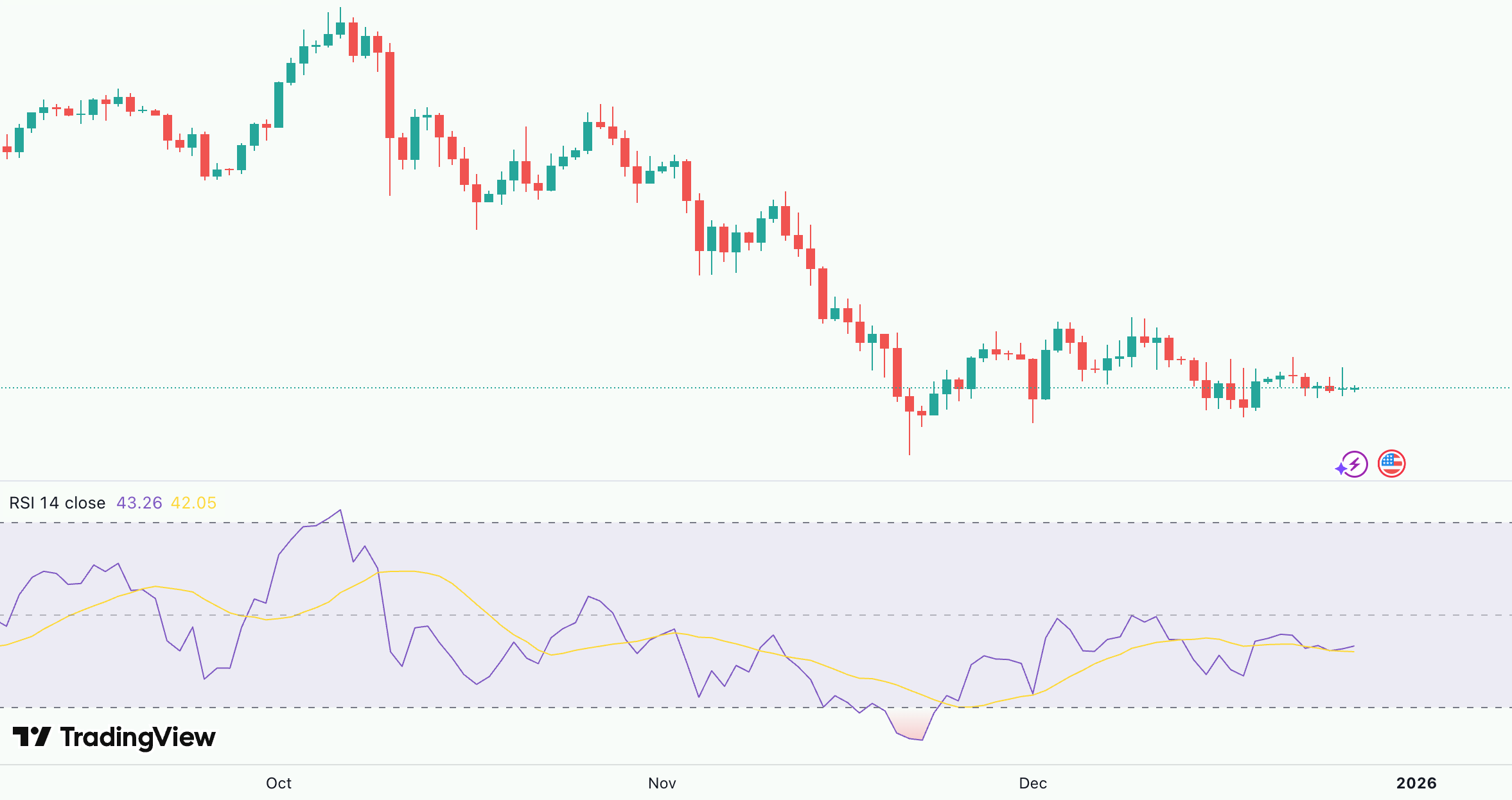
How the RSI Oscillator Works
The RSI is displayed as a line that moves between 0 and 100. It compares the size of recent price gains with recent price losses and converts that information into a momentum score.
In simple terms:
- When buyers have been stronger than sellers → RSI rises
- When sellers have been stronger than buyers → RSI falls
Most trading platforms use a 14‑period setting, which means the indicator is looking back over the last 14 candles (on whichever timeframe you are analyzing — 1H, 4H, daily, etc.).
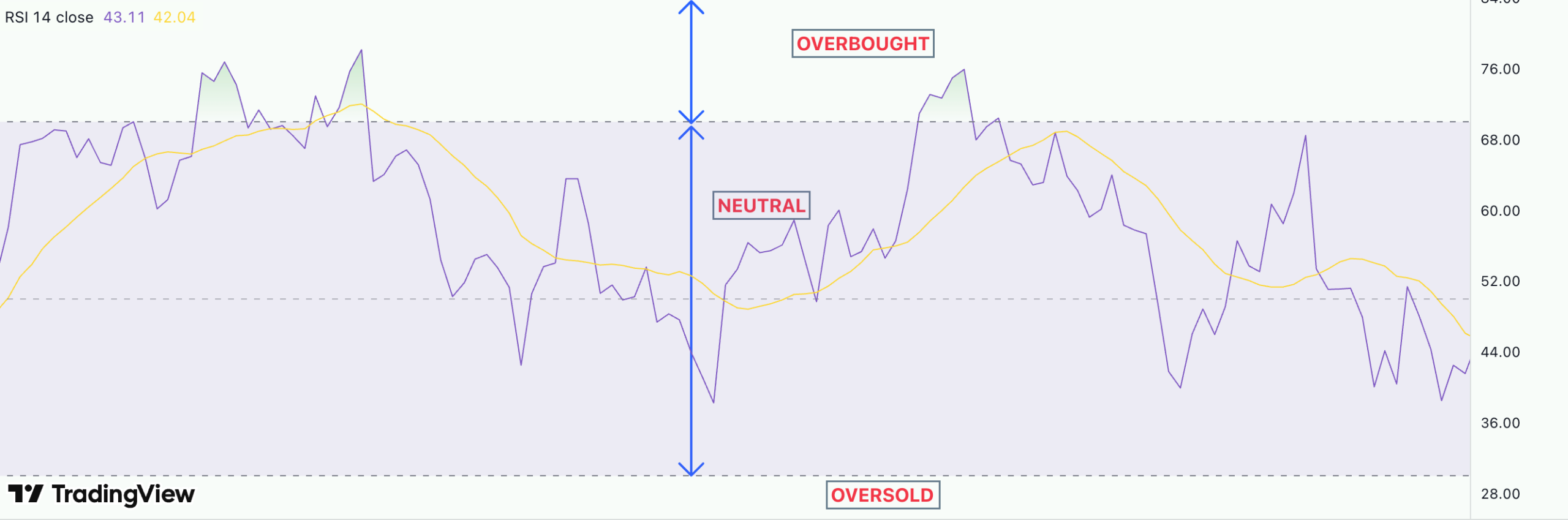
The three main RSI zones
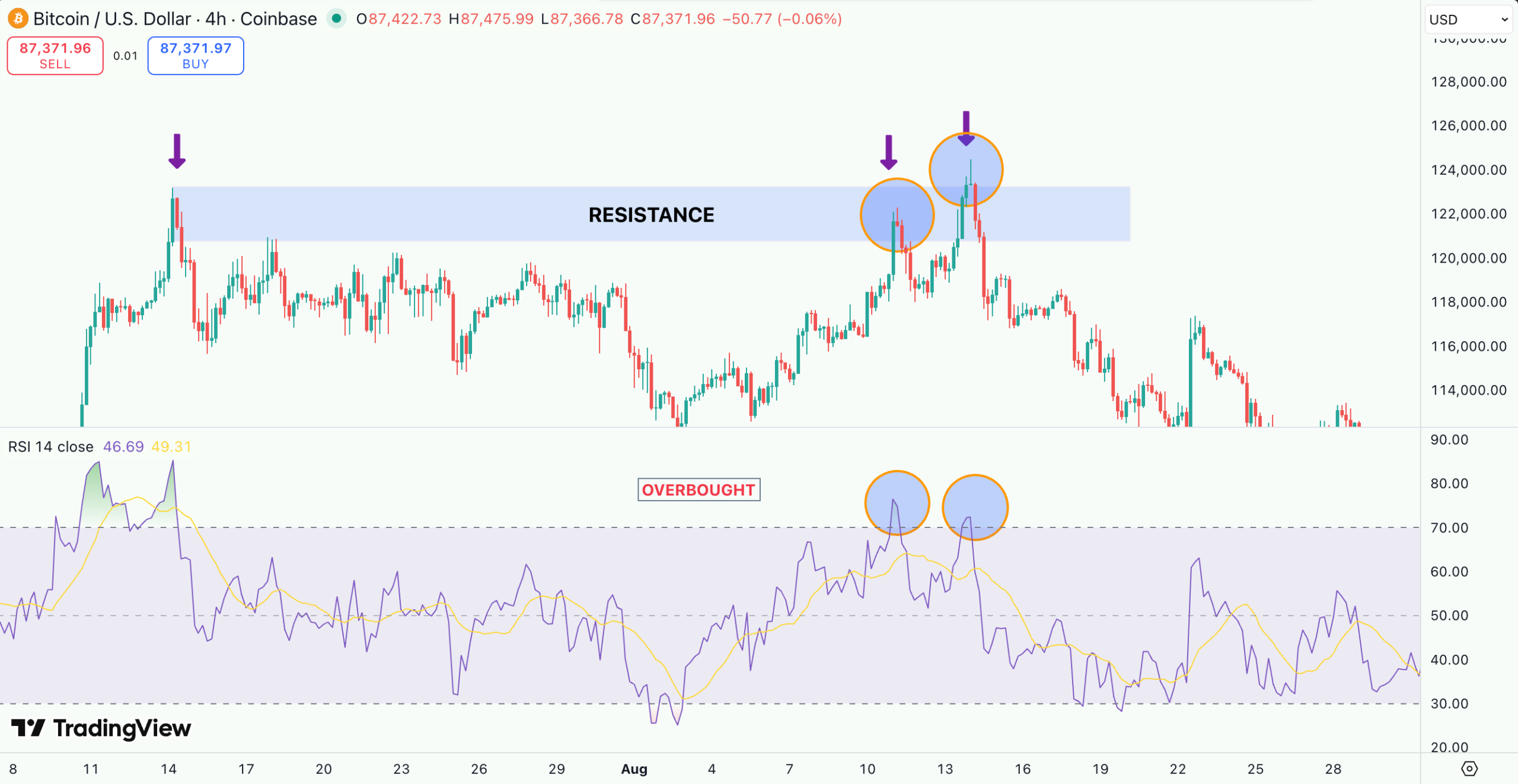
- Above 70 → often signals overbought conditions
- Below 30 → often signals oversold conditions
- Around 50 → indicates neutral or balanced momentum
These levels aren’t “automatic buy or sell signals,” but rather context clues about market strength and potential exhaustion.
Why Traders Use RSI
The RSI isn’t just about spotting extremes; it can help traders:
- Judge whether price momentum is strengthening or weakening
- Identify potential pullbacks or rebounds
- Confirm trends
- Spot early signs of reversals
Here are a few common ways RSI is interpreted in practice:
- When RSI approaches 70+, traders watch for slowing upside momentum
- When RSI approaches 30‑, traders look for signs that selling pressure may be fading
- When RSI spends time above 50, it often supports a bullish environment
- When RSI stays below 50, the market bias tends to lean bearish
RSI becomes especially helpful when combined with trend structure, support‑resistance zones, and volume.
RSI Divergence
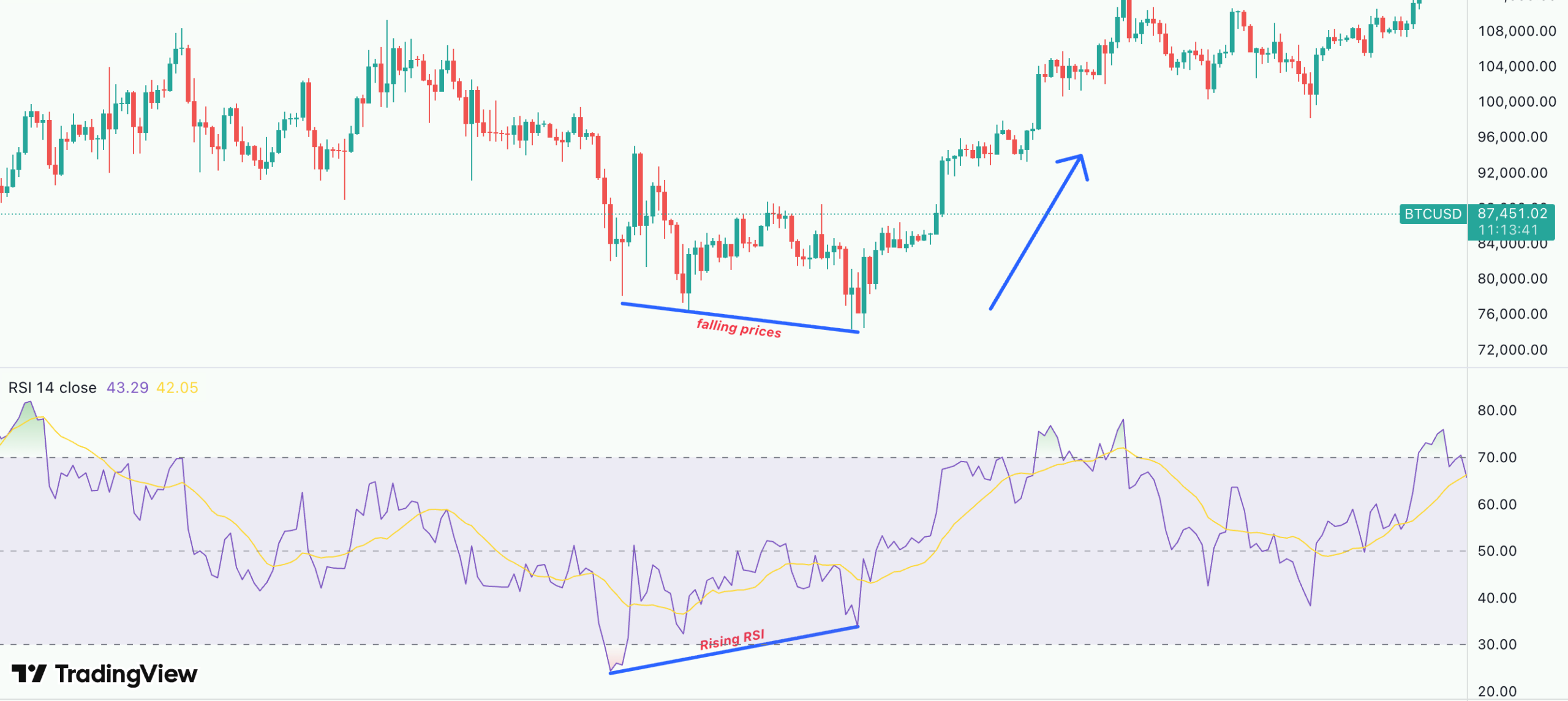
Divergence happens when price and RSI move in opposite directions.
- Bullish divergence
- Price makes lower lows
- RSI makes higher lows
- Suggests weakening selling pressure
- Bearish divergence
- Price makes higher highs
- RSI makes lower highs
- Suggests fading bullish strength
Divergence can be powerful, but it works best when aligned with support or resistance zones.
RSI Swing Rejections
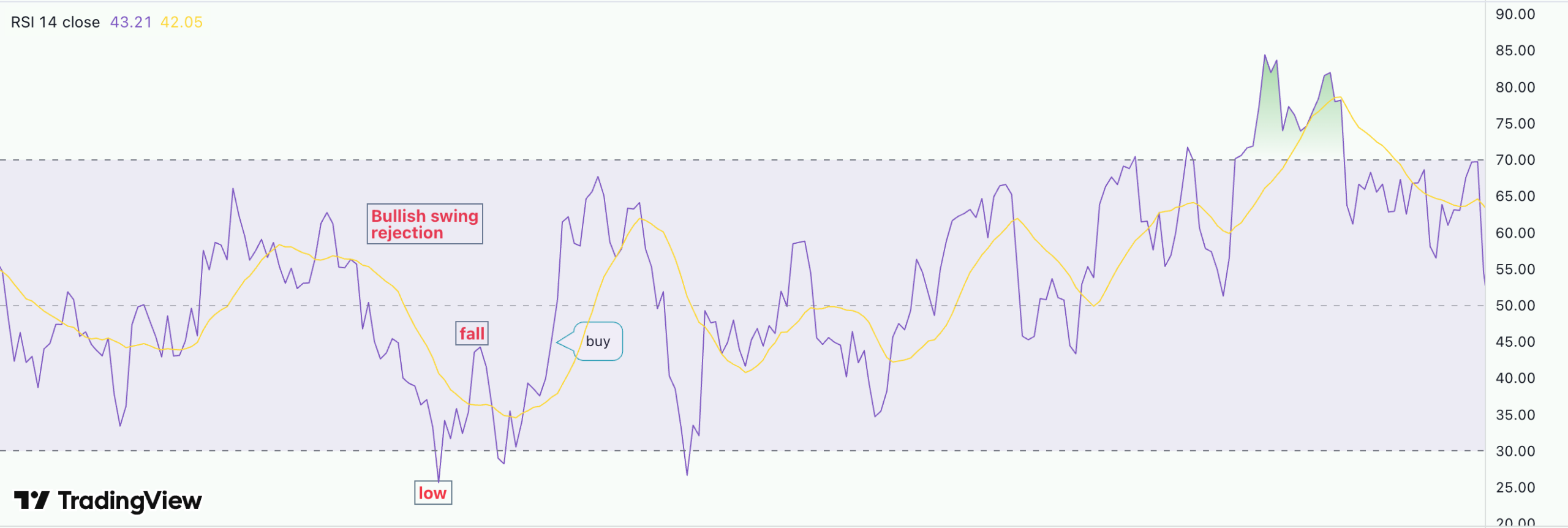
Swing rejections focus on RSI behavior after leaving an extreme zone.
Bullish swing rejection (oversold recovery):
- RSI drops below 30
- RSI moves back above 30
- RSI forms a higher low
- RSI breaks its previous RSI high
This can signal momentum shifting upward.
Bearish swing rejection (overbought cool‑off):
- RSI rises above 70
- RSI drops back below 70
- RSI forms a lower high
- RSI breaks its prior RSI low
These patterns are similar to drawing trendlines, but on the RSI itself.
How RSI Is Commonly Applied in Real‑World Trading
Here are some practical ways traders use RSI:
- To confirm the direction of the prevailing trend
- To look for momentum shifts near key price levels
- To avoid chasing extended price moves
- To time exits rather than force entries
- To evaluate whether a pullback is healthy or weakening
Examples:
- A bullish trader may wait for RSI to bounce from 40–50 before re‑entering an uptrend
- A bearish trader may look for RSI to reject near 50–60 during a downtrend
- A range trader may favor 70 / 30 reversals inside sideways markets
The indicator becomes more meaningful when paired with:
- Support & resistance
- Moving averages
- Market structure
- Volume trends
Strengths and Limitations of RSI
Like any indicator, RSI has advantages and boundaries.
Where RSI performs well
- Sideways or range‑bound markets
- Short‑term momentum analysis
- Identifying exhaustion after extreme moves
- Supporting other indicators
Where RSI can mislead
- Strong trending markets
- Highly volatile assets
- Parabolic price moves
- News‑driven spikes
RSI can remain overbought or oversold much longer than expected, especially in crypto or fast‑moving stocks. That’s why context always matters.
How Traders Customize RSI
Some traders adjust RSI settings based on their style:
- 5–9 period RSI → more sensitive, used for scalping & day trading
- 14-period RSI → standard swing‑trading setting
- 21–30 period RSI → smoother curve for long‑term investors
Others modify levels:
- Uptrend markets might use 40–90
- Downtrend markets might use 10–60
There isn’t one “right” configuration; the best approach depends on the timeframe, asset type, and strategy.
What Makes RSI So Useful?
The RSI oscillator remains popular because it compresses a lot of information into a single line: strength, momentum, and potential exhaustion. Rather than predicting the future, RSI helps traders interpret the current behavior of the price:
- Is buying or selling pressure accelerating?
- Is the trend strong or weakening?
- Is the price stretched, or simply trending?
When combined with good risk management and broader chart analysis, RSI can be a powerful decision‑support tool, not a shortcut, but a guide that helps traders read the market more clearly.