 English
  Nederlands
  Deutsch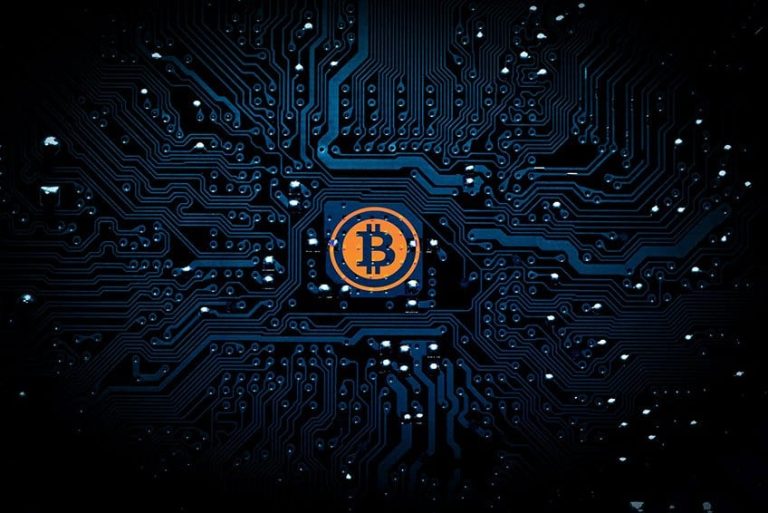
Bitcoin is the first ever working cryptocurrency. Bitcoin consists of two ‘main parts’. On the one hand, you have the coin itself (means of payment) and on the other hand, you have the underlying technology of the Bitcoin network, the ‘blockchain‘. With Bitcoin, payments can be made without intermediaries such as banks or credit card companies. The control of the correct number of available Bitcoins to make the transaction is done automatically by the blockchain.
So called ‘miners’ solve very complex calculations of multiple combined Bitcoin transactions. The first miner that solves the puzzle creates the next block in the blockchain. Each new block contains a reward of 3.125 bitcoins (after the April 2024 halving), supplemented with the paid fees of all confirmed transactions. This is the first confirmation of a transaction. With each new block, the previous block is confirmed again, because each new block is a derivative of the previous one. Often a cryptocurrency exchange requires at least six confirmations before a deposit is accepted.
Table of contents
- The history of Bitcoin
- Major milestones in Bitcoin’s history
- Applications of Bitcoin
- The Lightning Network
- Ordinals and Bitcoin NFTs
- Institutional adoption
- The Bitcoin protocol
- Energy consumption and environmental impact
- Regulatory landscape
- Bitcoin dominance
- Can you buy a part of a bitcoin?
- Where can you buy bitcoin?
The history of Bitcoin
Bitcoin was invented in 2008 by a software developer called Satoshi Nakamoto. Who Satoshi Nakamoto really is and whether this is his real name is still unknown to this day. There are people who have had e-mail contact with him/her, but it always remained anonymous. The last known contact with Satoshi Nakamoto was several years ago.
Bitcoin was invented due to the lack of trust in banks.
Banks have a great impact on the world and can influence the monetary system by means of printing money (central banks). Also ‘ordinary’ banks put extra money into circulation through the method of fractional-reserve banking. In addition, we must rely on a third-party to hold, transfer, and pay for our money. This situation is solved with the Bitcoin. Essentially, you will have the opportunity to be your own bank.
Major milestones in Bitcoin’s history
Since its creation, Bitcoin has achieved several historic milestones. In 2021, El Salvador became the first country in the world to adopt Bitcoin as legal tender, allowing citizens to pay taxes and settle debts using the cryptocurrency. That same year, the Taproot upgrade was activated, improving Bitcoin’s privacy features and enabling more complex smart contract functionality.
In January 2024, the U.S. Securities and Exchange Commission approved the first spot Bitcoin ETFs, opening the door for mainstream investors to gain exposure to Bitcoin through traditional brokerage accounts. This marked a significant step toward institutional acceptance and brought billions of dollars in new investment into the market.
Bitcoin’s price history reflects its growing adoption. From being worth mere cents in its early days, Bitcoin reached an all-time high above $100,000 in late 2024, cementing its position as a major global asset class.
Applications of Bitcoin
Bitcoin is used as a means of payment and has become a kind of reserve currency for other cryptocurrencies (like the dollar is for global currencies) on exchanges. Bitcoin transactions on the main network can become expensive compared to other cryptocurrencies, especially at times when many transactions take place. The price that has to be paid to miners can rise considerably during periods of high demand (for example: check current fees).
The invention of the Bitcoin network was also the starting point for many other projects based on blockchain.
The Lightning Network
To address Bitcoin’s scalability challenges, the Lightning Network was developed as a “layer 2” solution built on top of the Bitcoin blockchain. The Lightning Network enables near-instant transactions with extremely low fees by creating payment channels between users. Only the opening and closing of these channels are recorded on the main blockchain, while thousands of transactions can occur off-chain in between.
This technology has made Bitcoin practical for everyday purchases like buying coffee or paying for small services. Countries like El Salvador have integrated Lightning payments into their national Bitcoin infrastructure, demonstrating its real-world utility.
Ordinals and Bitcoin NFTs
In 2023, a new use case emerged for Bitcoin through the Ordinals protocol. This innovation allows data such as images, text, and other media to be inscribed directly onto individual satoshis (the smallest unit of Bitcoin). These inscriptions have created a new market for Bitcoin-native NFTs and digital collectibles, sparking debate within the community about the intended use of Bitcoin’s block space.
Institutional adoption
Bitcoin has moved far beyond its early days as an experiment among cryptography enthusiasts. Major corporations now hold Bitcoin on their balance sheets as a treasury reserve asset. Companies like MicroStrategy have accumulated tens of billions of dollars worth of Bitcoin, viewing it as a hedge against inflation and currency debasement.
Traditional financial institutions including BlackRock, Fidelity, and numerous banks now offer Bitcoin-related products and services to their clients. This institutional involvement has brought increased liquidity, regulatory clarity, and mainstream credibility to the Bitcoin market.
The Bitcoin protocol
The Bitcoin network utilizes the proof of work protocol.
Energy consumption and environmental impact
Bitcoin mining requires significant computational power, which translates to substantial energy consumption. This has made environmental impact one of the most debated topics surrounding Bitcoin. Critics argue that the energy usage is wasteful, while proponents point out that an increasing percentage of Bitcoin mining now uses renewable energy sources.
Some mining operations have set up near hydroelectric dams, solar farms, or in regions with excess energy capacity. Others capture flared natural gas that would otherwise be wasted. The Bitcoin mining industry continues to evolve, with ongoing efforts to improve energy efficiency and reduce environmental impact.
Regulatory landscape
Bitcoin regulation varies significantly around the world. Some countries have embraced it with clear regulatory frameworks, while others have imposed restrictions or outright bans. In the United States, Bitcoin is treated as property for tax purposes and is regulated by multiple agencies. The European Union has implemented comprehensive crypto regulations through its MiCA framework.
Understanding the regulatory environment in your jurisdiction is important before buying or using Bitcoin. Tax obligations, reporting requirements, and legal protections can differ substantially depending on where you live.
Bitcoin dominance
Bitcoin remains the largest cryptocurrency by market capitalization, typically accounting for 40-60% of the total crypto market value. This metric, known as “Bitcoin dominance,” fluctuates based on market conditions and the performance of alternative cryptocurrencies.
Many investors view Bitcoin differently from other cryptocurrencies. Its first-mover advantage, proven security track record, fixed supply of 21 million coins, and decentralized nature have earned it a reputation as “digital gold” – a store of value rather than just a payment method.
Can you buy a part of a bitcoin?
In the beginning, the value of a Bitcoin was only worth a few dollars. Now, however, one Bitcoin can cost tens of thousands or even over a hundred thousand dollars. For many people, it is therefore no longer financially feasible to buy an entire bitcoin. Fortunately, this is not necessary!
A Bitcoin can be divided into pieces just like normal currency. But it goes much further. The smallest amount of one dollar is one cent or $0.01. Bitcoin allows for much smaller divisions.
The smallest quantity can be 0.00000001. That is eight decimals. The smallest quantity is called a Satoshi, and is of course, named after the creator of bitcoin. At a price of $100,000 per Bitcoin, one Satoshi is worth $0.001. With the Lightning Network, it’s even possible to transact in millisatoshis for micropayments.
This makes Bitcoin now, and in the future, very suitable to use as a means of payment. The high transaction costs on the main chain remain a consideration for small purchases, but the Lightning Network has largely solved this problem for everyday transactions.
Where can you buy bitcoin?
Before you can buy Bitcoins you must first have a place (address) where you can save Bitcoins. This can be done on a trading platform (exchange) or a wallet, which is completely under your own control, if you can access the private keys.
You can create a wallet in different ways:
- On a cryptocurrency exchange (Binance, Kraken, etc.)
- By installing software on your computer or phone
- By purchasing a hardware wallet from Trezor, Ledger, or others (Ledger Nano S Plus review)
- With an online wallet service
For maximum security and true ownership of your Bitcoin, using a hardware wallet or self-custody software wallet where you control the private keys is recommended. Remember the saying in crypto: “Not your keys, not your coins.”
Now that you have a place where you can save Bitcoins, you can start buying Bitcoins. You can purchase Bitcoins in different places:
- On a cryptocurrency exchange
- At an online exchange service (Convert money to bitcoin, or altcoin to bitcoin)
- With a bitcoin ATM (You can find locations here: coinatmradar.com)
- Through a Bitcoin ETF in your brokerage account (for investment exposure without holding actual Bitcoin)
 Stay Ahead in Crypto