English
  Nederlands
  Deutsch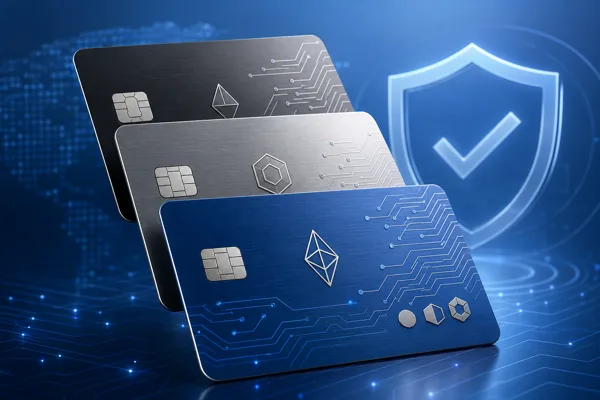




Key Takeaways
- The best crypto card is the one you can trust with your money, not the one with the flashiest cashback rate.
- We ranked five cards by Trustpilot score, regulatory licensing and track record, with rewards and fees as tiebreakers.
- Revolut, Coinbase, Bitpanda and Kraken lead the field, while Gnosis Pay earns a spot by removing the need to trust the issuer at all.
In This Article
Why Trust Beats Cashback
A crypto card lets you spend digital assets at any shop that takes Visa or Mastercard, with your coins converted to local currency the moment you pay. The market is crowded, and the headline cashback numbers often come from the riskiest providers. For this list we ranked trust first: Trustpilot scores checked in June 2026, regulatory licensing under frameworks like the EU’s MiCA regime, and each company’s record on hacks, withdrawals and enforcement actions. Rewards and fees served only as tiebreakers, and one pick earns its place by removing the need to trust the issuer at all. The result is five cards from companies that have shown they can hold customer money responsibly.
1. Revolut 

Revolut earns the top spot on reputation alone. It carries the highest Trustpilot rating in this group and is now a fully licensed bank in both the UK and the EU, which places customer deposits under formal protection schemes. Its card spends crypto by converting it to your local currency at checkout, and a dedicated physical crypto card arrived in May 2026.
- Trustpilot 4.7 out of 5 from 415,000+ reviews (June 2026), the largest review base on this list
- UK banking licence granted March 2026 with FSCS cover up to £120,000; EU deposits held at Revolut Bank UAB under ECB and Bank of Lithuania oversight
- MiCA crypto licence via Cyprus (CySEC); 180+ tokens available to spend
- No cashback on crypto payments, and conversion spreads apply at checkout
- Founded 2015, 65 million+ users, no hack or insolvency on record
2. Coinbase

Coinbase is the only publicly traded company on this list, listed on the Nasdaq under the ticker COIN. That status brings audited financials and disclosure requirements that private competitors avoid. Its Visa debit card is also one of the few widely available to US residents alongside UK and European users.
- Trustpilot 4.0 out of 5 from around 22,000 reviews (June 2026)
- Holds a New York NYDFS BitLicense and an EU MiCA licence; the US card is sponsored by Pathward, N.A.
- Available in 49 US states, the UK and most of the EEA
- Up to 4% back in rotating crypto in the US, with no staking requirement
- A 2.49% fee applies when spending non-stablecoin crypto, so spending USDC keeps costs lowest
3. Bitpanda

Bitpanda is the European specialist of the group, built in Vienna and regulated across three EU jurisdictions. It has operated since 2014 without a major hack or enforcement action, a clean record that few crypto firms can claim.
- Trustpilot around 4.0 out of 5 from roughly 15,000 reviews (June 2026)
- Separate MiCA licences in Austria (FMA), Germany (BaFin) and Malta (MFSA)
- Bitpanda Visa Platinum debit card pays 1% cashback with 0% foreign exchange fees
- Card reissued in April 2025 with Transact Payments Malta as issuer; 600+ assets spendable
- Available across the EEA; Apple Pay and Google Pay supported
4. Kraken

Kraken has the longest unbroken track record here, trading since 2011 without an exchange hack or insolvency event. Its Krak Mastercard is newer, launched in 2025, but it is issued through Monavate, an FCA-authorised e-money institution, and carries some of the lowest fees on this list.
- Trustpilot 3.4 out of 5 from about 7,300 reviews (June 2026)
- Holds a Wyoming SPDI charter, a Central Bank of Ireland e-money licence and a US broker-dealer registration
- 1% cashback paid in Bitcoin, euros or pounds, with a 0% transaction fee and 0% FX markup
- Available in the UK and EEA, with a global rollout announced; 400+ assets supported
- No token staking required to earn rewards
5. Gnosis Pay

Gnosis Pay takes a different route to trust: rather than asking you to trust the company, it removes the need to. Your funds stay in your own Safe smart account on Gnosis Chain, so the issuer cannot freeze or move your money the way a custodial provider can. The card is issued by Monavate, an FCA-authorised e-money institution, and built by the team behind Safe, the most widely used smart-contract wallet in crypto. Its Trustpilot page is still too new for a meaningful score, so it earns this spot on architecture and a clean record rather than a star rating. The main complaint to watch for on Trustpilot is slow or unresponsive customer support, a real drawback if something goes wrong, though the self-custody design means your funds are never locked inside the company in the first place.
- Self-custodial design: funds stay in your own Safe smart account until a payment is authorised, so the issuer cannot unilaterally freeze them
- Card issued by Monavate (FCA-authorised e-money institution) on the Visa network; IBAN provided by Monerium
- Launched July 2023 by the Gnosis team behind Safe; no hack, insolvency or enforcement action on record
- 1% to 4% cashback tiered by your GNO balance, paid weekly in GNO; interim rewards programme runs to 30 June 2026
- €30 annual fee with 0% FX; available across the EEA, UK and Switzerland, plus Brazil and Argentina
Big Names We Left Off
We checked Trustpilot scores and licensing for every major card before settling on five. A few well-known names were left out for clear, factual reasons:
- Crypto.com: wide global reach and strong licensing, but a 1.3 out of 5 Trustpilot score and a history of repeated reward cuts
- Gemini: a 1.2 out of 5 Trustpilot score and the 2022 Earn collapse that froze around $900 million in customer assets
- Wirex: a 2.6 out of 5 Trustpilot score with recurring complaints about frozen accounts and withheld funds
- Bitget: a 2.5 out of 5 Trustpilot score plus revoked licences in the US and Canada and warnings from several regulators
The Risks Worth Knowing
Even the most trusted card carries trade-offs that are easy to miss behind a headline cashback rate. Read these before you commit money or lock up a token.
- Token lockups: the highest reward tiers often require staking a provider’s own token for months, so your capital is frozen in place. You ride out every dip, and you also cannot sell to lock in gains if the token suddenly rallies.
- Volatile rewards: cashback paid in a native token like CRO, NEXO or GNO can lose value quickly, so an advertised rate is rarely the rate you actually keep.
- Changing terms: issuers regularly cut perks, reshuffle tiers or close programmes entirely, as Binance did across the EEA in 2023, so the deal you sign up for may not last.
- Hidden conversion costs: spending non-stablecoin crypto can trigger liquidation and currency-conversion fees that quietly offset much of your cashback.
- Frozen funds and slow support: most cards are custodial, accounts can be locked during compliance checks, and scripted or AI-only support can leave urgent problems unresolved for days.
How to Choose the Right Crypto Card
The right card depends on where you live and how you plan to use it. Availability is the first filter, since several strong cards are limited to Europe or the US. After that, weigh the trade-off between rewards and cost: high cashback paid in a provider’s own volatile token can be worth far less than a steady 1% paid in Bitcoin or fiat.
Spending stablecoins like USDC avoids the conversion fees that eat into rewards on most cards, so a card that supports stablecoin spending often costs less to use day to day. Finally, remember that most cards here are custodial, meaning the issuer holds your funds, so the company’s reputation is part of the product itself. A self-custody card like Gnosis Pay flips that equation, but for the rest, check the current Trustpilot score and regulatory status yourself before signing up, because both can change quickly in this market.
Watch: The Most Trusted Crypto Cards
Prefer to watch? Here is our full rundown of the five most trusted crypto cards, in under three minutes.
 Stay Ahead in Crypto