English
  Nederlands
  Deutsch


Key Takeaways
- A falling knife is a rapid, high-volume price drop, often triggered by negative news, regulation, or a broader loss of confidence in an asset.
- Trying to buy mid-decline is risky because the bottom is almost impossible to time and emotional decisions tend to amplify losses.
- Dollar-cost averaging, diversification, stop-loss orders, and a long-term mindset reduce exposure to these sharp drops in crypto.
In This Article
A falling knife is a trading term used to describe the rapid decline in the value of an asset like a stock or cryptocurrency. The expression is derived from the popular idiom “Don’t try to catch a falling knife”, meaning that buying an asset while its value is dropping sharply is dangerous because the price may fall further still. The concept is especially relevant to cryptocurrencies, which are known for high volatility and dramatic price swings. In this article we explore the phenomenon of falling knives in crypto and the risks and strategies tied to trading during these turbulent moments.
Understanding the Falling Knife
In financial markets a falling knife is typically characterised by a sharp, rapid drop in the price of an asset, often accompanied by elevated trading volume. In many cases it is triggered by a specific event or a combination of factors that lead to a loss of confidence among investors: negative news, regulatory changes, or broader trends that reshape the perception of the asset.
Cryptocurrencies such as Bitcoin and Ethereum have experienced numerous instances of falling knives since their inception. Due to the highly speculative nature of these digital assets and the relative immaturity of the asset class, it is not uncommon for prices to drop significantly over a very short period. Traders who try to buy during these declines, hoping to capture profits when the market rebounds, often find themselves catching the falling knife.
Example of a Falling Knife
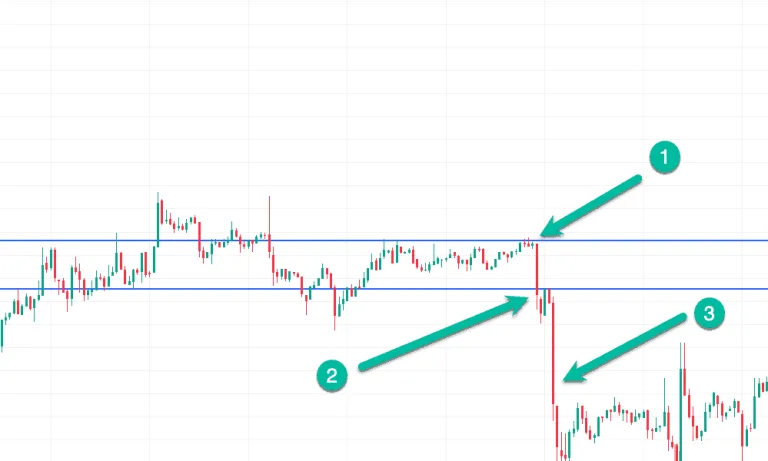
The example above shows the stock price hitting resistance at 1. Shortly after touching that level, it starts to decline. At 2, the price falls through support. It then begins to recover, and a trader might buy in, predicting a fakeout in the hope the share price bounces back. Instead, the price drops further until it hits bottom at 3. This is a classic example of why you should not try to catch a falling knife, and why it is wiser to wait until the price shows real signs of recovery.
Falling Knife vs a Healthy Dip
Not every price drop is a falling knife. A healthy DIP is a shallow, short-lived pullback inside an otherwise intact uptrend, often on declining volume, and the asset’s fundamentals remain unchanged. A falling knife, by contrast, is steep, fast, and usually accompanied by a clear catalyst (a hack, a regulatory action, a major exchange failure) and rising volume on the way down. The practical test is simple: if you cannot explain what has changed about the asset, and the chart is still cutting through support levels without pausing, you are looking at a knife, not a dip.
Risks of Falling Knives
- Timing the market. Predicting exactly when a declining asset will bottom is nearly impossible. Buy too early and the price keeps falling; wait too long and you miss the better entry.
- Emotional decision-making. Watching an investment plummet is stressful, and it is natural to want to cut losses or to “average down” by buying more. Trades driven by emotion tend to lead to worse outcomes, not better ones.
- Limited information. The crypto market is still relatively young, and the lack of unified regulation can make it hard to access accurate, timely information during a panic. Working with experienced crypto consultants can help bridge this gap, offering expert analysis grounded in market trends, regulatory developments, and asset fundamentals.
Strategies to Mitigate the Risks
- Dollar-cost averaging. Invest a fixed amount at regular intervals regardless of price. Spreading purchases over time reduces the impact of any single price spike or crash and removes the need to time the market perfectly.
- Diversification. Spread investments across asset classes, including stocks, bonds, and cryptocurrencies, so no single market or coin dictates the outcome of your portfolio.
- Risk management. Set stop-loss orders that automatically exit a position below a defined price, and use portfolio tools to track exposure. A clear, written risk tolerance helps you avoid impulsive decisions when markets turn.
- Research and education. Stay current with news, protocol developments, and regulatory changes, and understand the technology and use cases behind each asset. The better informed you are, the easier it becomes to tell a temporary scare from a real structural problem.
- Long-term perspective. Instead of trading every swing, focus on the long-term thesis. Selecting assets with strong fundamentals and growth potential gives you room to absorb temporary setbacks without panic-selling at the worst possible moment.
Final Thoughts: Don’t Catch a Falling Knife When You Invest
The falling knife is a stark reminder of the volatility built into digital assets. It can appear at any moment during trading hours. While capturing big profits during a downturn is tempting, attempting to catch the knife mid-fall is dangerous and costly. Dollar-cost averaging, diversification, disciplined risk management, ongoing research, and a long-term mindset all reduce that risk and improve your odds in the unpredictable world of crypto.
As the cryptocurrency market matures, investors need to stay alert and adaptive. Understanding the mechanics of falling knives, and applying the strategies above, will help you navigate volatile periods with a clear head and improve your long-term outcomes.
And if you did catch the knife and “cut your hand”, it can still make sense to hold the asset. If the project is fundamentally solid, the price will, in most cases, eventually recover.
 Stay Ahead in Crypto