English
  Nederlands
  Deutsch
Key Takeaways
- The next phase of real world assets is financialization: tokenizing real operating businesses with genuine cash flow, not just parking Treasuries on-chain.
- The projects worth watching combine three things: experienced operators, robust legal structure (SPVs, KYC/AML, regulated vehicles), and verifiable, recurring revenue.
- This produces sustainable real yield instead of yield manufactured from token emissions, but it also imports real-world execution, regulatory and liquidity risk that pure crypto rarely faces.
In This Article
The Quiet Shift Happening in 2026
For most of the last two years, the pitch for real world assets was simple to the point of being lazy: take something that exists off-chain, wrap it in a token, and call it innovation. Treasuries, property deeds, gold bars, even fine wine got the same treatment. The narrative rewarded announcements, not operations.
Something is shifting in 2026. The more serious end of the market has stopped asking “what can we tokenize?” and started asking a harder question: “what real business is actually generating the yield, and can we prove it?” That shift deserves a name worth using: RWA financialization. It describes the move from simply representing assets on-chain toward tokenizing real operating businesses that produce verifiable, recurring cash flow, wrapped in legal structures that would survive contact with a regulator.
This is not another hype cycle in a suit. It is the RWA narrative finally growing up. The projects that win the next phase will not be the ones with the loudest token launch. They will be the ones that pair experienced operators, real legal plumbing, and cash flows you can actually check.
From Tokenization to Financialization
To see where this is going, it helps to remember where it started. The first real RWA wave was built on the safest asset on earth: US government debt. Tokenized Treasury products gave crypto something it had been missing since the collapse of algorithmic yield, a boring, dollar-denominated return backed by an actual coupon. Institutions were comfortable, the compliance story was clean, and capital flowed in. In much the same way that stablecoins turned dollars into programmable money, tokenized Treasuries turned government debt into a token you could hold in a wallet.
The numbers show how fast this happened. Excluding stablecoins, the tokenized RWA market crossed roughly $25 billion in early March 2026, after nearly quadrupling from about $6.4 billion a year earlier, according to on-chain data reported by CoinDesk. By the end of the first quarter it sat closer to $27 to $29 billion, and industry trackers had it above $31 billion by mid-May. Tokenized Treasuries remain the single largest category at roughly $13 billion, led by products from BlackRock, Ondo, Circle and Franklin Templeton.
Here is the catch. A tokenized Treasury is a beautiful wrapper around a passive financial claim. It does not create yield; it forwards yield that already exists in the traditional system. When rates fall, that return falls with them, and the appeal thins out. Treasuries taught crypto that RWAs could be safe and liquid. They did not teach it how to generate return from real economic activity.
That gap is exactly what financialization tries to close. Instead of forwarding a government coupon, the next generation of real cash flow RWAs aims to bring the underlying business on-chain: the shipping company earning charter revenue, the property portfolio collecting rent, the lender booking interest from real borrowers. The yield is not borrowed from traditional finance. It is produced by an operator doing work. Binance Research captured the mood when it described 2026 as the year RWA tokenization matured from a Treasury-dominated narrative into a diversified yield ecosystem.
There is a structural signal underneath the headline growth, too. Surveys of RWA issuers suggest the expansion is being driven by capital formation rather than speculation: more than half said their main reason for tokenizing was raising funds more efficiently, while only about 15% pointed to secondary-market trading. In other words, real businesses are using tokenization to fund real operations. That is the whole thesis in one data point.
What Operator-First Actually Means
If financialization is the destination, operator-first tokenization is the road. The phrase points at a simple reordering of priorities. In the hype era, the token came first and the asset was an afterthought, sometimes a marketing prop. Operator-first flips that. The business and its operator come first; the token is just the access layer.
Strip away the jargon and serious RWA projects tend to share three traits:
- Experienced operators, not just token teams. Someone involved has actually run the underlying business, whether that is a fleet, a property portfolio or a lending book, long before a token existed.
- Robust legal structure. Real assets live inside a legal system. Special purpose vehicles ring-fence the assets, KYC/AML gates keep the regulated layer compliant, and a proper vehicle gives token holders an enforceable relationship to the cash flow.
- Verifiable, recurring cash flow. Charter revenue, rental income, loan repayments: money that arrives on a schedule and can be audited, not projected on a pitch deck.
Most early RWAs failed at least one of these tests, and usually all three. A token “backed by real estate” with no named property, no SPV and no audited rent roll is not a real world asset. It is a narrative with a contract address. The distinction that matters now is between a passive financial claim, like a Treasury, and an operational cash flow that comes from a business actually doing something.
This is why infrastructure has started to matter as much as marketing. Standards designed for slow-settling assets, and protocols building composable real yield from real receivables, give operators a way to plug genuine revenue into DeFi without pretending the underlying asset behaves like an instantly liquid token. The plumbing is quietly becoming the product.
Case Study: Ethra Ship and the Maritime Model
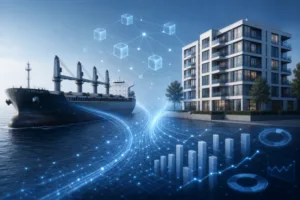
Consider maritime shipping, an unglamorous, capital-heavy industry that happens to throw off exactly the kind of cash flow financialization is chasing. Dry bulk vessels carry commodities like iron ore, grain and coal, and they earn revenue measured in Time Charter Equivalent, or TCE: roughly, the average daily rate a ship earns after voyage costs. Individual vessels are commonly valued between $30 million and $120 million, so this is real capital, not a meme.
Ethra Ship is one of the first projects trying to bring this maritime RWA model on-chain. According to its June 2026 launch announcement, the protocol is backed by Ethra Invest, a firm it says has been acquiring, managing and commercially operating dry bulk vessels since 2021. The design it describes is a clean illustration of the two-layer pattern operator-first projects tend to adopt:
- A permissionless layer: the $SHIP token, positioned as a governance and utility asset that lets holders participate in the ecosystem and view a fleet dashboard.
- A regulated layer: a KYC/AML-gated structure in which vetted investors take fractional exposure to SPVs that own the operating vessels and share in the charter revenue.
On paper, this is what maturity looks like: a public token for coordination, a compliant vehicle for actual ownership, and a real-world operator running the ships.
It also shows why this thesis demands skepticism rather than faith, and it is worth being direct about that. Ethra Ship’s claimed four-year operating history is, at the time of writing, self-reported, and there is no independent maritime-registry trail naming its vessels that we could verify. The live metrics on its own site, including fleet size, utilization and daily TCE, carry an explicit disclaimer that they are simulated for illustration. And crucially, the project’s own whitepaper states that the $SHIP token does not represent ownership of the vessels, the SPVs or the revenue streams. The tradeable token and the cash flow are, by design, two different things.
None of this makes the model wrong. If anything, it makes the model clearer. The value in financialization lives in the regulated SPV layer where the cash flow actually sits, not in the freely trading governance token that markets get excited about. Ethra Ship is best read not as a settled success but as a test case: a real-world claim that the market, and regulators, now get to verify. That is a healthier place for RWAs to be than the announce-and-moon pattern that came before.
Case Study: Flint and Real Estate RWA Vaults
If shipping shows the model at the frontier, real estate RWA vaults show it getting productized for ordinary on-chain users.
Real estate has always been the poster child for tokenization, and also its graveyard. Plenty of projects promised fractional property ownership and delivered illiquid tokens tied to a single building and a lot of legal ambiguity. The vault approach tries something different: abstract the legal and underwriting complexity away from the user and expose only a clean, yield-bearing position.
Flint is an example of this newer design. It is built on ERC-7540, an asynchronous extension of the widely used ERC-4626 tokenized vault standard that was finalized in 2024 specifically to handle assets that cannot settle instantly, which is exactly the situation with real-world assets. Flint’s vault runs on Lagoon Finance, a non-custodial vault infrastructure protocol, and according to its launch coverage it channels capital toward real estate operations in developed European markets.
The user experience is the point. Instead of asking a depositor to understand SPVs, jurisdictions and underwriting, the vault handles that machinery underneath and presents a single position that earns from real estate operations. The legal complexity does not disappear; it gets absorbed by the structure. For a wider look at how property is being brought on-chain, our overview of tokenized real estate investment maps the broader landscape.
A note of discipline here too. Some specifics that circulate about vaults like Flint, such as exact distribution schedules or custody arrangements, come from promotional material rather than independent audits, and readers should confirm them against primary documentation before treating them as fact. The design pattern is sound and the infrastructure beneath it is real and increasingly adopted by names like Centrifuge and Ondo. Whether any single vault delivers still depends on the operator and the assets underneath.
Where Financialization Goes Next
Shipping and real estate are early examples, not the boundary. The same operator-first, cash-flow-first logic extends to any business with predictable revenue and a clean legal wrapper.
Private credit is the most obvious next leg, and arguably it is already the largest operating-asset category on-chain, with several measures putting tokenized private credit well into the billions. Here the cash flow is loan repayments from real borrowers, and protocols such as Anzen’s private credit model are among those working to bring that underwriting on-chain. Lending against real economic activity produces a yield with little connection to crypto’s internal rate cycles, which is precisely its appeal.
From there the list gets long: trade finance and invoice factoring, revenue-share deals with operating companies, royalties, equipment leasing, even agricultural output. Purpose-built RWA chains such as Plume are positioning themselves as the settlement and compliance layer for exactly this kind of tokenized operating business, betting that operators will want infrastructure with identity and legal tooling baked in rather than bolted on.
Optimism should not crowd out the risks, and financialization imports a set that pure crypto rarely deals with:
- Operator execution. A tokenized business is only as good as the people running it. Ships sit idle, tenants default, borrowers stop paying. On-chain packaging does not remove real-world operational risk; it just makes it tradeable.
- Regulation. SPVs, securities law and KYC/AML gates are features, not bugs, but they are also moving targets that differ by jurisdiction. A structure that is compliant in one country may not travel to the next.
- Liquidity. Real assets are illiquid by nature. Async vault standards exist because you cannot redeem a share of a cargo ship on demand. Investors should expect exit friction, not instant liquidity.
- Verification. As the shipping example shows, the hardest part is proving that the operator, the assets and the cash flow are real. “Trust me” is not a legal structure.
The through-line is that financialization does not make RWAs risk-free. It makes the risks honest, and it puts them where they belong: in the business, not in the tokenomics.
Why 2026 Is the Real Test
The early RWA era proved that almost anything can be tokenized. The financialization era has to prove something harder: that tokenizing a real operating business produces durable, real yield without the emissions games and vaporware that defined the last cycle.
The framework to watch is not complicated. Ask three questions of any real cash flow RWA project. Is there an experienced operator actually running the underlying business? Is there a legal structure, an SPV or regulated vehicle with real KYC/AML, that would hold up under scrutiny? And is the cash flow verifiable rather than merely asserted? Projects that answer yes to all three are building the sustainable layer of this market. Projects that dodge any of them are usually selling the old hype in new packaging.
For the rest of 2026 and into 2027, a few things are worth predicting and then checking. Real yield RWAs backed by operating businesses should keep taking share from Treasury-only products as rates soften and investors hunt for return uncorrelated to crypto. The winning projects will look almost boring: strong compliance, named operators, audited numbers, unremarkable tokenomics. And the gap between projects that can prove their operations and those that only claim them will widen into the defining line of the sector.
Tokenization was the experiment. Financialization is the business. The interesting question for the next eighteen months is not how much can be put on-chain, but how much of it is actually real. That is a far better question for crypto to be asking, and it is the reason this quieter, more grounded phase of real world assets may end up mattering more than the loud one that came before.
Disclaimer: This article is for informational purposes only and is not financial or investment advice. The projects named, including Ethra Ship and Flint, are cited as illustrative examples of an emerging model, not as endorsements or recommendations. Claims about their operators, track records, revenue and distributions come largely from the projects’ own materials and had not been independently verified at the time of writing. Tokenized real world assets carry genuine operational, regulatory and liquidity risk. Always verify claims against primary sources and do your own research before making any decision.
 Stay Ahead in Crypto