English
  Nederlands
  Deutsch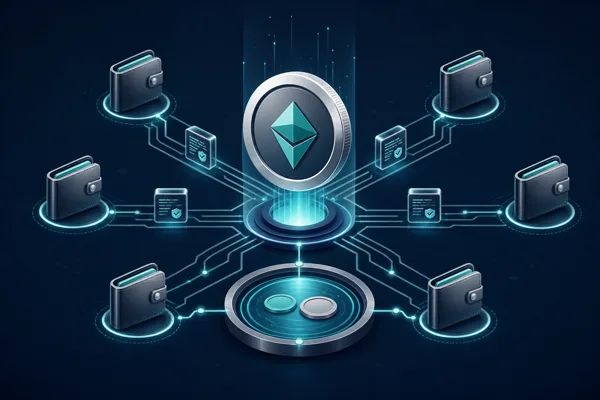

Key Takeaways
- An IDO lets crypto projects launch tokens directly on a decentralized exchange, giving investors instant access to trading and liquidity from day one.
- Unlike ICOs and IEOs, IDOs use smart contracts and liquidity pools instead of centralized intermediaries, making the process faster, cheaper, and more open.
- Participating in an IDO still carries real risks, including price volatility, unaudited smart contracts, and potential scams, so thorough research is essential.
In This Article
An Initial DEX Offering, usually called an IDO, is a way for a crypto project to launch a new token and raise funds through a decentralized exchange (DEX). Instead of going through a traditional exchange or big financial middleman, the project connects directly with the community using smart contracts and liquidity pools.
You can think of it like a digital crowdfunding launch, but instead of signing up on a website or buying shares, people contribute crypto and receive tokens as soon as the sale goes live. Once the sale finishes, the token is instantly tradable on the same DEX, which means liquidity is available from day one.
At its core, an IDO is built around three big ideas:
- Raising funds in a decentralized way
- Letting anyone with a wallet take part
- Giving immediate access to trading and liquidity
That is why IDOs became popular: they are fast, flexible, and community-driven.
How an IDO Works
Every IDO works slightly differently, but most follow the same flow.
A project launches its token sale on a DEX launchpad, creates a liquidity pool, and uses smart contracts to automate everything in the background. Investors contribute crypto (usually  ETH,
ETH,  USDT, or
  BNB), and when the token goes live, they receive their allocation automatically.
Here is how the process usually plays out:
- The project applies to or gets reviewed by a launchpad
- A sale price and token allocation are announced
- Some projects use a whitelist or allocation cap
- Investors contribute funds before or during the sale
- Part of the funds go into a liquidity pool
- Tokens become tradable right after launch

The key difference from earlier fundraising models?
There is no central company deciding who can launch, and no exchange gatekeeping the listing.
What Makes IDOs Different from ICOs and IEOs
The crypto industry evolved through a few fundraising phases.
ICOs (Initial Coin Offerings) were the first big trend. Projects raised money directly and handled everything themselves. It was fast and open, but also attracted scams and poorly run projects.
Then came IEOs (Initial Exchange Offerings), where centralized exchanges managed token sales, vetted projects, and listed tokens afterward. That added more safety but also meant higher fees, strict rules, and less control for teams.
IDOs emerged as a middle ground: decentralized but structured.
| ICO | IEO | IDO | |
|---|---|---|---|
| Run by | The project itself | Centralized exchange | Decentralized exchange |
| Vetting | None | Exchange reviews | Launchpad reviews |
| Listing speed | Varies | Slow (exchange approval) | Instant on DEX |
| Cost | Low | High (exchange fees) | Low |
| Liquidity | Delayed | Delayed | Immediate |
| Access | Open but risky | Restricted by exchange | Open, wallet-based |
IDOs did not just replace the older models; they improved them in a way that fits how Web3 communities operate.
Why Projects Choose to Launch via IDO
From a project’s point of view, IDOs are appealing because they are:
- Faster to launch than traditional fundraising
- Cheaper than centralized exchange listings
- More accessible to global communities
But the biggest benefit is immediate liquidity.
As soon as trading opens, the token has a live market, with no waiting days or weeks for exchange approval.
What Do IDO Tokens Usually Represent
Not every token does the same thing. In many projects, IDO tokens serve different roles inside the ecosystem.
They may be used for:
- Accessing platform features
- Governance and voting rights
- Staking rewards or liquidity incentives
- In-game or app utilities
Some tokens even support hybrid roles: part governance, part utility.
That flexibility is why IDOs are popular in areas like:
- DeFi platforms
- Gaming and metaverse projects
- Infrastructure tools
- Community-driven networks
The token purpose matters, and serious investors now look closely at how (and why) a token actually fits the project.
Risks and Challenges You Should Know
Of course, IDOs are not perfect.
Because they are open and fast-moving, they also come with real risks.
Some common issues include:
- Price swings immediately after launch
- Inexperienced teams or untested projects
- Fake launch pages and scams targeting investors
- Poorly written smart contracts
- Liquidity removed too quickly when not locked
And because regulation is still evolving, IDO landscapes can be complex depending on the country or platform.
That is why most experienced investors always:
- Read the whitepaper and roadmap
- Verify smart-contract audits
- Research the team and partners
- Check whether liquidity is locked
- Avoid FOMO-buying on hype alone
In IDOs, research is everything.
How People Typically Participate in an IDO
The general participation process is pretty straightforward.
Someone who wants to join an IDO normally:
- Sets up a compatible crypto wallet
- Funds it with the currency required for the sale
- Registers or joins a whitelist (if required)
- Connects their wallet to the launchpad
- Contributes during the sale window
- Receives tokens after allocation
- Decides whether to hold, trade, or stake
Some launchpads also use allocation tiers or staking systems to manage crowd demand, especially when hype is high.
Notable IDO Projects
A few well-known projects that used IDO-style models include:
 Raven Protocol: AI compute resource network launched via Binance DEX
- SushiSwap: grew rapidly after launching via community-driven token distribution
- Polkastarter projects: popular cross-chain IDO launch ecosystem


Each of these highlighted different strengths of IDOs, from community participation to fast-growing liquidity networks.
The Future of IDOs
IDOs are not just a trend; they are part of a bigger shift toward decentralized fundraising and community-owned ecosystems.
Over time, launchpads have become stricter with reviews and audits, security tools are improving, and token distribution models are becoming more thoughtful and balanced.
The space is moving toward:
- Better investor protection
- Smarter tokenomics
- Stronger project screening
- Clearer regulatory guidance
Bottom Line
IDOs keep giving builders and communities a way to launch together without needing permission from a central gatekeeper. As the tools improve and regulation catches up, IDOs are likely to remain a core part of how new crypto projects reach their audiences and build liquidity from day one.
 Stay Ahead in Crypto