English
  Nederlands
  Deutsch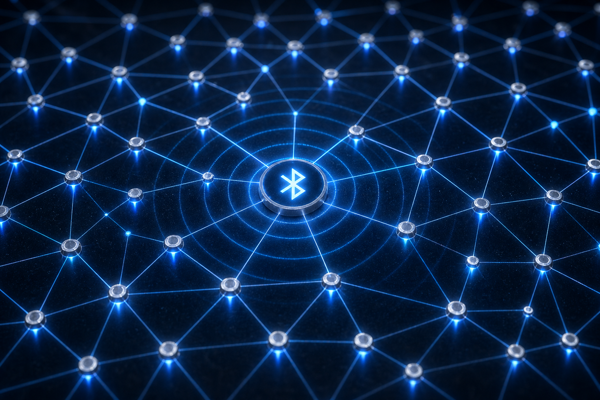
Key Takeaways
- BitChat is a decentralized messaging app that works over Bluetooth mesh networks with no internet connection, phone number, or account required.
- Created by Jack Dorsey in July 2025, it combines Noise Protocol encryption for local mesh communication with optional Nostr relay integration for global reach when internet is available.
- With over 3 million downloads and documented deployment during government-imposed blackouts in Uganda, Iran, and Nepal, BitChat has become a proven real-world communication resilience tool.
In This Article
When the Internet Goes Dark
In January 2026, Uganda’s government suspended internet access for 101 hours ahead of a contested election. Within days, BitChat had been downloaded 400,000 times, reached the top spot on both the Apple App Store and Google Play Store, and was being publicly recommended by opposition leader Bobi Wine to supporters who needed a way to stay in contact. No servers to block. No ISP to pressure. No phone number to trace.
That moment illustrated why BitChat, a messaging app that runs entirely over Bluetooth, had accumulated over 3 million downloads since its launch less than a year earlier. It fills a gap every other popular messaging app leaves open: what happens when the infrastructure those apps depend on is switched off?
BitChat at a Glance
BitChat is a free, open-source, decentralized messaging application that enables encrypted communication over Bluetooth Low Energy (BLE) mesh networks. Unlike Signal, WhatsApp, or Telegram, it does not require an internet connection, a phone number, a user account, or any central server to function.
Each device running BitChat acts simultaneously as both a client and a relay node. Messages hop between devices within Bluetooth range, forming a mesh network that extends coverage far beyond any single device’s reach. When internet connectivity is available, the app optionally bridges to the Nostr protocol for global reach, but this is never a requirement for core functionality.
Where It Started
On July 6, 2025, Jack Dorsey, co-founder of Twitter and Square, posted on X that he had spent a weekend building a Bluetooth mesh messaging app using Block’s AI coding tool Goose. He described it as a “weekend experiment” and framed the concept simply: messaging should have a peer-to-peer architecture, the same way Bitcoin gave finance a peer-to-peer layer with no bank in the middle.
The open-source code landed on GitHub the next day. The TestFlight beta hit its 10,000-user cap within hours. The app reached the Apple App Store on July 29, 2025. Security researchers quickly found vulnerabilities in the early build, including a man-in-the-middle impersonation attack. Dorsey’s team patched all five identified issues within four hours. By mid-July 2025, the app had migrated to the full Noise Protocol Framework, a significant architectural upgrade that gave it a formally verified security foundation.
How Does BitChat Work?
BitChat uses a layered architecture that separates local mesh communication from optional internet bridging.
Bluetooth Mesh Layer
When the app opens, a device begins advertising and scanning over BLE simultaneously. No login takes place. Each session generates a random ephemeral peer ID, so there is no persistent identifier to track across sessions. Messages are encrypted using Noise_XX_25519_ChaChaPoly_SHA256, a formally specified handshake pattern that provides mutual authentication and forward secrecy without requiring pre-shared keys. Messages are binary-serialized, LZ4-compressed for payloads over 100 bytes, and padded to fixed sizes to resist traffic analysis.
Each node checks a Bloom filter before forwarding a packet. If the message ID has not been seen, the node gossips it to all neighbors. If it has been seen, the packet is dropped. A TTL counter decrements at each hop and the packet is discarded when it reaches zero. The maximum hop count is 7, covering approximately 300 meters in relay chains under good conditions.
Nostr Internet Bridge
When two mutually favorited users both have internet connectivity, BitChat automatically routes their messages through Nostr relays, extending communication range globally. This handoff requires no configuration. The Nostr layer uses NIP-17 gift-wrap encryption so relay operators cannot read message content. Geohash-coded location channels let users join geographic chat rooms at city-block, neighborhood, or country-level granularity, across a network of 290+ globally distributed relays.
Proven in the Field
BitChat’s real-world deployment record is unusually well-documented for an app less than a year old. Nepal saw downloads surge from roughly 3,300 to more than 48,000 within five days after the government blocked 26 social platforms in September 2025. Indonesia saw over 11,000 downloads during parliamentary protests the same month. Iran’s nationwide blackout produced 1.5 million aggregate installs. Uganda’s election-period suspension added 400,000 downloads in days.
China’s Cyberspace Administration ordered the app removed from the Chinese App Store in February 2026, effective April 2026, citing the app’s “social mobilization capabilities” as justification. It was the second time Chinese authorities had targeted a Dorsey-backed decentralized protocol, following the 2023 Nostr/Damus ban.
Benefits of BitChat
- Works with no internet connection, no cellular network, and no central server, making it resilient to infrastructure outages and government shutdowns.
- Requires no account, phone number, or personal information, offering strong baseline anonymity and censorship resistance.
- Forward secrecy through the Noise Protocol means past messages cannot be decrypted even if a key is later compromised.
- Open source under the Unlicense (iOS/macOS) and GPL-3.0 (Android), allowing anyone to audit the code or build on it without restriction.
- Free with no advertising, no subscription, and no financial incentive to collect user data.
Risks and Limitations
- Effective range is limited to roughly 10-100 meters per Bluetooth hop, meaning the mesh only forms reliably in areas with sufficient local user density.
- The initial release contained five security vulnerabilities, including a critical buffer overflow, partly attributed to AI-generated cryptographic code. All were patched quickly, but the incident is a caution for rapid AI-assisted development in security-critical contexts.
- Text-only as of mid-2026. No voice, image sharing, or file transfer is available over the mesh layer.
- The Unlicense legally permits unauthorized forks, including malicious ones. A donation-soliciting fake clone appeared during Iran’s internet blackout.
- App Store distribution remains a dependency. China’s removal order demonstrates that government pressure on Apple or Google can cut off access in heavily controlled environments.
BitChat vs. Other Messaging Apps
| BitChat | Signal | Briar | Meshtastic | |
|---|---|---|---|---|
| Internet required | No | Yes | No | No |
| Extra hardware needed | No | No | No | Yes ($30-50) |
| Account / phone number | No | Yes | No | No |
| Range per hop | 10-100m | Global | 10-100m | 1-10km+ |
| Open source | Yes | Yes | Yes | Yes |
| iOS support | Yes | Yes | No | App only |
Signal is the standard for encrypted internet messaging but is completely non-functional in a network blackout. Briar is BitChat’s closest philosophical predecessor: no accounts, offline Bluetooth mesh, no servers. Its Android-only limitation and smaller user base give BitChat a practical advantage in reach. Meshtastic offers much greater per-hop range through LoRa radio hardware but requires purchasing dedicated devices. FireChat pioneered consumer Bluetooth mesh messaging during Hong Kong’s 2014 Umbrella Movement but shut down in 2018 when its parent company folded. BitChat is its open-source successor with modern cryptography.
Why BitChat Matters in 2026
In 2025, documented internet blackouts cost global economies an estimated $19.7 billion, up 156% from the prior year. The governments ordering those shutdowns are not primarily targeting infrastructure. They are targeting communication. BitChat’s architecture makes that significantly harder, because there is no server to block, no company to pressure, and no centralized service to regulate.
The app does not require cryptocurrency to function, but it shares a core design philosophy with the broader decentralized technology movement: systems that require no trusted third party are more resilient and harder to co-opt than those that do. For a broader look at how decentralized networks create value across different contexts, the post on benefits of decentralized social networks covers related principles in depth.
BitChat is not a finished product. Voice, image sharing, and MLS group encryption are on the roadmap. Security audits are ongoing. But six documented blackout deployments in under a year, across four continents, are an unusually direct signal that a real need exists and that this tool is meeting it.
 Stay Ahead in Crypto