English
  Nederlands
  Deutsch
Key Takeaways
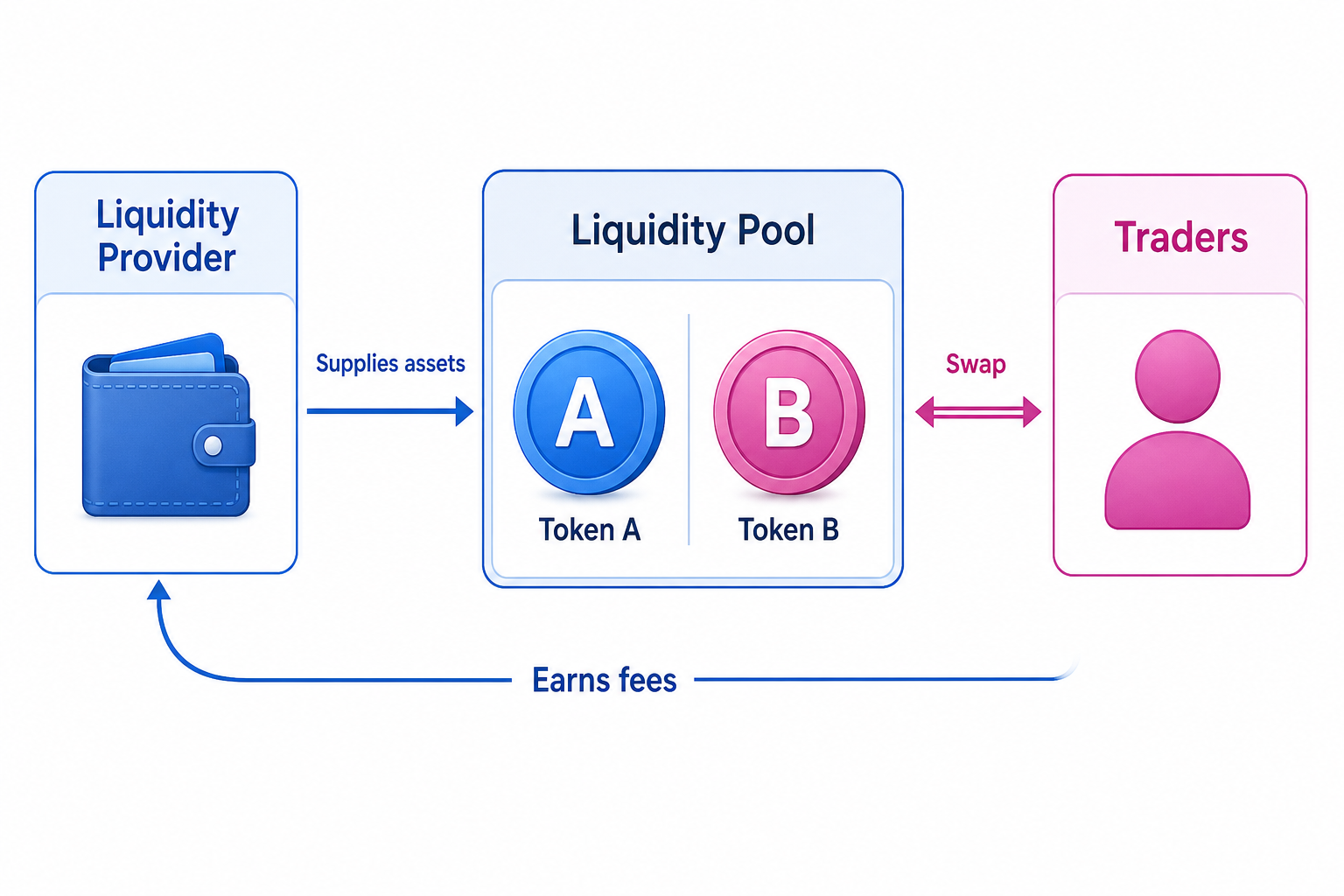
- Liquidity providers (LPs) supply assets to a market or pool so that other users can trade at any time with minimal slippage, and earn a share of the fees in return.
- On DEXs, LPing usually means depositing two tokens into an automated market maker pool; the main risks are impermanent loss, smart-contract bugs, MEV, and oracle issues.
- Higher fee tiers and concentrated liquidity boost returns but require more active management and tolerance for volatility; stable-stable pools are the calmest entry point.
In This Article
Think of a busy farmers’ market. If no one brings products, shoppers leave. Markets need inventory. In finance and crypto, the people (or algorithms) that bring inventory, assets ready to buy or sell, are called liquidity providers (LPs). They make trading possible, reduce wait times, and help buyers and sellers find fair prices.
What is a Liquidity Provider?
A liquidity provider supplies assets to a marketplace so that others can trade at any time with minimal price impact (low slippage). In return, LPs earn compensation, typically fees, spreads, and sometimes additional token rewards.
- Traditional markets: Specialist firms (market makers) continuously quote bid and ask prices on order books. They keep inventory and profit from the spread and rebates while hedging the risk.
- Crypto AMMs and DEXs: Anyone can become an LP by depositing two (or sometimes one) assets into a liquidity pool. Traders swap against the pool and pay a fee, which is distributed to LPs pro rata.
Why Liquidity Matters
- Tight spreads and fair prices: More liquidity means smaller gaps between bid and ask, which means better prices for everyone.
- Lower slippage: Large orders move the price less in deep pools.
- Faster execution: You don’t wait for a counterparty; liquidity is already there.
Without liquidity providers, markets feel empty: prices jump around, trades fail, and confidence erodes.
Two Core Models
Order-Book Market Making (CEXs, TradFi)
- How it works: LPs place limit buy and sell orders around the current price, updating them rapidly as the market moves.
- Revenue: The spread, exchange rebates, and sometimes maker incentives.
- Risks: Inventory risk (price moves against you), adverse selection (trading against informed flow), and technology and latency costs.
AMM Liquidity Provision (DEXs)
- How it works: LPs deposit assets into an automated market maker (AMM). The pool’s formula (such as constant product x·y=k) sets prices based on the ratio of assets.
- Revenue: Trading fees (0.05% to 1% per swap depending on the pool), plus optional liquidity mining rewards.
- Risks: Impermanent loss, smart-contract and oracle risk, L1/L2 congestion and gas costs, and MEV attacks that can reduce fee capture.
Key Terms
- TVL (Total Value Locked): How much capital sits in a pool; a useful proxy for depth and trust.
- Fee tier: The percentage fee charged to traders; higher tiers compensate LPs for more volatile pairs.
- Slippage: How far the execution price moves from the quoted price due to trade size and depth.
- LP tokens or positions: Receipts for your share of the pool; you burn or remove them to withdraw.
- Concentrated liquidity: Provide liquidity only in a chosen price range (Uniswap v3 style). Increases fee earnings per dollar but requires active management.
- MEV (Miner or Validator Extractable Value): Bots or validators reorder transactions to profit, causing worse prices, slippage, or reduced earnings for users.
- Impermanent loss (IL): Temporary divergence between a pool position and a simple hold of the underlying tokens. Becomes realised when liquidity is withdrawn.
- L1/L2 congestion and gas costs: Network traffic increases fees and slows transactions, affecting trade execution or liquidity adjustments.
- Oracle risk: Faulty or manipulated price feeds can cause incorrect pricing, trades, or liquidations.
How LPs Earn
- Trading fees: The primary revenue stream; paid in proportion to your share of the pool and the time your liquidity is active in the active price range.
- Incentives: Some protocols distribute extra tokens to LPs as emissions, typically time-limited.
- Spread capture (order books): CEX and TradFi market makers earn by buying slightly below and selling slightly above the market.
Rule of thumb: Higher fees and more volume generally mean more revenue, but also higher volatility and inventory risk.
Impermanent Loss
Impermanent loss is the difference between holding the assets versus providing them to a pool when prices diverge.
Example: You provide $5,000 in ETH and $5,000 in USDC to a 50/50 pool. ETH doubles. As traders arbitrage the pool, you end up holding less ETH and more USDC than if you had just held. Your pool position is still worth more in USD than at deposit, but worth less than a pure hold would have been.
Fees can offset IL. Stable-stable pools (USDC/USDT, stable/LST) have low IL; volatile-volatile pairs (ETH/altcoin) have higher IL.
Concentrated liquidity magnifies both outcomes: higher fee capture if trades occur inside your range, but you earn nothing (and still face IL) when the price exits your range until you rebalance.
AMM Variants in DeFi
- Constant product AMMs (x·y=k): Popular for volatile pairs (Uniswap v2 forks).
- Stable-curve AMMs: Optimised for correlated assets (USDC/DAI). Very low slippage and minimal IL.
- Concentrated liquidity AMMs: Granular price-range LPing (Uniswap v3 and v4, Algebra, Arrakis, Slipstream).
- Single-sided / covered LP: Some protocols let you deposit one asset; the protocol mints or borrows the pair internally, often with added risk.
- Meta-pools and weighted pools: Balancer-style pools with non-50/50 weights (such as 80/20) to skew exposure.
Risks to Respect
- Smart-contract risk: Bugs or exploits in pool or token contracts.
- Oracle and price risk: Manipulated or delayed prices can harm pools that rely on external oracles.
- Regulatory and counterparty risk: Jurisdictional issues, plus centralised operators on bridges or L2 sequencers.
- MEV and sandwiching: Can reduce fee revenue or cause worse execution in volatile moments.
- Concentration risk: If one token rug-pulls or depegs, the pool is left holding bad inventory.
- Tax: Fee income and token rewards may be taxable, and IL can complicate accounting. Consult a professional in your jurisdiction.
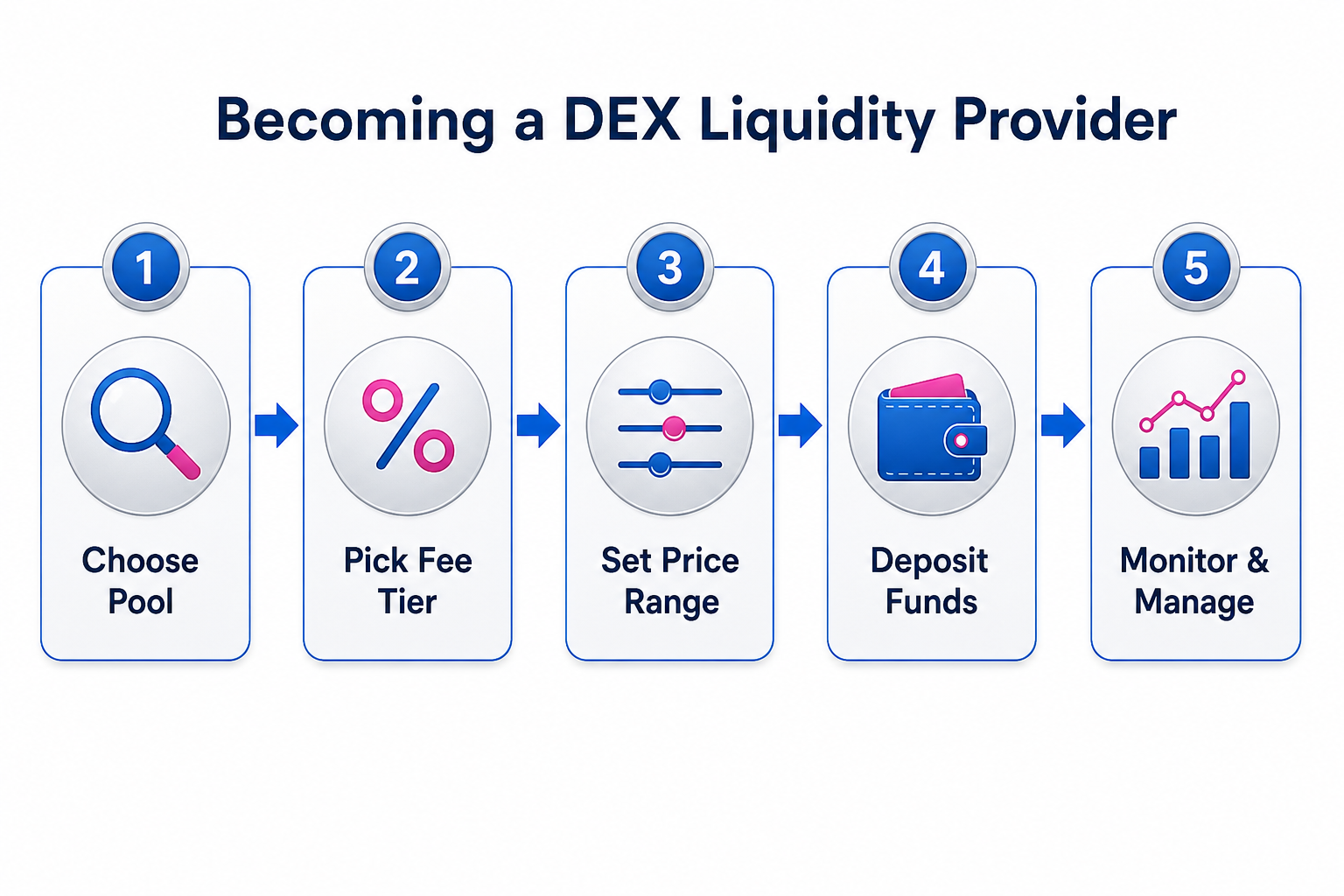
Practical Playbook: Becoming a DEX LP
1. Choose your pool
Start with blue-chip or stable-stable pairs to learn mechanics. Check TVL, recent volume, and historical fees; the fees-to-TVL ratio gives a rough yield proxy.
2. Pick your fee tier or pool type
Stable pairs typically use the lowest fee tier (0.01% to 0.05%). Volatile pairs use higher tiers (0.3% to 1%) to compensate for IL.
3. Decide on price range (if concentrated)
Wide range is easier to set and forget but less capital efficient. Narrow range gives higher fee density, but you must rebalance if price moves out of range.
4. Deposit funds
Approve tokens, add liquidity, and receive LP tokens or a position NFT. Keep a small buffer for gas and consider MEV-resistant routers when available.
5. Monitor and manage
Track P/L, uncollected fees, percentage of time in range, and IL estimates. Rebalance ranges after big moves and harvest fees periodically.
Optional: Hedging
Use perps or options to hedge directional exposure, for example shorting a portion of the more volatile asset. Hedging costs reduce net yield but can tame IL.
Exit
Burn LP tokens or close the position to withdraw the underlying assets plus accumulated fees. Be mindful of exit gas and any lockups or reward-vesting schedules.
How to Evaluate a Pool
- Depth and volume: Deep TVL with steady daily volume is ideal.
- Fee APR vs. IL: Look at fee income relative to expected volatility.
- Asset quality: Reputable, audited, non-rebasing (or rebasing-aware) tokens.
- Protocol security: Audits, bug bounties, battle-tested contracts.
- Operational costs: Gas, rebalancing frequency, external tool subscriptions.
- Incentives: Attractive but usually temporary. Don’t rely on emissions persisting.
- Composability: Does the LP token unlock extra yield (leverage, lending, restaking)? Stacking boosts both returns and risk.
LP Strategies by Risk Profile
- Conservative: Stable-stable pools (USDC/DAI), low fee tier, wide range. Goal: steady fees, minimal IL.
- Balanced: Major-major (ETH/BTC) or LST-ETH pools; moderate fee tier and range, occasional rebalancing.
- Aggressive: Narrow-range volatile pairs, frequent rebalancing, periodic delta-hedging with perps or options.
- Event-driven: Provide liquidity around known catalysts (airdrops, upgrades) when volume spikes, then exit.
LPing on Centralized Exchanges
On CEXs, retail users cannot usually LP directly. Instead, professional market makers (firms or bots) provide liquidity and earn from spreads and rebates. Becoming a market maker at scale requires low-latency infrastructure, robust risk models, and capital for inventory and hedging across venues.
FAQ
Is LPing passive income?
Sometimes, but not truly “set and forget”. Concentrated pools need active management, and even stable pools can face depegs or contract upgrades.
What yields are realistic?
Yields vary widely with volume and volatility. A quiet week on a stable pool might be below 5% APR; a volatile week on a high-fee pool can spike into double digits. Past yields don’t predict future returns.
What about single-sided LP?
Convenient, but the protocol often pairs or synthetically balances your asset, introducing borrowing costs or smart-contract complexity. Read the docs before depositing.
How do I avoid IL entirely?
You can’t, if prices move. IL is structural to AMMs. You can minimise it (stable pairs, hedging, wider ranges) or aim to out-earn it via fees.
 Stay Ahead in Crypto