English
  Nederlands
  Deutsch
Key Takeaways
- A dip is a short-term drop in an asset’s price, usually followed by a recovery to the previous level or higher.
- Not every dip is a buying opportunity: some mark the start of a sustained downtrend, so confirmation matters.
- Traders combine technical and fundamental analysis with strict risk management to buy dips without catching a falling knife.
In This Article
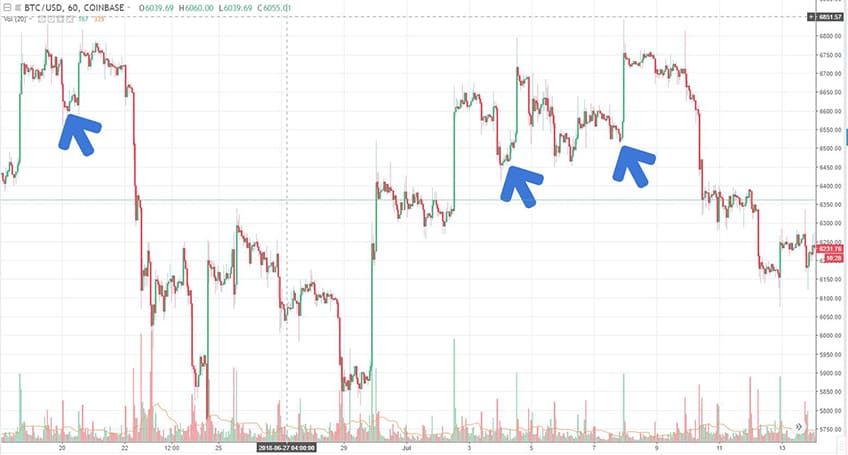
A dip is a rapid decrease in the value of an asset (such as a stock, Bitcoin, oil, or a commodity). Dips occur daily across all kinds of markets. In the crypto market especially, we see dips happen on a regular basis. Traders can respond and use this to their advantage by buying an asset during a dip and selling it at the next top. This strategy is commonly called ‘buy the dip’.
In the image below, the blue arrows indicate dips.
Why do dips occur?
Dips are driven by a mix of market psychology, news flow, and technical levels. Common triggers include:
- Profit taking after a sharp rally, as short-term holders lock in gains.
- Negative headlines, such as regulatory crackdowns, exchange hacks, or macroeconomic shocks.
- Large liquidations, where leveraged positions are force-closed and cascade into further selling.
- Technical rejections at resistance levels, trendlines, or round numbers.
Understanding what caused a dip is the first step in judging whether it is a temporary pullback or the start of a deeper correction.
Beginning of a downtrend?
The problem is that a dip is easy to recognize on a historical chart, but much harder to identify on a live chart. If an asset has made a sharp drop, it may look like a good entry point, but that is not always the case. A well-known saying captures this risk: ‘never catch a falling knife’. The example below shows how a dip can also mark the beginning of a downtrend.
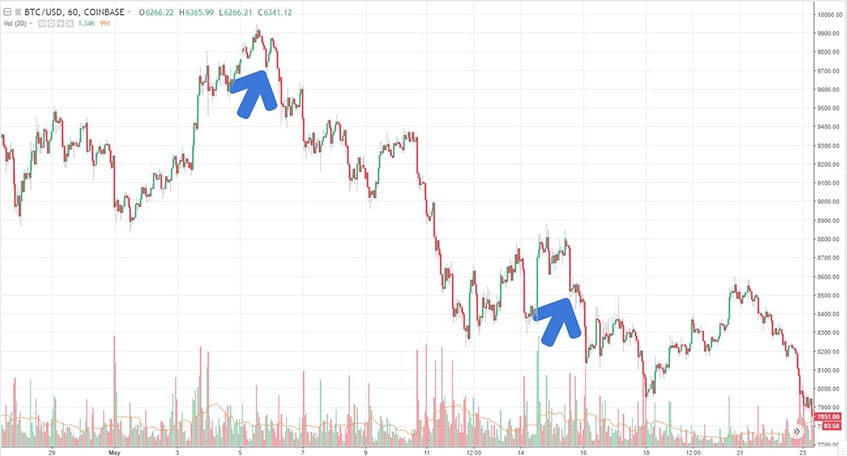
To buy a cryptocurrency on a dip, it often pays to wait until the price has started to recover before entering. Always confirm that the dip is temporary and not the beginning of a broader downtrend. Many techniques can help with this, covering both fundamental analysis and technical analysis.
Verifying a dip with technical analysis
With technical analysis, you do not focus on the fundamentals of an asset but on price action combined with a set of indicators. The more technical indicators that agree the price should rise again soon, the stronger the signal becomes. The chart below shows an example of a dip together with supportive technical indicators.
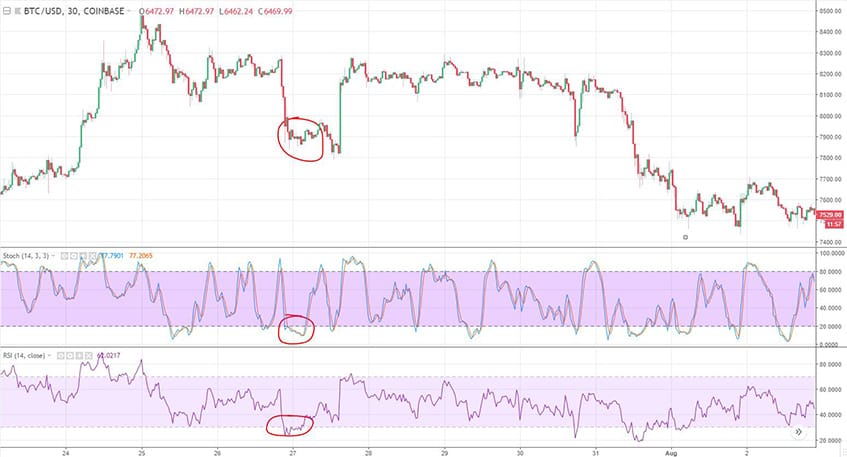
Commonly used indicators for dip confirmation include the Relative Strength Index (RSI), the MACD, Bollinger Bands, and horizontal support levels. A bullish divergence between price and RSI, or a price bouncing off a long-standing support zone, can add weight to a buy signal.
Verifying a dip with fundamental analysis
To verify a dip, you can also apply a fundamental strategy. The best-known fundamental approach comes from one of the most successful investors of all time, Warren Buffett. He owes his success to the intrinsic value strategy: in short, the actual value of a share is estimated, and if the market price during a dip is far below that value, it signals a good time to buy.
The intrinsic value of a cryptocurrency or token cannot be calculated in the same way. You are not buying part of a company but rather a share of a network or ecosystem. The more people use that network, the more likely its coin will increase in value. Since investing in crypto is still relatively new for most people, fewer models have been developed and tested than for traditional equities.
An important difference between cryptocurrencies and shares is that the supply of a cryptocurrency usually increases, which in theory has a downward effect on the price. This is due to mining, built-in inflation, or the release of pre-mined coins. For shares, this mainly happens in the case of an equity issuance.
Managing risk when buying dips
Even with strong technical and fundamental signals, no dip is a guaranteed winner. A few rules help keep losses manageable:
- Use position sizing: risk only a small percentage of your portfolio on any single dip buy.
- Scale in with partial entries rather than committing your full budget at one price.
- Set a stop-loss below the most recent swing low, so a confirmed downtrend does not destroy your capital.
- Define an exit plan in advance: know both your target price and the level at which you will admit the thesis was wrong.
These habits turn dip buying from a gut-feeling trade into a repeatable process.
Final thoughts
Buying the dip can be a powerful strategy, but only when it is backed by analysis and discipline. Always confirm that the drop is a short-term pullback, use technical and fundamental tools to validate the setup, and protect yourself with clear risk rules. Treated this way, dips become opportunities rather than traps.
 Stay Ahead in Crypto