English
  Nederlands
  Deutsch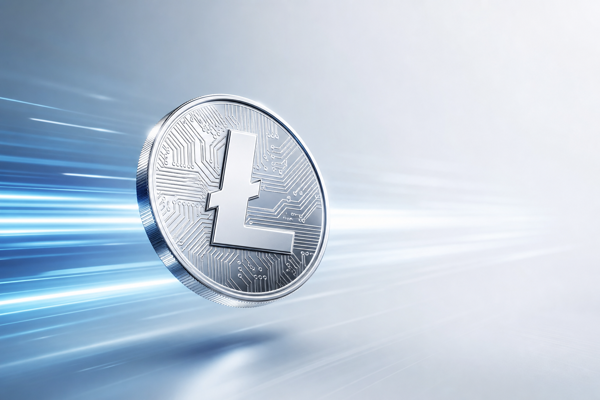


Key Takeaways
- Litecoin (LTC) is a decentralized cryptocurrency launched in 2011 as a faster, cheaper alternative to Bitcoin for everyday payments.
- It processes blocks four times faster than Bitcoin using the Scrypt algorithm, with 2.5-minute block times and consistently low fees.
- After 14+ years of uninterrupted operation, Litecoin remains one of the most widely supported and longest-running crypto networks.
In This Article
The Digital Silver of Crypto
If Bitcoin is digital gold, Litecoin was built to be the everyday spending counterpart. Since its launch in 2011, Litecoin has positioned itself as a faster, cheaper alternative for peer-to-peer payments. While thousands of cryptocurrencies have come and gone over the years, Litecoin remains one of the longest-running and most widely supported networks in the industry.
Understanding Litecoin
Litecoin (LTC) is a decentralized, open-source cryptocurrency created as a fork of Bitcoin’s source code. It uses a proof-of-work consensus mechanism and shares much of Bitcoin’s underlying architecture, including the UTXO transaction model and a fixed supply cap.
The key differences are deliberate: Litecoin processes blocks four times faster, supports a total supply of 84 million coins (versus Bitcoin’s 21 million), and uses a different mining algorithm called Scrypt. These design choices prioritize speed and lower transaction costs, making Litecoin more practical for small, everyday payments.
Where Litecoin Started
Charlie Lee, a former software engineer at Google, released Litecoin on October 7, 2011, with the genesis block mined on October 13. Lee later served as Director of Engineering at Coinbase from 2013 to 2017 before leaving to focus on the Litecoin Foundation full-time.
Lee designed Litecoin to complement Bitcoin rather than replace it. His goal was straightforward: create a cryptocurrency optimized for everyday transactions while keeping Bitcoin’s security-first principles intact. Litecoin became one of the earliest and most successful altcoins, consistently ranking among the top cryptocurrencies by market capitalization throughout its first decade.
How Does Litecoin Work?
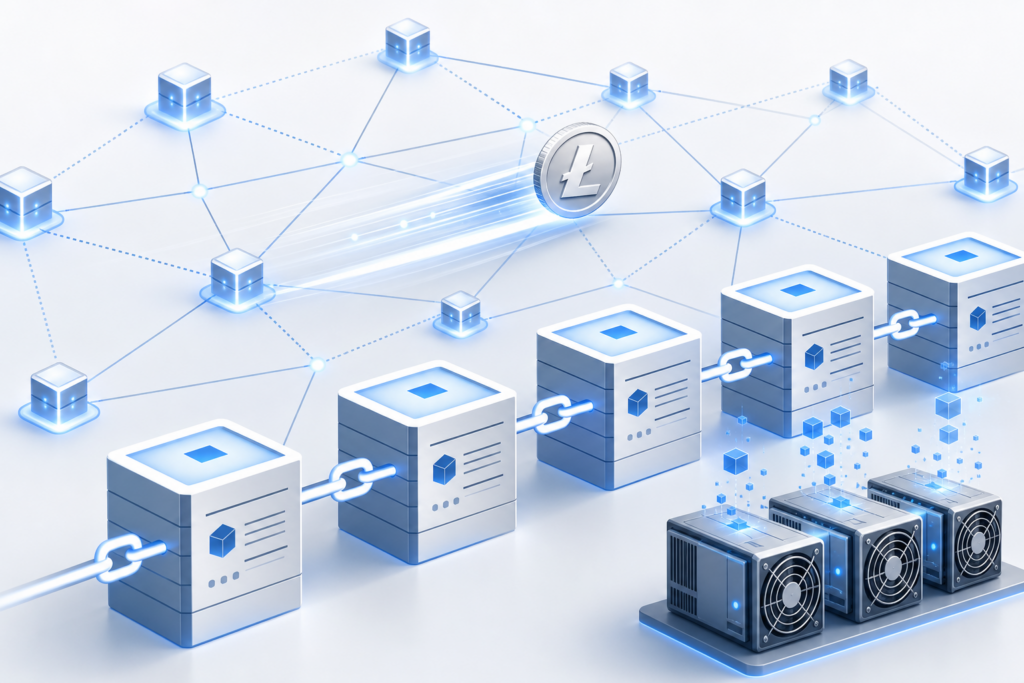
Like Bitcoin, Litecoin relies on miners who validate transactions and add new blocks to the blockchain. The process follows a familiar pattern: transactions are broadcast to the network, miners compete to solve a cryptographic puzzle, and the winner adds a new block containing verified transactions.
Scrypt Mining Algorithm
Where Bitcoin uses SHA-256, Litecoin uses the Scrypt hashing algorithm. Scrypt is memory-intensive, meaning it requires significant RAM alongside processing power. This was originally designed to keep mining accessible to everyday users by resisting specialized ASIC hardware. Although Scrypt-compatible ASICs were developed by 2014, the algorithm still differentiates Litecoin’s mining ecosystem. Notably, Dogecoin also uses Scrypt and has been merge-mined with Litecoin since 2014, allowing miners to secure both networks simultaneously.
Block Rewards and Halving
Litecoin follows a halving schedule similar to Bitcoin’s. The block reward is cut in half approximately every four years (every 840,000 blocks). Starting at 50 LTC per block in 2011, the reward has been halved three times: to 25 LTC in August 2015, to 12.5 LTC in August 2019, and to 6.25 LTC in August 2023. The next halving is projected for mid-2027, reducing the reward to 3.125 LTC.
Key Features and Upgrades
SegWit and Lightning Network
Litecoin activated Segregated Witness (SegWit) in May 2017, months before Bitcoin followed in August of that year. This made Litecoin a real-world testing ground for the upgrade, which separates signature data from transactions to increase effective block capacity and fix transaction malleability. SegWit also enabled Lightning Network compatibility, allowing near-instant LTC payments with negligible fees through off-chain payment channels.
MimbleWimble Extension Blocks (MWEB)
In 2022, Litecoin activated the MimbleWimble Extension Blocks upgrade, adding optional privacy features to the network. MWEB allows users to make confidential transactions that obscure amounts, improving fungibility for those who need it. The feature is opt-in: users can “peg in” to the extension block for privacy and “peg out” to the transparent main chain. This hybrid approach balances user privacy with regulatory compliance, though some exchanges (particularly in South Korea) have delisted MWEB-enabled addresses due to anti-money laundering concerns.
What Litecoin Is Used For
Litecoin was designed first and foremost as a payment currency, and that practical focus still defines how people use it today.
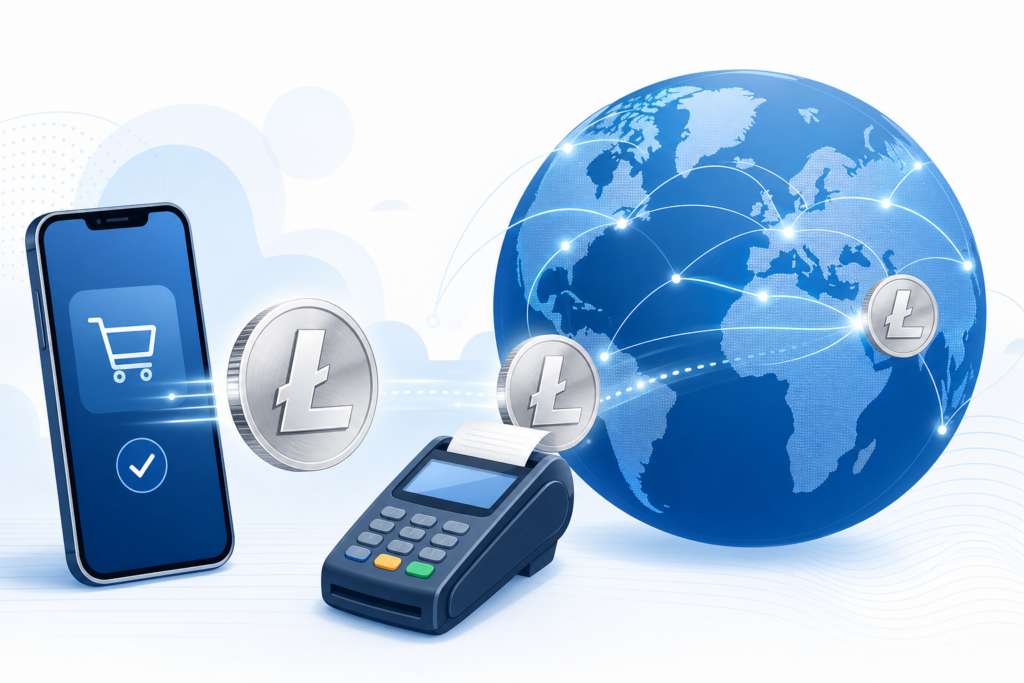
- Everyday payments: Online stores and a growing list of merchants accept LTC, where fast confirmations and low fees suit point-of-sale purchases and smaller transactions.
- Trading: Litecoin is listed on nearly every major exchange and remains a liquid, actively traded asset across crypto portfolios.
- Cross-border transfers: Sending value internationally settles in minutes rather than the days a bank wire can take, and at a fraction of the cost.
- Portfolio diversification: Many holders keep LTC alongside assets like Bitcoin and Ethereum as a long-established, battle-tested altcoin.
Benefits of Using Litecoin
- Faster confirmations: With 2.5-minute block times, six confirmations take roughly 15 minutes compared to Bitcoin’s 60 minutes, making Litecoin more practical for point-of-sale transactions.
- Lower fees: Transaction costs remain consistently low, often fractions of a cent, even during periods of higher network activity.
- Proven reliability: Over 14 years of continuous operation with no successful 51% attacks on the main network, establishing one of the longest track records in crypto.
- Wide support: Listed on virtually every major exchange and supported by popular hardware and software wallets including Ledger, Trezor, and Exodus.
- Optional privacy: MWEB provides confidential transactions for users who need them, without making privacy mandatory for the entire network.
Risks and Limitations
- Narrowing value proposition: Bitcoin’s Lightning Network increasingly addresses the same speed and fee advantages that once set Litecoin apart, raising questions about long-term differentiation.
- Declining relative position: Once consistently a top-5 cryptocurrency, Litecoin has dropped in market cap rankings as newer projects with smart contracts and richer ecosystems have drawn developer and investor attention.
- MWEB regulatory friction: The optional privacy feature has triggered exchange delistings in some jurisdictions, and further regulatory tightening could create additional compliance challenges.
- Mining centralization: Despite Scrypt’s original intent to resist ASICs, specialized mining hardware now dominates, concentrating hash power among larger operations.
- Founder optics: Charlie Lee’s decision to sell all of his LTC holdings near the December 2017 market peak remains controversial, with critics viewing it as a lack of long-term commitment despite his continued involvement through the Foundation.
Litecoin vs Bitcoin
Litecoin and Bitcoin share the same foundational architecture, but their design choices reflect different priorities. Bitcoin optimizes for security and decentralization with its 10-minute block time and SHA-256 mining, positioning itself as a store of value. Litecoin optimizes for speed and accessibility with 2.5-minute blocks, Scrypt mining, and a supply cap four times larger.
| Feature | Bitcoin | Litecoin |
|---|---|---|
| Launched | 2009 | 2011 |
| Average block time | ~10 minutes | ~2.5 minutes |
| Mining algorithm | SHA-256 | Scrypt |
| Maximum supply | 21 million | 84 million |
| Typical role | Store of value | Everyday payments |
In practice, Litecoin has often served as a testing ground for Bitcoin upgrades. SegWit went live on Litecoin first, and Lightning Network transactions were demonstrated on the Litecoin network before Bitcoin’s implementation matured. For users who need fast, low-cost transfers between exchanges or wallets, Litecoin’s confirmation speed offers a practical advantage over Bitcoin’s base layer.
The relationship is less about competition and more about complementary roles. Wrapped versions of both assets now exist on smart contract platforms, allowing each to participate in DeFi ecosystems beyond their native chains.
Why Litecoin Matters in 2026
Litecoin enters 2026 with several tailwinds. Spot Litecoin ETF applications are under review in the United States, and approval would open the door to regulated institutional investment. The network’s classification as a commodity rather than a security gives it a favorable regulatory position compared to many altcoins.
The payments use case continues to evolve. Major payment processors like BitPay support Litecoin for merchant transactions, and the combination of low fees, fast confirmations, and Lightning Network compatibility makes LTC a practical option for real-world commerce. With the fourth halving projected for mid-2027, new supply will tighten further along Litecoin’s deflationary trajectory.
Whether Litecoin sustains its relevance depends on continued merchant adoption, the outcome of ETF decisions, and its ability to remain a trusted, battle-tested network in an increasingly crowded market. For a broader look at the technology powering networks like Litecoin, our introduction to blockchain covers the fundamentals.
 Stay Ahead in Crypto