English
  Nederlands
  Deutsch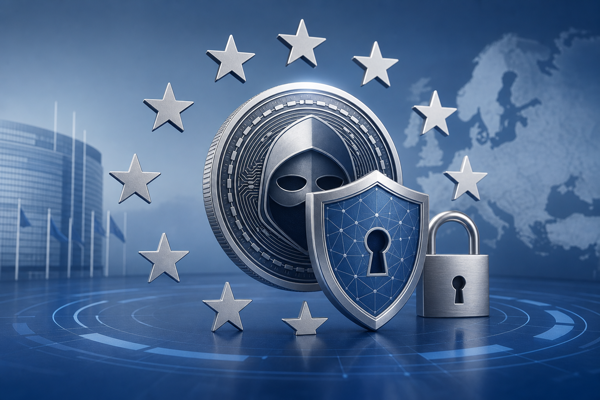



Key Takeaways
- Owning privacy coins like Monero, Zcash, and Dash stays legal in the EU, but regulated exchanges and custodians must stop offering them under the Anti-Money Laundering Regulation (AMLR), which applies from 10 July 2027.
- The rules bind regulated service providers, not individuals, so transfers between self-hosted wallets remain outside their scope.
- The shift is already underway: Kraken, Binance, and OKX have removed Monero across the European market well ahead of the deadline.
In This Article
- The Short Answer
- What Privacy Coins Actually Are
- The Rule Behind the Headlines
- What Article 79 Prohibits
- Which Coins Are Affected
- How MiCA and the AMLR Fit Together
- What It Means for Exchanges and Users
- The Case for the Rules
- The Criticism and Legal Questions
- Why This Matters in 2026
- Watch the Video
The Short Answer
Privacy coins are not being made illegal to own in Europe, but they are being pushed off regulated platforms. From 10 July 2027, exchanges and custodians licensed in the EU will be barred from listing, holding, or facilitating trades in coins designed to hide transaction details. The change comes from the European Union’s Anti-Money Laundering Regulation, and parts of it are already in motion. Several large exchanges removed Monero across the European market more than a year before the deadline.
So the honest answer to “are privacy coins being banned?” is split: yes on regulated exchanges, no for personal ownership. Most of the alarm in the headlines blurs that line.
What Privacy Coins Actually Are
Most blockchains are public ledgers. Anyone can follow a Bitcoin transaction as it moves from one address to the next. Privacy coins are built to break that visibility. They use cryptography to obscure who sent what to whom, and how much, so that digital money behaves more like cash, leaving no public paper trail.
For a fuller breakdown of how these assets work, see our guide on what privacy coins are. The same feature that appeals to privacy-minded users is exactly what worries regulators, because the opacity that protects a citizen can also hide the movement of criminal funds.
The Rule Behind the Headlines
The talk of a “ban” traces back to one law: Regulation (EU) 2024/1624, known as the Anti-Money Laundering Regulation, or AMLR. The European Parliament adopted it on 31 May 2024, and it becomes applicable across the bloc on 10 July 2027. You will see “1 July 2027” repeated in some coverage, but the date written into the regulation is the 10th.
The AMLR replaces a patchwork of national laws with a single, directly applicable rulebook for the whole bloc. A new supervisor, the Authority for Anti-Money Laundering (AMLA), is being built in Frankfurt to oversee it, and it formally opened in mid-2025. Day-to-day enforcement of the 2027 deadline falls to national regulators first.
What Article 79 Prohibits
The key provision is Article 79. It prohibits credit institutions, financial institutions, and crypto-asset service providers from keeping anonymous accounts of any kind, including “anonymous crypto-asset accounts” and any account that allows “the anonymisation or increased obfuscation of transactions, including through anonymity-enhancing coins.”
Who the rule binds
The wording is deliberate. It applies to regulated businesses: the licensed exchanges, custodians, and brokers that act as the on and off ramps between euros and crypto. It places no obligations on private individuals and does not reach the wallet itself.
What “anonymity-enhancing coins” means
The regulation defines these as crypto-assets built with features that anonymize or obscure transaction information. That definition is broad enough to capture coins that are private by default and, on a strict reading, coins that merely offer privacy as an option. Exactly where that line falls is one of the open questions still being settled.
Which Coins Are Affected
Three names appear in almost every analysis: Monero, Zcash, and Dash. Monero is the clearest case. It is private by default with no transparent mode, which leaves a compliance team with nothing to inspect. Analysts widely describe it as having no compliant path on regulated venues.
Zcash and Dash sit in a grayer zone. Both pair their privacy features with a transparent mode: Zcash offers shielded and unshielded addresses, and Dash runs transparently on its base chain with an optional mixing feature. Whether they can survive on regulated platforms through transparent-only handling is still being worked out, and the final detail rests with technical standards from the European Banking Authority. Smaller privacy tokens such as Verge, Firo, and Horizen have already been caught in exchange delistings.
How MiCA and the AMLR Fit Together
The AMLR is not the first EU rule to touch privacy coins. MiCA, the Markets in Crypto-Assets regulation that became fully applicable for crypto firms at the end of 2024, already addressed them. Its Article 76(3) stops trading platforms from admitting assets with a built-in anonymization function unless holders and their transaction history can be identified.
MiCA cracked the door, and the AMLR closes it. Where MiCA only restricted trading platforms from listing such assets, Article 79 extends the restriction to every regulated provider and to the act of keeping the accounts, not just listing the coins.
What It Means for Exchanges and Users
For exchanges
Licensed providers must strip privacy coins from their product lines before the 2027 deadline or face penalties and operational restrictions. Many are not waiting for the date. You can still find a wide range of compliant assets on MiCA-regulated crypto exchanges, but privacy coins are quietly disappearing from their menus across the EU.
For individuals
For everyday users, the effect is narrower than “banned” suggests. You can still legally own privacy coins and hold them in a self-hosted wallet, and transfers between two self-hosted wallets stay outside the rules. What changes is access: buying or selling them through a regulated European exchange becomes difficult or impossible, and balances left on those platforms are typically converted to another asset or withdrawn. Moving crypto above 1,000 euros between an exchange and your own wallet also triggers extra identity checks.
The Case for the Rules
- Closes a known channel for laundering criminal proceeds, which is the regulation’s stated purpose.
- Creates one consistent rulebook across all member states instead of 27 separate national approaches.
- Holds crypto service providers to the same anti-money laundering standards that banks already follow.
- Gives law enforcement clearer traceability for funds that move through regulated platforms.
The Criticism and Legal Questions
- Critics argue it strips law-abiding people of a digital equivalent of cash that protects them from data harvesting and surveillance.
- It may push privacy-coin activity toward decentralized exchanges, atomic swaps, and offshore venues rather than stopping it.
- Monero contributor Riccardo Spagni and privacy advocates say it conflicts with Articles 7 and 8 of the EU Charter of Fundamental Rights, which protect privacy and personal data.
- The treatment of optional-privacy coins like Zcash and Dash is still unsettled, leaving exchanges guessing ahead of the deadline.
- Legal challenges have been signaled but not yet filed, so the rule could still face court tests once it takes effect.
Why This Matters in 2026
The 2027 date can make this feel like a distant problem, but the direction is already set. Through 2024 and 2025, major exchanges including Kraken, Binance, and OKX pulled Monero from the European market, citing regulatory change, force-converting balances to other assets.
By 2026, privacy coins have largely disappeared from the big regulated venues, and the open question is how far the rules will reach optional-privacy assets once the European Banking Authority finalizes the technical detail. For anyone weighing financial privacy against regulated access, the debate is far from settled, and it keeps circling back to a larger question the industry has not answered: whether privacy and regulation can truly coexist on public blockchains.
Watch: The EU Privacy Coin Rules Explained
Prefer to watch? Here is the two-minute version covering what changes in 2027 and what stays legal.
 Stay Ahead in Crypto