English
  Nederlands
  Deutsch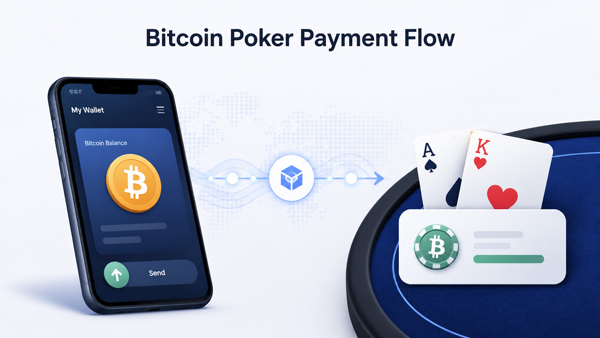

Key Takeaways
- Bitcoin poker has three layers: the wallet holds the coins, the account balance reflects usable value, and the poker table is where the cards are played.
- The blockchain only records the transfer; the platform decides when it becomes a playable balance.
- Once funded, the session itself feels like ordinary online poker. The payment method does not change card decisions.
In This Article
Bitcoin poker becomes easier to understand when the payment path is separated from the card game. The wallet transaction is one layer. The account balance is another. The poker session is the third. Once those layers are clear, Bitcoin stops feeling like a mysterious extra feature and starts looking like a practical route into a familiar digital card environment.
A blockchain payment begins with a transfer recorded across a distributed ledger, then becomes usable by the player only after the platform recognizes it inside the account. That distinction matters because the chain records movement, while the account shows usable value. A 2024 open-access review on trust and acceptance in blockchain-based digital payments highlights how clarity, security perception, privacy, and ease of use shape whether people feel comfortable adopting blockchain payment systems. For poker, that translates into a simple reader question: when does the Bitcoin payment result in a playable balance?
From Wallet Movement to Poker Context
The most useful way to read the flow is not as a list of buttons or payment labels. It is a sequence of states. First, the player holds Bitcoin in a wallet. Next, the player sends it to the receiving address shown by the poker platform. Then, the platform reflects that value in the account, typically as a usable balance, rather than as something the player needs to track on-chain during every hand.
To see the concept in a real Bitcoin poker setting, this crypto poker page shows how a platform presents Bitcoin deposits, withdrawals, supported digital coins, account funding, and poker activity in one connected environment. For anybody just getting started with Bitcoin, it can be a useful example of how the whole payment process flows.
Bitcoin poker is easier to understand when wallet movement, account status, and platform messaging are seen as connected parts of one digital experience. Of course, the casinos offering it still tend to accept fiat currency for these games, even going so far as to offer giveaways to their users at times! This ensures those who aren’t comfortable with crypto can still enjoy the entertainment on offer.
The 3 Layers Readers Often Mix Together
Each layer answers a different question. The wallet answers “Where does the value start?” The account answers “When is it visible inside the platform?” The poker table answers “How does the game unfold?” That distinction keeps the explanation grounded without turning the article into a dense rules manual.
| Layer | What It Means | Why It Matters |
|---|---|---|
| Wallet | Where the Bitcoin begins before it is sent | It explains the origin of the payment action |
| Account balance | Where the platform reflects usable value | It shows when the payment becomes part of the session environment |
| Poker table | Where the card decisions happen | It separates payment mechanics from play |
What Changes Compared with Regular Online Poker
Hand rankings, position, timing, and table selection remain poker concepts. The difference is the payment route before the session begins. Standard online poker usually starts with a conventional payment method. Bitcoin poker starts with a wallet transaction that later appears as a platform balance.
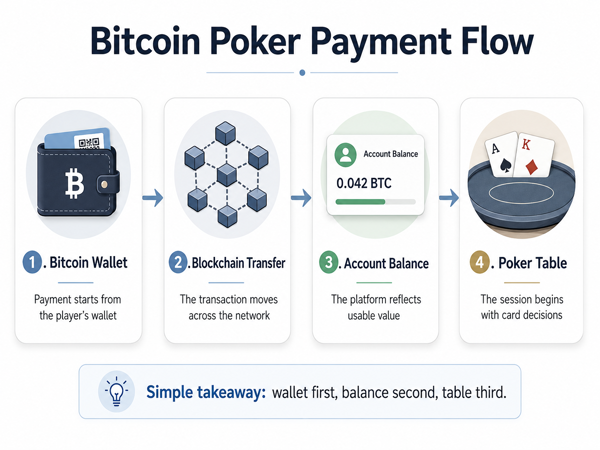
Payment-flow thinking is more useful than hype. A reader does not need vague claims about the future of online play. They need a calm explanation of how one digital system hands off to another. The blockchain records a transfer. The platform recognizes value. The player then interacts with poker formats through the account.
The subtle point is that Bitcoin is most visible before and after the poker table, not during every decision. Once the balance is ready, the active part of the session feels closer to ordinary online poker. The payment method matters, but it does not change card reading, pattern observation, or table decisions.
Why Payment Flow Is The Best Beginner Lens
Payment flow gives beginners a clean mental model without reducing the topic to a technical manual. It respects both sides of the subject. Bitcoin has its own mechanics, and poker has its own rhythm. The overlap happens when a blockchain transfer becomes a balance that supports a session.
That is why good explanations should avoid treating cryptocurrency as decoration. The important question is not simply whether a platform mentions Bitcoin. The important question is how the user moves from wallet ownership to account clarity to active participation. When that path is described plainly, the topic becomes useful for crypto readers, poker readers, and anyone trying to understand real-world digital asset use.
In practice, the clearest summary is this: wallet first, balance second, table third. That order keeps the payment technology in the right place and prevents the poker discussion from becoming overloaded with blockchain vocabulary. It also matches how people build confidence with new payment systems.
 Stay Ahead in Crypto