English
  Nederlands
  Deutsch
Key Takeaways
- Crypto OTC trading lets institutions and high-net-worth individuals execute large trades privately without moving market prices.
- OTC desks use principal, agency, or broker models to source liquidity and settle trades outside public order books.
- While OTC offers deeper liquidity and price stability, counterparty risk and regulatory variation remain key challenges.
In This Article
Crypto OTC (Over-the-Counter) trading is the behind-the-scenes marketplace where large crypto transactions happen privately instead of on public exchanges. While regular exchanges are great for everyday trading, they can become inefficient when someone needs to move millions of dollars’ worth of assets. Large orders can trigger price swings, slip through multiple price levels, or attract unwanted market attention.
That’s where OTC trading steps in, offering deeper liquidity, price stability, and private execution for high-value trades.
OTC trading allows two parties to trade crypto directly, either through a broker, trading desk, or institutional platform, without posting orders to a public order book. This keeps trades discreet, reduces market impact, and allows pricing to be negotiated instead of determined in real time by the exchange.
OTC trading is widely used by hedge funds, crypto firms, miners, High-Net-Worth Individuals (HNWIs), market makers, payment processors, and corporate treasuries. In many ways, it has become a core liquidity pillar alongside centralized exchanges (CEXs) and decentralized exchanges (DEXs).
How the OTC Trading Process Works
While every platform has its own approach, most OTC trades follow a structured workflow designed to minimize risk and ensure smooth settlement.
The goal is to complete the transaction privately, in full, and without disturbing market prices.
Step-by-Step Breakdown
- Trade Inquiry
A client approaches an OTC desk with trade details, asset type, size, and preferred pricing range. - Quotation and Negotiation
The desk returns a quote, often valid for a short time window.
Both parties can negotiate until a final price is confirmed. - Execution and Liquidity Sourcing
The desk fills the order using:- internal reserves
- partner liquidity networks
- other OTC counterparties
- Settlement and Delivery
Settlement may occur through:- fiat bank transfer
- stablecoin transfers
- custodial accounts
- escrow-protected transfers
- Post-Trade Reporting (where applicable)
Institutional desks may provide trade tickets, audit reports, or aggregated volume disclosures.
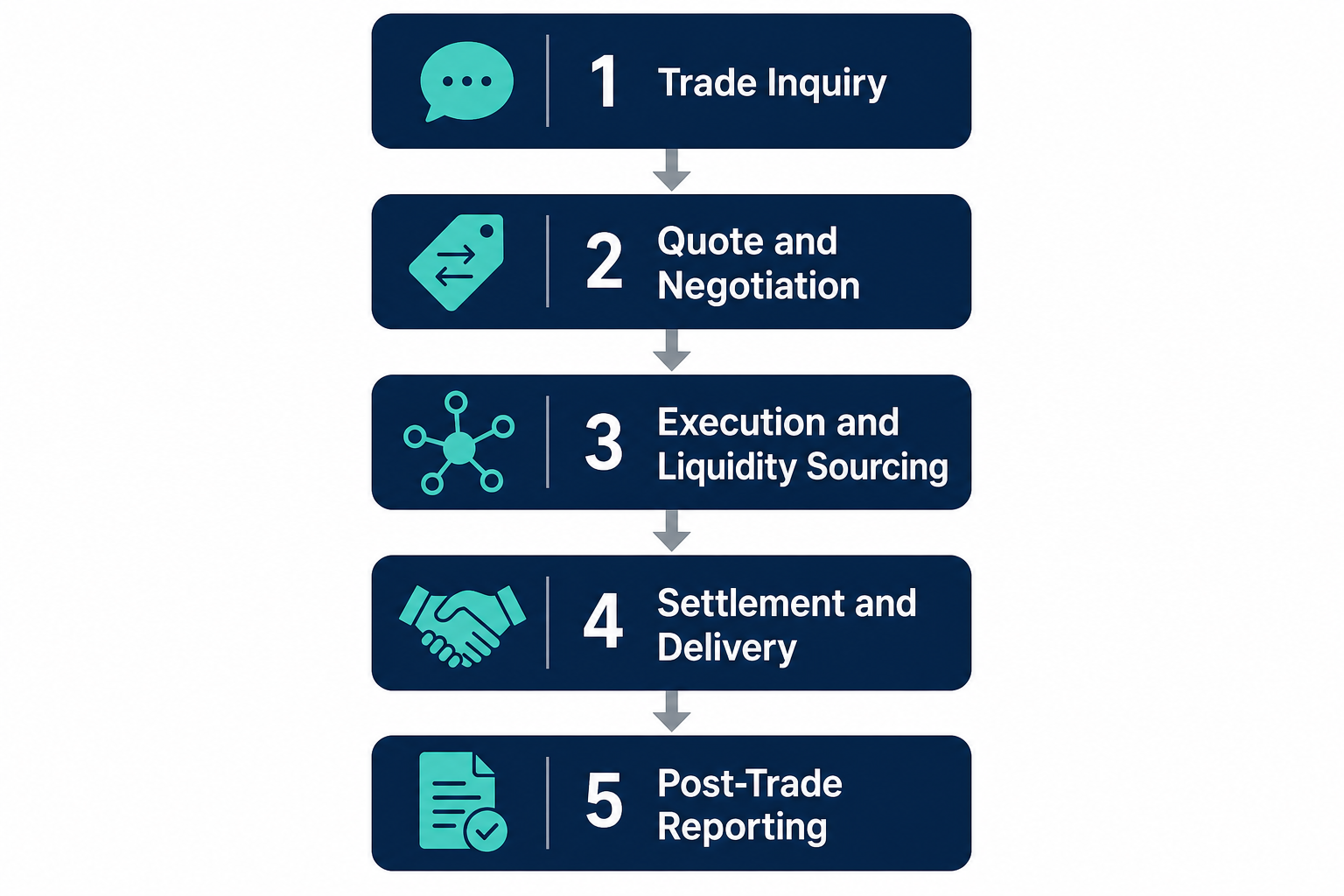
This approach allows large trades to complete in a single ticket rather than being fragmented across multiple exchange orders.
Types of OTC Desks and Trading Models
OTC trading models differ depending on how risk is handled and how trades are executed.
Principal OTC Desks
The desk trades using its own capital and assumes market risk during execution.
This model is common for:
- hedge funds
- corporate treasuries
- miners liquidating rewards
Clients benefit from fast execution and fixed pricing.
Agency OTC Desks
The desk does not risk its own capital.
Instead, it matches buyers and sellers and charges a fee.
This model prioritizes:
- price discovery
- counterpart matching
- brokerage-style execution
Broker-Facilitated OTC Platforms
Brokers coordinate trades across networks of liquidity providers, sourcing:
- competitive pricing
- deep liquidity access
- flexible settlement options
They also help manage compliance, onboarding, and counterparty selection.
P2P OTC Trading
Some OTC trades occur directly between private parties, often using escrow services.
This method offers flexibility but requires greater trust, risk checks, and due diligence.
Why Traders Use OTC Instead of Public Exchanges
OTC isn’t just about big numbers; it’s about control, privacy, and execution quality.
Large public trades can ripple across markets, triggering slippage or attracting speculation.
OTC trading helps traders:
- avoid price shocks from large orders
- execute privately without broadcasting intentions
- negotiate tailored pricing and timelines
- access deeper liquidity pools
- reduce partial fills and fragmentation
It is especially useful when transactions involve treasury management, fund allocations, or institutional portfolio balancing, situations where stability and discretion matter.
OTC vs Exchange Trading
The two approaches serve different needs. Here is how they compare across the factors that matter most to institutional traders.
| Factor | OTC Trading | Exchange Trading |
|---|---|---|
| Order size | Optimized for large blocks ($100K+) | Best for small to mid-size orders |
| Price impact | Minimal, negotiated privately | Can move the market on large orders |
| Privacy | High, trades are not visible on any order book | Low, orders visible to all participants |
| Speed | Varies by negotiation and settlement | Near-instant for market orders |
| Pricing | Negotiated, often includes a spread or fee | Market-driven, transparent |
| Settlement | Flexible: fiat, stablecoin, escrow, custodial | Standardized via exchange wallet |
| Counterparty risk | Present unless escrow or custody is used | Exchange acts as intermediary |
| Regulatory oversight | Varies by jurisdiction and desk | Typically licensed and audited |
Risks and Challenges
Even with strong benefits, OTC trading carries its own considerations.
Common risks include:
- Counterparty risk: a party may fail to honor settlement
- Regulatory differences across regions
- Operational security concerns in unregulated environments
- Limited price transparency compared to exchanges
To manage risk, professional OTC desks now emphasize:
- KYC/AML compliance
- segregated custody
- multi-sig wallet controls
- on-chain provenance screening
- escrow or tri-party settlement structures
Reputable partners and licensed platforms are essential when executing large trades.
Who Typically Uses OTC Trading?
OTC trading is widely adopted across the institutional crypto ecosystem, including:
- asset managers and hedge funds
- ETF issuers and liquidity providers
- crypto miners and infrastructure firms
- corporate treasurers and fintech companies
- family offices and high-net-worth investors
- payment processors and remittance operators
- market makers balancing inventory
These participants rely on OTC because they need:
- efficiency at scale
- predictable execution
- confidentiality
- flexible settlement rails
OTC functions as the professional trading layer where size, timing, and precision outweigh speed-of-click exchange execution.
Bottom Line
Crypto OTC trading has evolved from a niche side-channel into a major liquidity hub that supports institutional adoption and large-scale crypto activity. By allowing trades to be executed privately, efficiently, and with reduced market impact, OTC desks play a crucial role in keeping markets stable while enabling big moves behind the scenes.
For anyone moving significant volumes, whether allocating capital, managing treasury positions, or carrying out strategic portfolio adjustments, OTC trading offers a more controlled and customizable alternative to traditional exchange trading.
 Stay Ahead in Crypto