English
  Nederlands
  Deutsch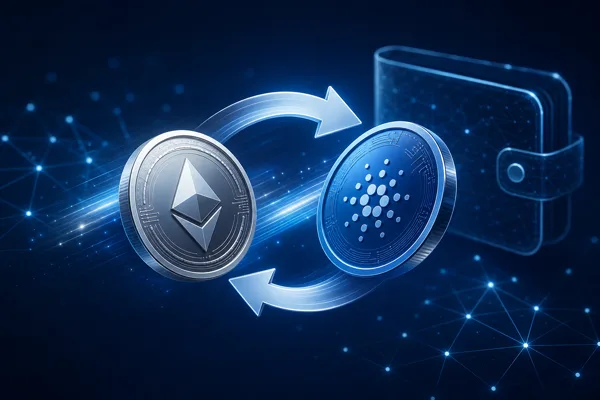

Key Takeaways
- An instant crypto swap converts one coin directly into another in a single step, usually within minutes and often without an account.
- The convenience comes from a service routing your funds through external liquidity, so even a non-custodial swap still relies on trusting the operator.
- Fixed rates lock the amount you receive, floating rates can move with the market, and atomic swaps remain the only fully trustless cross-chain option.
In This Article
- Swapping One Coin for Another in Minutes
- What Is an Instant Crypto Swap?
- Instant Swaps vs. Traditional Exchanges
- How a Swap Actually Happens, Step by Step
- Swaps, DEXs, Atomic Swaps and Bridges
- The Upsides of Instant Swapping
- Risks and Limits to Keep in Mind
- Choosing a Swap Service You Can Trust
- Why Instant Swaps Matter in 2026
Swapping One Coin for Another in Minutes
You hold one cryptocurrency, you want another, and you would rather not open a trading account, clear identity checks, or learn how an order book works just to make the switch. That everyday gap is exactly what instant crypto swaps were built to fill. They turn a process that used to involve several screens and a waiting period into something closer to a currency exchange counter: pick what you have, pick what you want, and collect the result.
Services such as Godex exchange let you convert one coin straight into another in a single flow, frequently in a matter of minutes and, on many platforms, without creating an account at all. The appeal is obvious for one-off conversions, but the mechanics underneath are worth understanding before you send any funds.
This guide breaks down what an instant swap really is, how the conversion works from the moment you send a coin to the moment a different one lands in your wallet, and how that model compares to decentralized exchanges, atomic swaps, and bridges. It also covers the genuine benefits and the trade-offs, so you can decide when an instant swap is the right tool.
What Is an Instant Crypto Swap?
An instant crypto swap, sometimes called an instant exchange, is a service that performs a direct crypto-to-crypto conversion in one step. You choose an input coin and an output coin, the service quotes a rate, you send the input asset, and the output asset is delivered automatically to a wallet address you control. There are no buy and sell sides to manage and no trading pair to monitor.
That single-step design is what separates a swap from a trade. A trade on an exchange asks you to place orders into a market and wait for them to fill. A swap behaves more like a conversion counter: one asset goes in, a different asset comes out, and the pricing and routing happen behind the scenes. Most consumer-facing instant exchangers are essentially a friendly front end sitting on top of liquidity sourced elsewhere, rather than a venue running its own deep order book.
Instant Swaps vs. Traditional Exchanges
A traditional centralized exchange matches buyers and sellers through a central order book. To use one, you typically register, deposit funds into the platform’s custody, complete identity verification, place your orders, and later withdraw. These venues remain the backbone for serious trading and fiat on-ramps.
An instant swap strips that model down. There is no order book to read and, on many services, no standing balance held for you and no sign-up. Your coins are only ever in transit: you send them in, the conversion runs, and the result is forwarded out. This is the non-custodial style of swapping, where the platform never parks your assets as an account balance.
One honest caveat belongs here. A non-custodial centralized exchanger is convenient, but it is not trustless. Your coins still pass through the operator’s system during the swap, so you are trusting that company to forward your funds and honor the quoted rate. That is a real distinction from an on-chain swap, where code rather than a company guarantees the outcome.
How a Swap Actually Happens, Step by Step
The flow is remarkably consistent across the major instant exchangers. A typical non-custodial swap looks like this:
- Select the pair, for example Bitcoin in and Ethereum out, and a calculator shows the estimated amount you will receive.
- Enter the amount you want to swap, keeping any per-pair minimum or maximum in mind.
- Choose a rate type: fixed or floating.
- Provide your destination wallet address, the only address you control in the whole process.
- Receive a one-time deposit address generated by the service, plus a memo or tag for chains that need one.
- Send your input coin from your own wallet to that deposit address.
- The service waits for enough blockchain confirmations, then converts the funds through its liquidity sources.
- The output coin is sent to your wallet, usually within roughly five to thirty minutes.
Most of that time is not the swap itself but the underlying blockchains confirming transactions, which is why network congestion can stretch the wait.
Fixed Rate vs. Floating Rate
This choice matters more than it first appears. With a floating rate, the number you see is an estimate, and the final rate is locked only when your deposit clears. If the market moves in your favor during those minutes you receive a little more, and if it moves against you, a little less. Floating rates usually carry a lower fee because you are carrying the price risk.
With a fixed rate, the quote is locked for a short window, commonly ten to thirty minutes, and you receive exactly the amount shown regardless of market swings. The service absorbs the volatility risk, so a fixed rate typically costs a slightly higher spread. In calm markets a floating rate often works out cheaper, while a fixed rate buys certainty when prices are jumpy or the amount is large.
Where the Liquidity Comes From
Instant exchangers rarely hold deep liquidity of their own. They source prices and fills from external venues, including large centralized exchanges and market makers, then add a small spread or commission. That is how a platform advertising “no fee” still earns: the margin is baked into the rate. The headline amount you are quoted already nets out both the network fee and the service spread, so comparing the actual output amount across services is more honest than comparing advertised fees.
Swaps, DEXs, Atomic Swaps and Bridges
These terms get blurred together constantly, yet they describe quite different machinery. The table below sorts them out.
| Method | Custody | On-chain? | Cross-chain? | Trust model |
|---|---|---|---|---|
| Instant exchanger | Funds in transit | Off-chain routing | Yes | Trust the operator |
| DEX / AMM | Self-custody | Yes | Usually same-chain | Trustless code |
| Atomic swap | Self-custody | Yes | Yes | Trustless cryptography |
| Bridge | Locked and wrapped | Yes | Yes | Trust validators / contract |
A decentralized exchange (DEX) settles swaps on-chain through liquidity pools, with you signing from your own wallet and keeping custody throughout. The trade-off is that a single pool is usually limited to one network and you pay that chain’s gas fees. An instant exchanger abstracts all of that away and can move you across chains in one action, at the cost of routing through a company.
An atomic swap is a different beast entirely. It is a direct, peer-to-peer exchange of two native coins on two blockchains with no intermediary holding funds, enforced by a hash time-locked contract. Either both sides of the trade complete or both parties are refunded, which is what “atomic” means. As the neutral definition on Wikipedia puts it, it is an exchange of cryptocurrencies without a trusted third party. The first cross-chain atomic swap was completed in September 2017 between Decred and Litecoin, yet the model never reached the mainstream because both chains must support compatible scripting and both parties must stay online. That friction is a big reason convenient centralized instant exchangers exist at all.
A bridge does something else again: it locks an asset on one chain and mints a wrapped version on another, so you end up holding a synthetic claim on the same asset rather than a genuinely different coin. Bridges have also been among the most exploited parts of the ecosystem, with the Ronin bridge losing around 620 million dollars in 2022, so they call for extra caution.
The Upsides of Instant Swapping
- Speed and simplicity: a one-step convert flow that usually finishes in minutes, with no order placement to learn.
- No account on many non-custodial services, which suits a quick one-off conversion without onboarding.
- You avoid parking funds on a platform, since assets pass through in transit rather than sitting in custody.
- Wide coin support and cross-chain reach, letting you move between assets on different networks in a single action.
- Predictable pricing through fixed rates, useful when markets are volatile or the amount is significant.
Risks and Limits to Keep in Mind
- Floating-rate exposure: the final amount is set at settlement, so an adverse move means you receive less than the estimate.
- Counterparty trust: even a non-custodial exchanger routes your coins through its backend, which is not trustless like a DEX or atomic swap.
- Regulatory exposure: “no-KYC” is conditional, and a service can pause a swap and request verification if a transaction is flagged.
- Irreversibility: a wrong address, wrong network, or missing memo can mean permanent loss, with no chargeback.
- Phishing clones: fake exchanger sites imitate popular brands to steal deposits, so always verify the exact URL.
Choosing a Swap Service You Can Trust
Because an instant swap leans on the operator, picking a reputable one matters. Confirm the exact web address before sending anything, since cloned phishing sites are a common trap, and prefer services with a long operating history and visible support for refunds on stuck transactions. Compare the actual output amount across a few providers rather than the advertised fee, and decide whether the certainty of a fixed rate is worth its slightly higher spread for your particular swap.
It also helps to see how a platform explains itself. Many operators publish practical material that shows a real swap from start to finish. The blog by Godex is one example, with how-to guides, crypto tips, and coin price predictions that can give you a feel for the process before you commit funds. Whatever service you choose, start with a small test amount the first time so you can confirm the flow end to end.
Why Instant Swaps Matter in 2026
Demand for quick, account-free conversions keeps growing as users look to avoid leaving balances on exchanges and to skip full onboarding for a single trade. At the same time, the regulatory picture in Europe is tightening sharply. Under the framework described on the European regulator’s MiCA page, crypto-asset service providers serving the EU must be authorized, and the accompanying transfer-of-funds rules require identity data on transfers with no minimum threshold. The practical effect is that the fully anonymous swap model is becoming harder to reconcile with regulated operation in the EU, and more services are adding tiered or conditional checks.
On the technology side, the appetite for moving value across chains is rising even as the industry moves past the era of frequent bridge hacks toward more trust-minimized routing. Centralized instant exchangers will likely remain the simplest consumer experience for some time, precisely because they hide the complexity. Understanding what they do behind that simple interface, including who you are trusting and how the rate is built, is what turns a convenient tool into a safe one.
 Stay Ahead in Crypto