English
  Nederlands
  Deutsch


Key Takeaways
- Hyperliquid is a Layer-1 DEX with a fully on-chain central limit order book for spot and perpetual futures trading.
- Its dual architecture splits execution between HyperCore (order books, matching, margin) and HyperEVM (EVM-compatible smart contracts).
- The native HYPE token powers gas, staking, and governance, with a max supply of 1,000,000,000.
In This Article
- What is Hyperliquid?
- The Architecture: HyperCore + HyperEVM
- What Can You Trade?
- Orders, Risk, and Liquidations
- The HYPE Token: Roles, Supply, and Staking
- Launching on Hyperliquid: HIP-1, HIP-2, HIP-3
- Interoperability and Integrations
- Fees and Costs
- Security, Audits, and Risks
- Getting Started
- Who Is Hyperliquid For?
- Bottom Line
 What is Hyperliquid?
 What is Hyperliquid?
Hyperliquid is a high-performance blockchain and exchange designed to house all finance on a single chain. It puts the exchange’s order books, matching engine, liquidations, and settlement directly on-chain, aiming to deliver CEX-like speed with DeFi transparency. In plain English, you trade from self-custody with the familiar tools of a pro exchange.
At a high level, Hyperliquid specializes in perpetual futures, but it also supports spot markets via its native token standard. Unlike AMMs or off-chain matchers, every order, cancel, and trade is executed on-chain with one-block finality under the protocol’s HyperBFT consensus.
The Architecture: HyperCore + HyperEVM
- HyperCore is the exchange engine of the chain. It contains the state for margin, risk, order books, and liquidations. The design goal is full decentralization: a single, canonical transaction order across the network (no off-chain books). Current docs mention support for roughly 200,000 orders per second, with ongoing optimizations.
- HyperEVM is an EVM-compatible environment that shares the same HyperBFT consensus as HyperCore, allowing smart contracts to interact directly with HyperCore’s spot and perp books. That means dApps can read book state and programmatically place or modify orders, unlocking new on-chain strategies and structured products.
Why this matters: developers can build protocols (vaults, structured products, algo-trading agents, launch tools) that use the live order book as a primitive, rather than routing through off-chain services. This is the core differentiator of Hyperliquid’s L1 approach.
What Can You Trade?
Perpetuals (including hyperps)
Hyperliquid offers classic crypto perpetual futures with peer-to-peer funding to keep perp prices anchored to spot. Funding is paid periodically from one side to the other, depending on the basis; it is not a protocol fee (it transfers between longs and shorts).
The exchange also supports hyperps, Hyperliquid-only perps that don’t require a spot or index oracle (useful for pre-launch or hard-to-index assets). Instead, funding references a moving-average mark price to dampen manipulation typical of pre-launch futures.
Spot markets (HIP-1 tokens)
Spot trading is native to the chain via HIP-1, Hyperliquid’s fungible token standard. Each HIP-1 token automatically gets a  USDC spot pair with an on-chain order book, and fees on non-USDC pairs can be redirected or burned, giving builders flexibility over their token’s fee economics.
Orders, Risk, and Liquidations
- Order tools: Market, limit, and stop orders are supported, plus time-in-force flags (GTC/IOC/Post-Only) and Reduce-Only to control position changes, familiar to professional traders.
- Liquidations: Positions are liquidated if account equity drops below the maintenance margin (half of the initial margin at max leverage, typically 1.25% to 16.7% depending on the asset’s max leverage).
Traders get a CEX-style experience, precision order control, and instant book feedback, but with on-chain settlement and transparent risk logic. Developers can also subscribe to the public API and WebSocket feeds to build bots, analytics, or portfolio apps.
The HYPE Token: Roles, Supply, and Staking
HYPE is Hyperliquid’s native asset. It powers gas, staking (security), and governance and is also embedded in listing mechanics and certain incentives across the ecosystem. On HyperEVM, HYPE is the gas token for smart-contract execution; it can be moved between HyperCore and HyperEVM natively.
Supply and market data. There are 1,000,000,000 HYPE as max supply; circulating supply and market cap change over time and can be checked on data aggregators.
Staking. You can stake HYPE to validators (or delegate) to help secure the chain and earn emissions-based rewards; typical flows include a short lock to stake and a 7-day withdrawal queue to return tokens to your spot balance.
Governance. Hyperliquid is evolving toward on-chain governance guided by Hyperliquid Improvement Proposals (HIPs). Validators play a formal role; for example, HIP-3 (builder-deployed perps) specifies slashing rules and a required 500k HYPE stake for deployers, with validator votes governing slashing in case of malicious behaviour.
Where to obtain HYPE: Review the Markets tab on reputable data aggregators (e.g., Blockspot.io) for available exchanges and pairs, compare fees and liquidity, and verify contract details before transacting.
Launching on Hyperliquid: HIP-1, HIP-2, HIP-3
HIP-1: Native tokens and spot books
HIP-1 defines a capped-supply token with parameters like maxSupply, decimal settings, and genesis allocations. Deployers also configure Hyperliquidity for the USDC pair at genesis. Notably, the gas cost for deployment is set by a 31-hour Dutch auction that bottoms at 500 HYPE, aligning cost with market demand for blockspace during token creation.
HIP-2: Hyperliquidity (single-sided, programmatic)
To bootstrap early liquidity on the order book, HIP-2 introduces Hyperliquidity: a fully on-chain, operator-less strategy (in the chain’s transition logic) that updates every 3 seconds or more and guarantees a roughly 0.3% spread across its price ladder while allowing any other maker to join alongside it. It’s currently available for USDC spot pairs.
HIP-3: Builder-deployed perps (permissionless markets)
HIP-3 pushes perpetual listings toward permissionless creation by builders, guarded by stake-based accountability (500k HYPE requirement) and validator-driven slashing for abusive behaviour, turning Hyperliquid from a single DEX into a market factory that others can extend.
Interoperability and Integrations
Hyperliquid integrates with cross-chain infrastructure. Chainlink CCIP documents how multichain tokens can be made trade-eligible on Hyperliquid, easing onboarding for assets issued elsewhere.  LayerZero provides a Hyperliquid Composer for advanced cross-chain flows. Together, these let builders bridge liquidity and users from other ecosystems while still settling on Hyperliquid’s L1.
Fees and Costs
Hyperliquid uses a volume-based fee schedule across spot and perps. For HIP-1 spot, non-USDC fee proceeds can be redirected to the token’s deployer or burned (configurable by the deployer, with one-way reductions), giving projects levers over long-term sustainability. Perps are margined in USDC, and funding payments occur directly between longs and shorts.
Security, Audits, and Risks
- Audits. The Hyperliquid bridge contract has been audited by Zellic (public reports available in the project docs). A public bug bounty program is also maintained.
- Known risks. The docs enumerate risks typical of new L1s and on-chain derivatives: L1 instability, oracle manipulation, and liquidity shocks. The protocol mitigates some of these with open-interest caps and guardrails on order placement relative to oracle prices. Always do your own risk assessment and size positions accordingly.
Getting Started
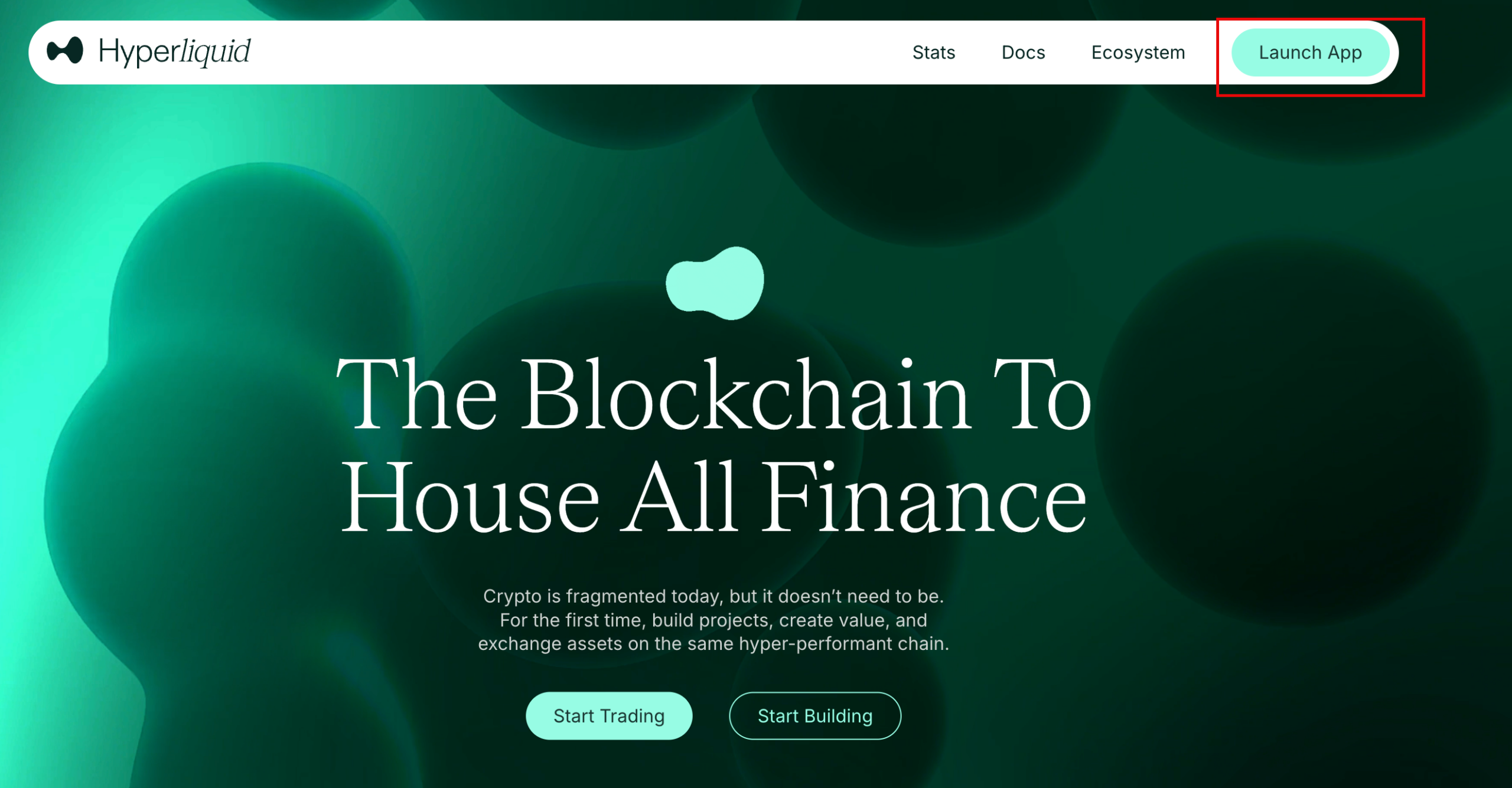
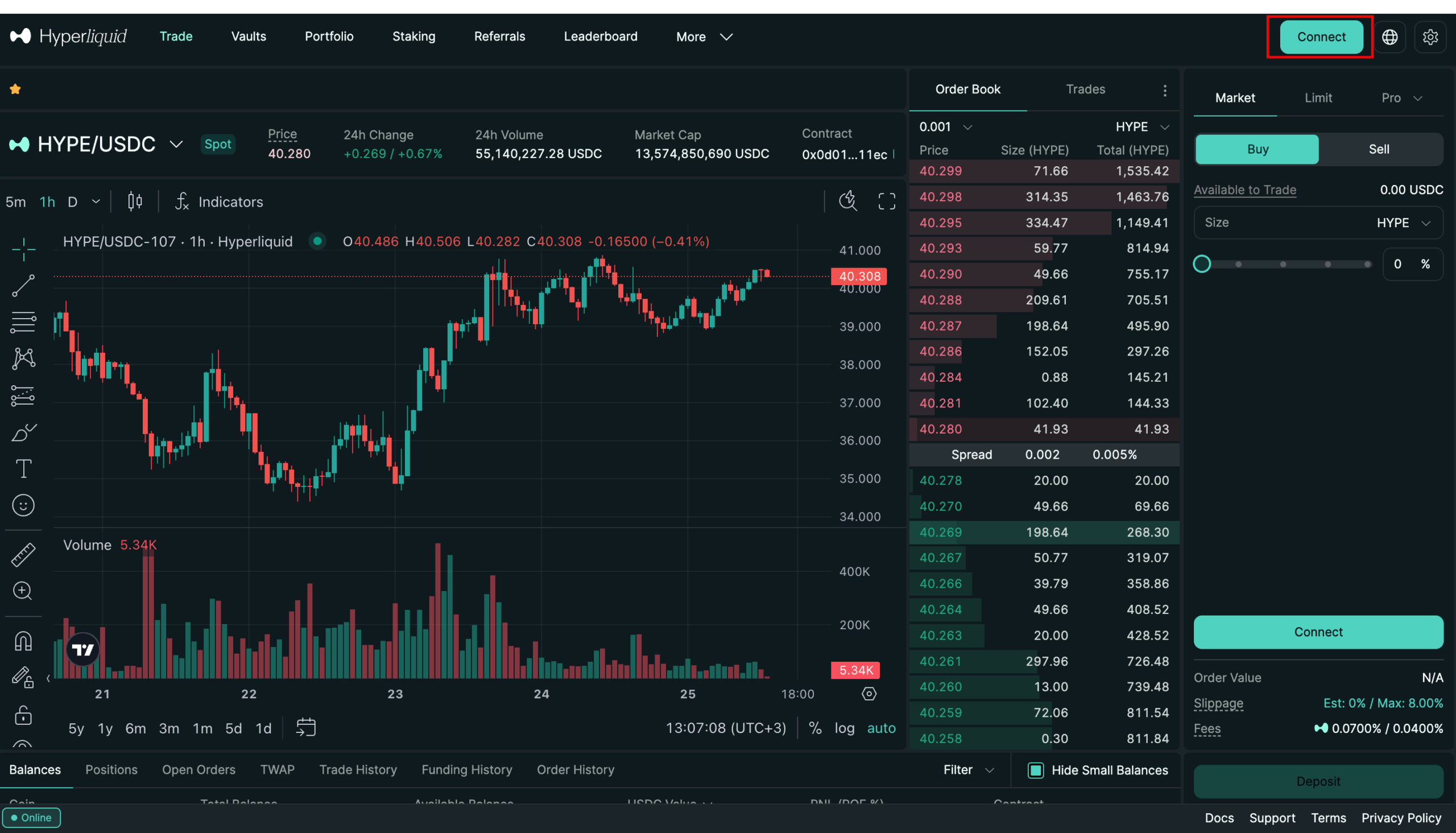
- Create or connect a wallet
Visit the official app and create a Hyperliquid wallet or connect a compatible one. Use only official links; beware of look-alikes. - Fund your account
Bridge USDC (for perps margin) or HYPE (for gas and staking) to Hyperliquid. You can later transfer HYPE between HyperCore and HyperEVM if you plan to use smart contracts or build on-chain strategies. - Place your first trade
Start small. On perps, pick an instrument, set size and leverage, and choose an order type (market or limit). Use flags like Post-Only to make markets, IOC when you want instant execution, and Reduce-Only for protective exits. Remember that funding may be credited or debited periodically. - Risk management
Set stops and take-profit levels, monitor maintenance margin, and understand liquidation thresholds before sizing up. - Explore HIP-1 tokens and LPing
If you’re a builder, study HIP-1 and HIP-2 to configure your token’s genesis parameters and to bootstrap liquidity programmatically with Hyperliquidity. Test on testnet before mainnet deployment; gas for token deployment is priced via a Dutch auction and is paid in HYPE. - Stake HYPE
In the Staking section, delegate to a validator to earn rewards and support network security. Note the 1-day stake lock and 7-day exit queue when unbonding back to your spot balance.
Who Is Hyperliquid For?
- Active traders who want CEX-like tools (tight spreads, order flags, fast settlement) with on-chain transparency.
- Builders who want smart contracts that trade directly on a live order book (not just call an AMM). The HyperEVM/HyperCore design gives you a programmable exchange surface.
- Token projects seeking a transparent, code-driven launch with on-chain price discovery (HIP-1/HIP-2), and teams planning to launch their own perpetuals under HIP-3.
Bottom Line
Hyperliquid blends exchange mechanics and blockchain design into one stack: a CLOB-first L1 where orders are first-class state. That architectural choice shows up everywhere, from order types and funding to permissionless token and market creation under HIP-1/2/3, to a developer experience where the order book is a composable primitive for new DeFi apps. If you’re exploring on-chain trading or building market-integrated dApps, Hyperliquid is worth a serious look, but treat it like any new L1: read the docs, start small, and understand the risks before you size up.
 Stay Ahead in Crypto