English
  Nederlands
  Deutsch
Key Takeaways
- Polymarket is a decentralised prediction market on Polygon where users trade “Yes” or “No” shares in real-world events using USDC, with the share price acting as the market-implied probability.
- Trading is non-custodial, no KYC is required on the main international platform, and outcomes are settled on-chain through UMA’s Optimistic Oracle.
- It has become one of the most-watched signals in politics, sports, and crypto, and following a CFTC settlement and the QCEX acquisition has reopened a regulated U.S. footprint.
In This Article
Polymarket is a decentralised online prediction platform where users bet on real-world events using cryptocurrency. It runs on the Polygon blockchain and uses the USDC stablecoin for all transactions.
The platform shows market-based probabilities for events such as elections, sports outcomes, economic policy changes, and crypto price levels. Users trade “Yes” or “No” shares, where winning shares always pay $1 and losing shares pay $0.
How Polymarket Works
On Polymarket, traders do not bet against a bookmaker. They trade against each other. Every market displays live prices, which reflect the crowd’s current belief about how likely an outcome is.
Shares for “Yes” or “No” outcomes trade at prices between $0.01 and $0.99. The closer a price is to $1, the higher the implied odds for that outcome.
Example:
- If a “Yes” share is $0.65, the market sees a 65% chance the event will happen.
- If the event occurs, that share settles at $1.
- If it doesn’t, the share settles at $0.
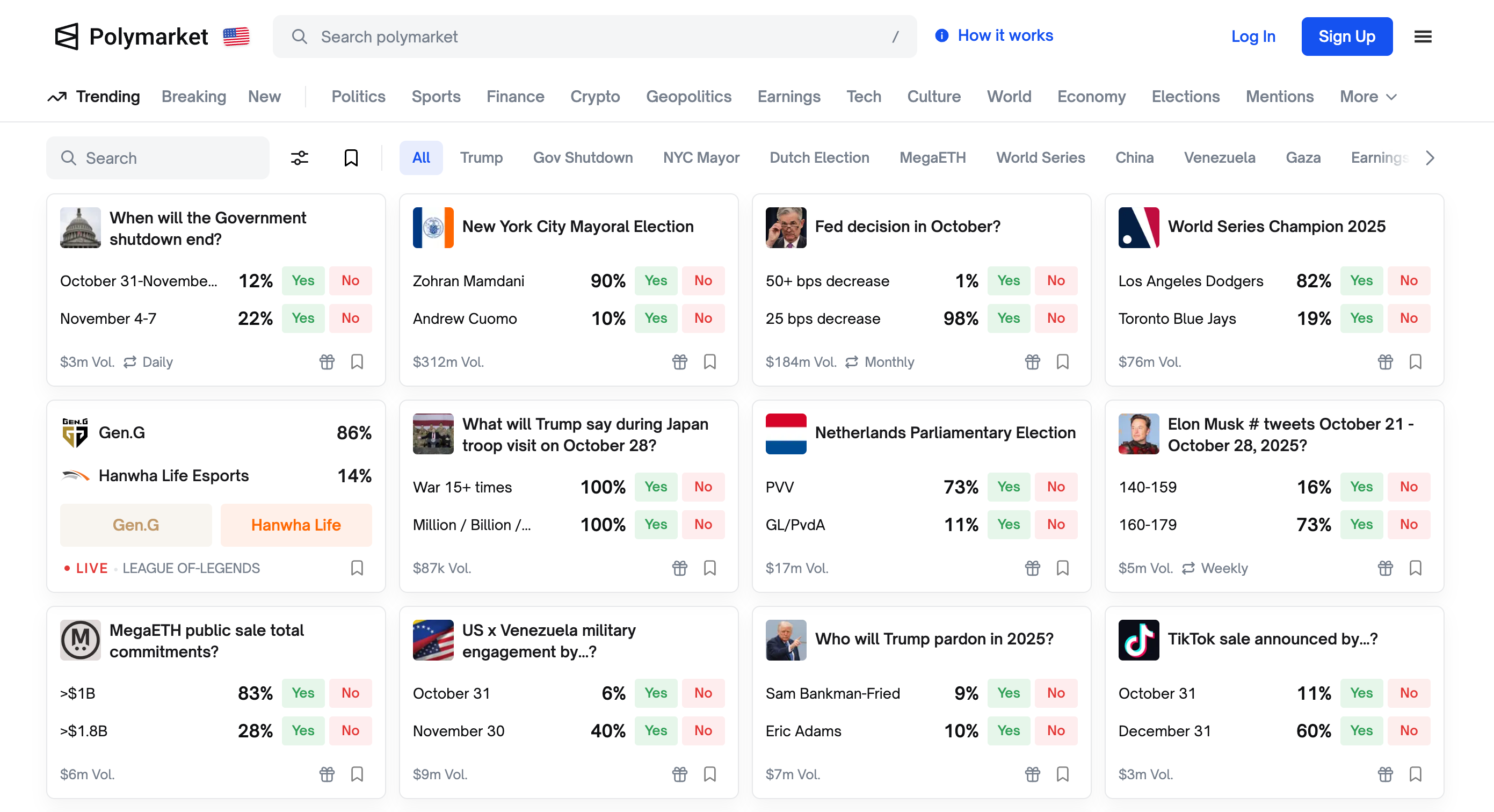
Users can trade in and out of markets before they close. Prices change in real time as supply and demand shift.
Polymarket settles on Polygon, a Layer 2 scaling network for Ethereum, which keeps transactions fast and cheap. Trades are executed and recorded on-chain through smart contracts.
The platform uses USDC, a stablecoin pegged to the U.S. dollar, so positions are not exposed to crypto price volatility outside the market itself. Users connect a Web3 wallet to deposit, trade, and withdraw.
Trading Without KYC
The main international Polymarket does not require KYC for most activity. Users connect a non-custodial wallet such as MetaMask and start trading.
That gives users full control over their funds and privacy, but it also means they are responsible for their own private keys. The newer U.S. version, operated through QCEX, follows a different model and applies the KYC checks that a regulated venue requires.
Resolution and Payouts
Polymarket uses a rules-based system to settle each market. Resolution criteria are published when the market is created and spell out exactly what counts as a winning outcome.
When the event ends, a resolver submits the result through UMA’s Optimistic Oracle. If no one disputes the proposed outcome within the challenge window, shares settle accordingly.
If there’s a disagreement, anyone can post a challenge by staking USDC. UMA token holders then vote on the correct outcome, and the result is enforced on-chain. The whole settlement path is permissionless and verifiable.
Markets Available
Polymarket lists markets on politics, sports, crypto prices, weather, economic policy, geopolitics, and pop culture. Trading volume often spikes around major global events as users update their positions.
Popular examples include:
- U.S. Presidential Election winner.
- “Will Bitcoin hit a given price by a given date?”
- “Will a specific law pass by a given date?”
- Winner of a major sports tournament.
Market prices update continuously as traders react to news and data, which is why journalists and analysts increasingly cite Polymarket prices alongside polls.
How to Get Started
Anyone with a Web3 wallet can use the platform. The flow is short.
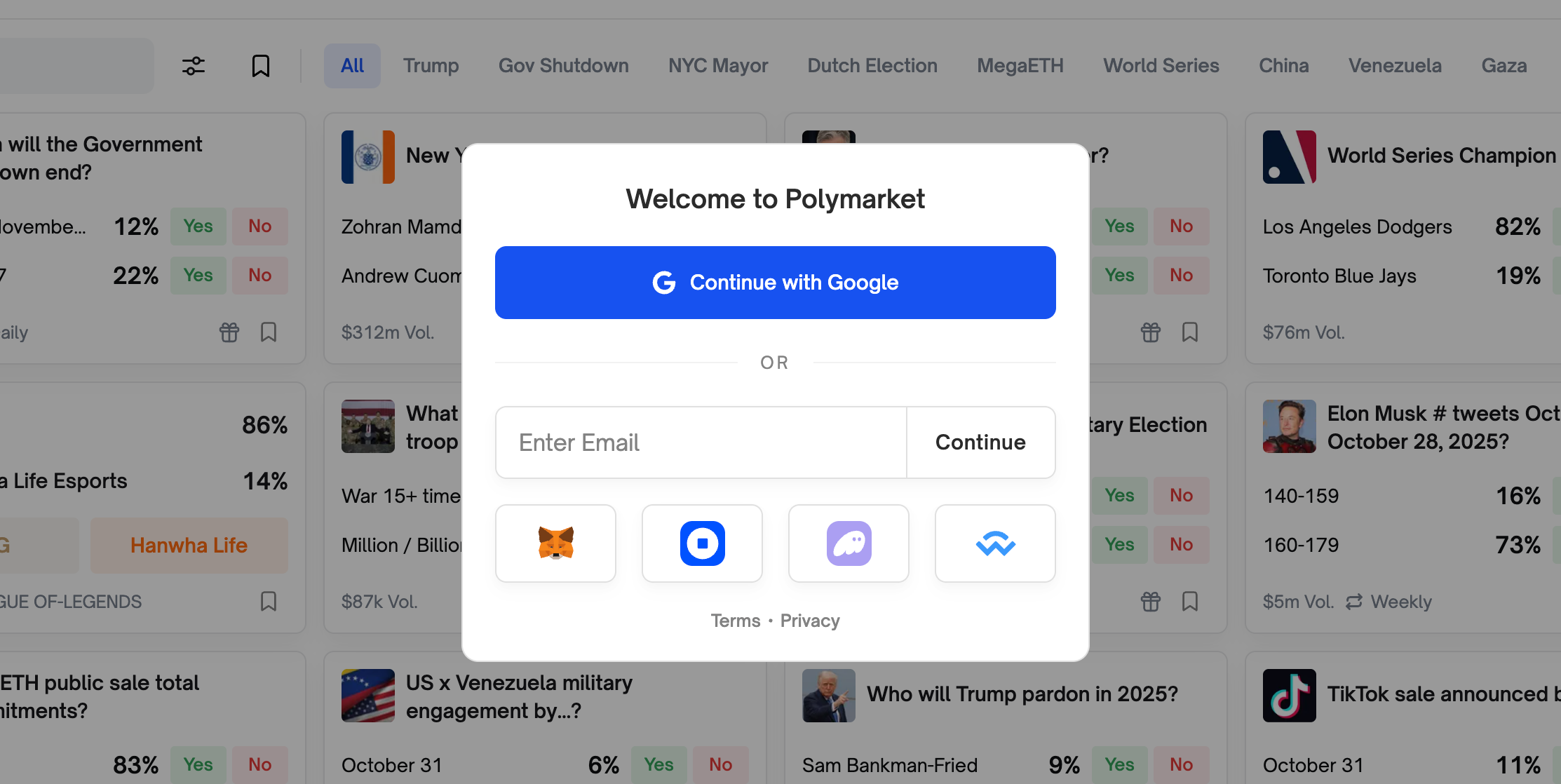
- Connect a wallet. Link a Web3 wallet such as MetaMask. The wallet stays under your control at all times.
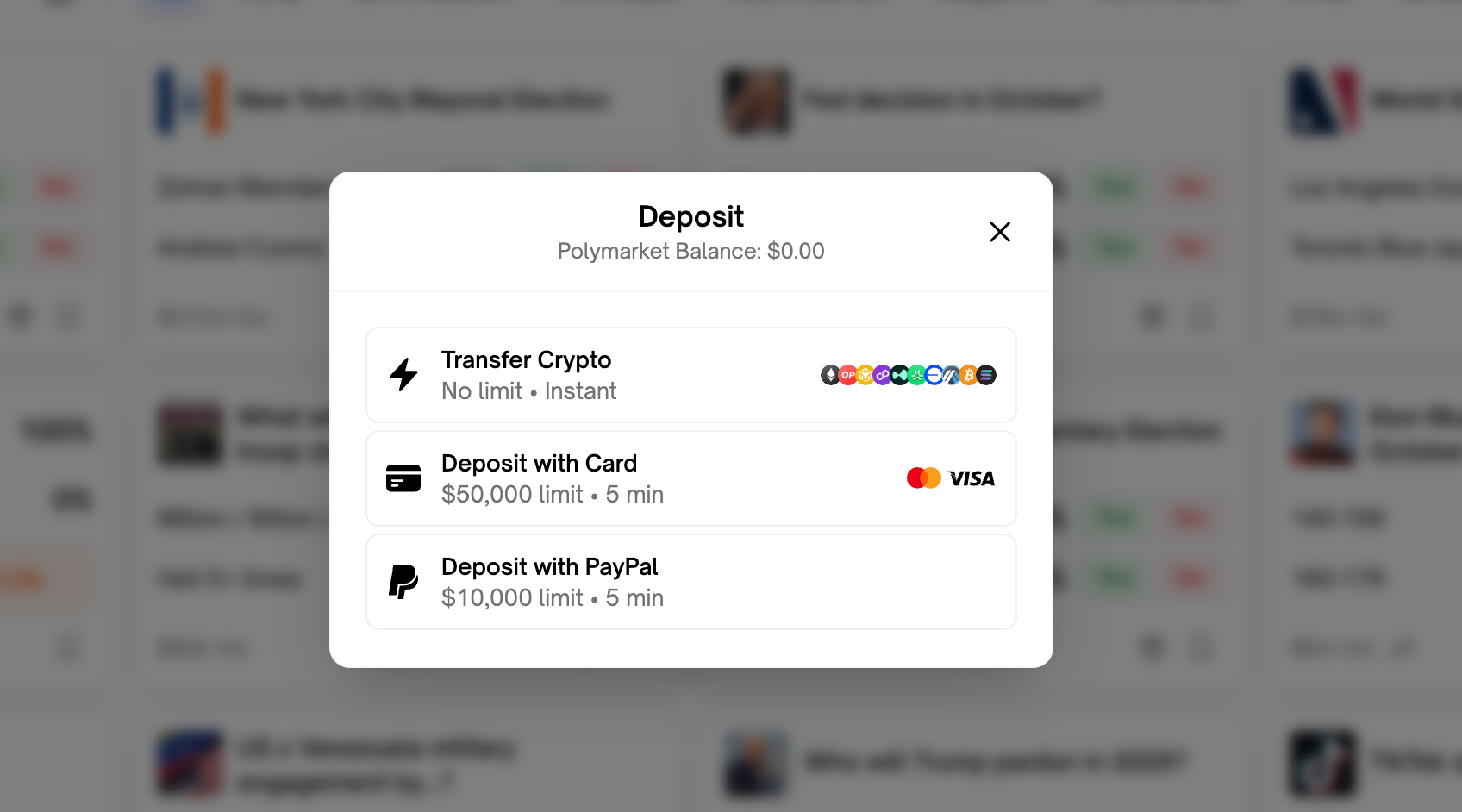
- Deposit funds. You can fund your account several ways, depending on the option offered in your region.
- Transfer crypto: Deposit instantly from multiple supported networks (Polygon, Ethereum, Optimism, Arbitrum and others).
- Deposit with card: Add funds with Visa or Mastercard, usually up to a $50,000 limit and processed in a few minutes.
- Deposit with PayPal: Add up to $10,000 in about five minutes via PayPal.
- Choose a market. Browse active markets and pick the event you want to trade.
- Buy or sell shares. Pick “Yes” or “No” at the current price.
- Withdraw profits. When you’re done, withdraw funds directly to your wallet.
On the main international platform, your wallet is your identity and no traditional account is needed. The U.S. platform layered on top of QCEX uses a more conventional sign-up.
Fees
Polymarket itself does not charge trading, deposit, or withdrawal fees on the international platform. Users still pay blockchain gas where it applies, and certain deposit routes route through third-party relayers.
The typical relayer fee for some deposit paths is around $3 plus network costs, or 0.3% of the deposit, whichever is higher. That fee goes to the relayer, not to Polymarket. Depositing USDC directly on the Polygon network is normally the cheapest route.
Providing Liquidity
Polymarket depends on liquidity providers (LPs) to keep its markets active. Anyone can become an LP by depositing USDC into a market’s pool. LPs earn rewards or a share of trading flow for keeping markets deep and spreads tight, especially during high-volume events.
Real-World Impact
Polymarket gained mainstream attention during the 2024 U.S. presidential cycle. The platform’s odds moved well ahead of legacy polling on several pivotal events, including the eventual withdrawal of Joe Biden from the Democratic primary. Cumulative wagering on the 2024 U.S. election alone passed $3.3 billion.
Since then, media outlets and researchers regularly cite Polymarket prices alongside polling, treating them as a real-time signal of market consensus rather than a curated forecast.
Legal and Regulatory Status
Polymarket has faced regulatory scrutiny in several jurisdictions. In 2022, the U.S. Commodity Futures Trading Commission fined the platform $1.4 million for running an unregistered derivatives exchange, and the company restricted U.S. access.
In 2025, Polymarket acquired QCEX, a CFTC-licensed derivatives exchange, and used that licence to launch a regulated U.S. version of the product. The international platform continues to operate under the original non-custodial model.
Authorities in France, Belgium, Poland, and Singapore have also restricted access at various points, citing local gambling rules. Whether the platform is available where you live can change, so it’s worth checking before signing up.
Investment and Growth
In May 2024, Polymarket raised about $70 million from investors including Vitalik Buterin and Founders Fund. In October 2025, Intercontinental Exchange (ICE) announced a deal to invest up to $2 billion in the company, valuing Polymarket at roughly $8 billion, a clear signal of institutional interest.
Monthly volume on the platform crossed roughly $2 billion during the run-up to the 2024 U.S. election, and active users have climbed steadily through 2025 and into 2026 as new markets keep launching around political, sporting, and macro events.
Common Strategies
- Buy early, sell later: Enter at a lower price and sell if odds move in your favour before resolution.
- Hold to expiration: If you’re confident, hold until settlement for the full $1 payout per winning share.
- Watch the whales: Large trades move markets. Tracking big wallets can highlight sudden shifts in sentiment.
- Read the resolution rules: Always read the resolution criteria carefully before taking a position.
- Use partial exits: Lock in some profit by selling part of your position early while keeping exposure.
- Arbitrage related markets: Look for price gaps between related Polymarket markets or between Polymarket and other prediction venues.
- News-driven entries: Move on breaking news or polls to pick up undervalued shares.
- Cross-platform arbitrage: Compare Polymarket prices to regulated venues like Kalshi when the same event is listed on both.
Risks to Watch
- Market volatility: Prices can swing fast around news, especially near event resolution.
- Resolution disputes: Ambiguous events can lead to challenge votes and delayed payouts.
- Legal access: Some jurisdictions block or restrict the platform. Check the rules where you live.
- On-chain costs: Trading is free on Polymarket but blockchain gas and deposit relayer fees still apply.
- Private key loss: Your wallet is your account. Losing access to your keys means losing access to your funds.
Polymarket vs. Competitors
| Platform | Decentralised | U.S. Access | KYC Required | Fees | Native Token |
|---|---|---|---|---|---|
| Polymarket (international) | Yes | Restricted | No | Low | No |
| Polymarket US (via QCEX) | No | Yes | Yes | Low | No |
| Kalshi | No | Yes | Yes | Low | No |
| PredictIt | No | Limited | Yes | Higher | No |
| Augur | Yes | Yes | No | Variable | Yes (REP) |
Why Polymarket Is Growing
- Built on blockchain: Trades and settlements are publicly verifiable.
- No central party controls outcomes: Resolution runs through a permissionless oracle process.
- Wallet-based identity: The international platform doesn’t require traditional accounts.
- Low fees: No trading fees, with on-chain costs the main expense.
- Open data: All trades and balances are visible on-chain.
- Smart-contract governance: Reduces room for manipulation by any single party.
Polymarket combines real-world forecasting with on-chain settlement and a low-friction user experience. As regulation evolves and institutional capital arrives, it’s well positioned to remain the most-watched venue in the prediction-market category.
 Stay Ahead in Crypto