English
  Nederlands
  Deutsch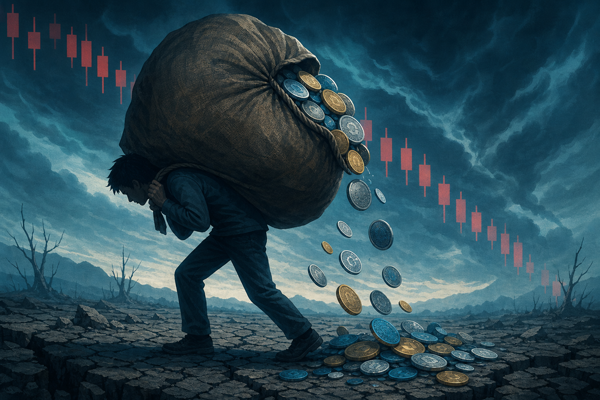
Key Takeaways
- A bag holder is an investor who refuses to sell a declining asset, hoping for a recovery that rarely comes.
- The behavior is driven by emotional biases such as loss aversion, sunk cost fallacy, and overconfidence, not rational analysis.
- Setting clear exit points, sizing positions sensibly, and reviewing portfolios on a schedule are the most effective defenses against bag holding.
In This Article
Investors who continue to hold losing assets are facing rising risks as global market volatility intensifies. Many traders still refuse to exit declining positions, hoping for recovery even when indicators point to further losses.
Understanding What a Bag Holder Is
A bag holder is a trader or investor who continues holding a declining asset, hoping for a rebound that never arrives. Despite clear red flags such as weakening fundamentals, poor technicals, and ignored on-chain or off-chain metrics they remain invested, often dismissing repeated price drops and warning signs that signal deeper issues.
Bag holders can be found in both traditional stock markets and the cryptocurrency space. They typically hold assets through long downtrends, locking up capital that could be reinvested elsewhere.
Key traits of bag holders:
- Refuse to sell despite heavy losses
- Ignore market data and technical signals
- Often buy more of a losing asset to “average down”
- Hold emotional or ideological attachments to investments
The Psychology Behind Bag Holding
Bag holding isn’t only a financial mistake; it’s also a psychological one. Emotional biases and decision-making flaws often prevent traders from exiting losing positions.
Major psychological factors include:
- Loss Aversion: Investors hate realizing losses and prefer to “wait it out.”
- Sunk Cost Fallacy: They justify holding because they’ve already invested time or money.
- Overconfidence Bias: Traders believe they know better than the market.
- Hope and Denial: Many expect sudden reversals even when fundamentals collapse.
Such emotions distort rational thinking and create a false sense of control. Traders convince themselves that patience will pay off, even as losses deepen.
Famous Bag Holder Examples
Market history provides clear reminders of how destructive this behavior can be.
- Lehman Brothers (2008): Investors held shares despite signs of financial collapse, losing everything when the bank failed.
- Bed Bath & Beyond (2021 to 2023): Retail investors kept buying after the meme-stock rally ended, eventually seeing shares fall below $1.
 Terra (LUNA) Collapse (2022): Crypto traders held on or even doubled down as the token dropped from $100 to nearly zero.

In each case, emotional decision-making overpowered rational analysis.
Market Conditions That Create Bag Holders
Certain market environments make traders more vulnerable to bag holding.
Common triggers include:
- Market Bubbles: Hype and rapid price surges cause irrational buying near peaks.
- Liquidity Crises: A lack of buyers traps traders in positions they can’t exit.
- Extended Bear Markets: Falling prices convince traders to wait for rebounds that never come.
- Manipulative Practices: Pump-and-dump schemes lure traders with artificial price spikes.
These conditions feed on fear and greed, pushing traders into reactive and emotional behavior.
Bag Holding vs. HODLing
Bag holding is sometimes confused with HODLing, but the two behaviors are very different. HODLing is a deliberate long-term strategy: an investor commits to a strong project, accepts short-term volatility, and holds because the underlying thesis is intact. Bag holding is reactive: the original investment thesis has broken down, the asset is showing structural weakness, yet the investor refuses to sell because of emotion or denial.
The clearest test is to ask whether you would buy the asset again today, with full knowledge of its current state. If the answer is yes, holding is rational. If the answer is no and you are still holding, you are likely a bag holder rather than a long-term investor.
How to Avoid Becoming a Bag Holder
Preventing bag holding requires discipline, preparation, and emotional control, starting with a structured trading plan before entering any position. Investors can further reduce risk by using clear evaluation methods to assess crypto projects and spot red flags early, helping them avoid poor investments from the start.
Effective strategies include:
- Set Clear Exit Points: Define stop-loss levels to limit potential damage.
- Review Portfolios Regularly: Track performance and act quickly on negative signals.
- Stay Objective: Avoid emotional attachment; treat investments as financial tools, not beliefs.
- Diversify Investments: Spread capital across multiple sectors or assets to reduce risk.
- Manage Position Size: Keep individual trades small enough to exit comfortably if needed.
These practices help maintain flexibility and prevent emotional paralysis when markets turn volatile.
The Cost of Ignoring Risk
Bag holding doesn’t just reduce profits; it erodes confidence and drains opportunities. Capital stuck in failing assets cannot be redeployed into stronger ones. Over time, this limits growth and increases frustration.
Traders who ignore exit signals often find themselves reacting too late, forced to sell at rock-bottom prices. Those who plan ahead, on the other hand, can cut losses early and recover faster.
Why Discipline Matters More Than Hope
Every successful trader understands that losses are part of the process. What separates professionals from bag holders is the ability to act decisively, not emotionally.
Discipline turns uncertainty into strategy. Traders who respect their limits and follow their plans rarely face catastrophic losses. Hope alone, however, is not a trading strategy; it’s a risk multiplier.
Avoid Emotional Trading
Bag holding remains a widespread issue across markets, fueled by emotion, overconfidence, and poor planning. Despite technological tools and real-time analytics, human psychology still drives most financial mistakes.
To succeed in volatile markets, investors must trade with structure, not emotion. Recognizing when to exit a losing position is just as important as knowing when to enter a winning one. Those who stay objective, manage risk, and act early avoid being left holding the bag when the market moves on.
 Stay Ahead in Crypto