English
  Nederlands
  Deutsch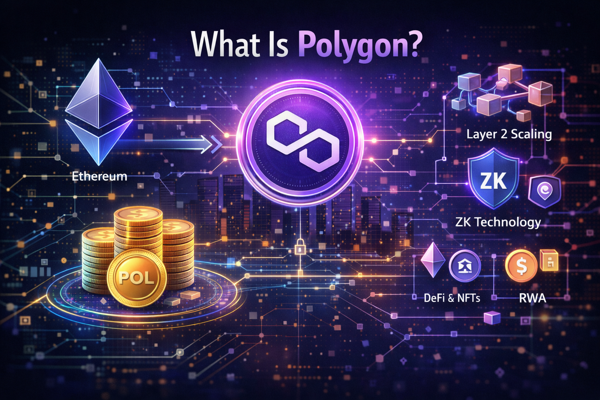

Key Takeaways
- Polygon is a Layer-2 scaling ecosystem that makes Ethereum faster and cheaper to use while keeping its security and developer tools.
- Its native token, POL (formerly MATIC), pays fees, secures the network through staking, and powers governance across many Polygon chains.
- Polygon combines a PoS chain, zkEVM rollups, and an Aggregation Layer to handle real payments, stablecoins, DeFi, NFTs, and tokenized real-world assets at scale.
In This Article
If you have spent any time around crypto, you have probably heard people complain about Ethereum being slow or expensive. Polygon exists because of that problem, and it has grown into one of the most important projects in Web3 because it tackles those pain points head-on.
At its core, Polygon is a blockchain ecosystem built to help Ethereum scale. It makes transactions faster, cheaper, and easier to use without giving up Ethereum’s security or developer ecosystem.
Polygon started as Matic Network back in 2017 and over time evolved into something much bigger: a full toolkit for building scalable, Ethereum-compatible blockchains. Today, Polygon is not just a sidechain; it is an infrastructure for payments, DeFi, NFTs, stablecoins, and enterprise blockchain apps.
The Problem Polygon Is Solving
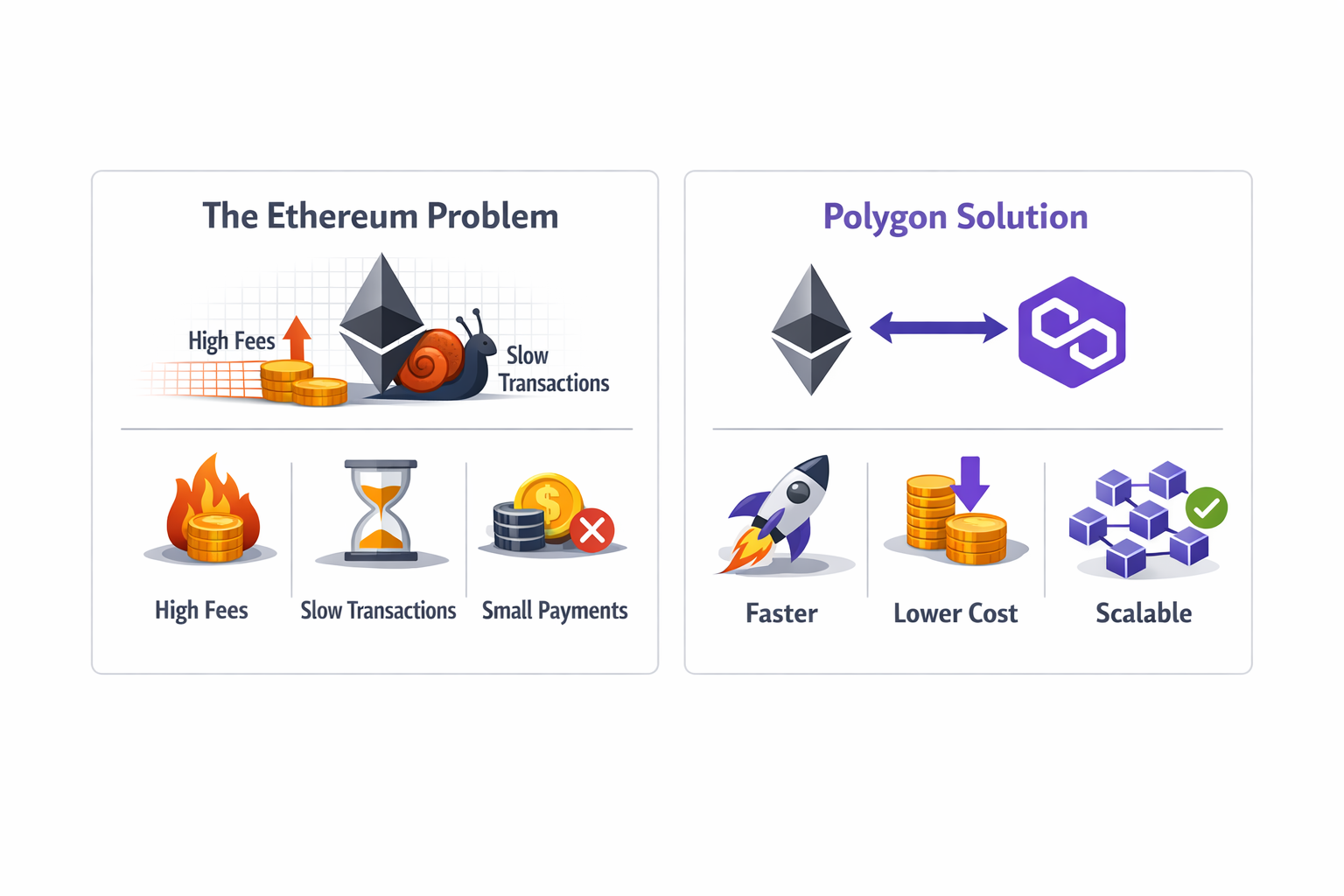
Ethereum changed everything by introducing smart contracts, but popularity came with trade-offs. On Ethereum mainnet:
- Fees can spike during high demand.
- Transactions can take longer than users expect.
- Small payments often do not make economic sense.
That is where Polygon steps in. Polygon acts like an express lane for Ethereum. Instead of every transaction competing for space on the main chain, Polygon processes activity off the main network and then settles it securely back on Ethereum. The result:
- Faster confirmations.
- Lower costs.
- A smoother experience for users and developers.
What Exactly Is Polygon?
Polygon is best described as a Layer-2 scaling ecosystem. That means:
- It runs alongside Ethereum, not instead of it.
- It stays compatible with Ethereum’s tools and smart contracts.
- It focuses on speed, scale, and cost efficiency.
Polygon supports multiple scaling approaches, including:
- Sidechains.
- Zero-knowledge (ZK) rollups.
- Aggregation layers that connect multiple chains together.
This flexibility is why Polygon has become a go-to platform for serious Web3 projects.
 Meet the POL Token (Formerly MATIC)
 Meet the POL Token (Formerly MATIC)
Polygon’s native token recently went through a major upgrade. MATIC transitioned into POL, which now powers the entire ecosystem. POL is not just gas money; it is designed to be a multi-purpose, long-term utility token. POL is used for:
- Paying transaction fees.
- Staking to secure the network.
- Governance voting.
- Earning fees across multiple Polygon chains.
This shift allows Polygon to support a multi-chain future, where one token secures and coordinates many networks at once.
Polygon by the Numbers
Polygon is not a theory; it is already running at scale:
- 5.3+ billion total transactions processed.
- 117 million+ unique addresses.
- Around 1,000 transactions per second on the PoS chain.
- $0.001 average transaction cost.
- 99.99% uptime.
- $3B+ stablecoin supply on-chain.
These are not testnet stats. This is real usage, with real money moving daily.
How Polygon Actually Works
Polygon uses Proof of Stake (PoS) to secure its network. Here is the simple version:
- Validators stake POL tokens.
- They verify transactions and produce blocks.
- Honest validators earn rewards.
- Bad behavior gets penalized.
Users who do not want to run validator infrastructure can delegate their POL to validators and still earn staking rewards. Behind the scenes, Polygon uses multiple scaling technologies depending on the chain and use case.
Polygon’s Main Scaling Technologies
Polygon is not one chain but a family of scaling technologies. Here is how the main pieces compare:
| Technology | What it does | Best for |
|---|---|---|
| Polygon PoS Chain | EVM-compatible chain with ~2 second blocks, anchored to Ethereum | Everyday low-cost DeFi, NFTs, and games |
| zkEVM | ZK rollup that posts cryptographic proofs to Ethereum | Apps wanting stronger security with EVM compatibility |
| AggLayer | Connects many Polygon chains into one shared environment | Unified liquidity and a seamless cross-chain experience |
1. Polygon PoS Chain
This is the most widely used Polygon network today.
- EVM-compatible, so Ethereum apps run easily.
- Fast block times (around 2 seconds).
- Very low fees.
- Finality anchored to Ethereum.
Many DeFi apps, NFT platforms, and games started here because it feels familiar to Ethereum, just faster.
2. Zero-Knowledge Rollups (zkEVM)
Polygon is heavily invested in zero-knowledge tech. ZK rollups:
- Bundle thousands of transactions together.
- Post cryptographic proofs to Ethereum.
- Reduce data and gas costs dramatically.
- Offer stronger security guarantees.
Polygon’s zkEVM allows developers to deploy Ethereum apps without rewriting code, which is a big deal for adoption.
3. Aggregation Layer (AggLayer)
This is where Polygon gets ambitious. The Aggregation Layer connects multiple Polygon-powered chains into:
- A shared liquidity environment.
- A unified security model.
- A seamless user experience.
Instead of fragmented blockchains, Polygon aims for a network of networks that feels like one system.
Why Developers Like Polygon
Polygon did not just optimize tech, it optimized the developer experience. Key reasons builders choose Polygon:
- Ethereum compatibility.
- Strong documentation and tooling.
- Grants, accelerators, and mentorship.
- A massive existing user base.
Programs like Polygon Village help startups move from idea to prototype to production without starting from zero.
Real-World Use Cases
Polygon is increasingly used where speed and cost matter.
Payments
- Instant settlement, even on weekends.
- Near-zero fees.
- Global, always-on infrastructure.
Stablecoins
- Billions in stablecoin liquidity.
- High transaction velocity.
- Used for remittances and on-chain commerce.
DeFi
- Lending, borrowing, and trading without high gas costs.
- Cross-border finance without banks.
- On-chain liquidity that never sleeps.
NFTs and Gaming
- Cheap minting.
- Fast interactions.
- A better experience for mainstream users.
Real-World Assets (RWA)
- Tokenized funds.
- Digital bonds.
- On-chain ownership of real-world assets with real compliance layers.
Strengths and Trade-Offs
What Polygon does well:
- Extremely low fees.
- Fast transaction speeds.
- Ethereum-level compatibility.
- Proven real-world usage.
- Enterprise-ready infrastructure.
Things to be aware of:
- It still depends on Ethereum’s health.
- The tech stack is complex, by design.
- Long-term success depends on the adoption of newer layers.
Polygon is not trying to replace Ethereum, it is trying to make Ethereum usable at internet scale.
Where Polygon Is Headed
Polygon’s roadmap focuses on:
- Scaling from thousands to 100,000+ transactions per second.
- Expanding ZK technology.
- Becoming core infrastructure for global payments.
- Supporting regulated financial use cases.
There is also growing talk of Polygon playing a role in regulated on-chain payments, especially in the U.S., a sign the project is thinking far beyond crypto-native users.
The Bottom Line
Polygon is no longer just a scaling solution; it is becoming financial infrastructure. By combining:
- Ethereum security.
- Lightning-fast transactions.
- Ultra-low fees.
- Real adoption at scale.
Polygon positions itself as the blockchain where money actually moves. If Ethereum is the settlement layer, Polygon is the highway system built on top of it, and POL is the fuel that keeps everything running.
In short: Polygon makes blockchain feel usable, not theoretical. And that is exactly why it matters.
 Stay Ahead in Crypto